Life flickers in the flurries of a thousand snowflakes,
Fragile as they touch the warm solid ground.
Disappearing into the earth as the sky rains frozen
water,
again and again.
Thomas Gentry-Funk
Patrul Rinpoche (1808 – 1887) born in Tibet and trained in Vajrayana Tantric practice, wrote many books on a wide variety of Buddhist topics. Arguably, none is more precious or important than his commentary on the Tibetan Book of the Dead, The Words of My Perfect Teacher. I came to know about these texts through online courses taught through Rigpa.org. This organization trained teachers to communicate the ideas of Vajrayana Buddhism to a lay audience. My first introduction to these ideas came from a cassette I purchased at Borders Bookstore in Santa Fe, New Mexico. I was experiencing my own crisis of consciousness and was searching for grounding in an impossible situation. As I wandered the shelves, I purchased two things: Thich Nhat Hahn’s Breathe You Are Alive, and a cassette of Sogyal Rinpoche’s talk on spaciousness called Bringing the Mind Home. The talk by Sogyal Rinpoche propelled me into the world of Vajrayana Buddhism and sent me on a path that I continue today.
As I sat with my father in the final weeks of his life, I turned to the teachings on the Bardo Thodol and the passages I had memorized years before. My copy of The Tibetan Book of Living and Dying by Sogyal Rinpoche, and The Words of My Perfect Teacher informed my daily practice as I stayed in the moment with my Dad.
The dog-eared and torn pages of each book allowed me to return to important passages and ideas that kept me grounded as my father was dying. The truth is, I had no idea how I would experience this process going into it and I found that the texts I had read and the retreats I had experienced helped me maintain a calm mind as the moment of my father’s death approached.
Technically, I learned a lot about the dying process from these texts and recognized the signs and symptoms of my father’s transition. As I stayed near him for days on end, I felt a kind of joy of service and care: simply focused on what needed to be done to help him find his way. In the quiet moments of my experience, I found a kind of communion with my Dad in ways I never experienced. I bathed his fragile body, helped him to the bathroom when he could still walk, and gave him medication to soothe his pain.
In those moments of care, I reached a state of transcendence. Specifically, time slowed and I was no longer in what we might call the real world. I was in a place and time that I hadn’t expected to be a part of. I didn’t feel fear or anxiety; I felt absolute calm and resilience. In this place, I sensed rather than heard my father, understanding his needs while those around me were bewildered.
In my father, I noticed he, too, became more and more calm as the end came near. He was with me and communicated his intentions to me in the final hours of his life. While I’ve read stories of someone’s passing, my father was gone to us a few hours before he died. I waited with him, holding his hand and putting a warm cloth on his forehead as his breathing and heart rate changed dramatically. While I could feel his presence, he was more distant and detached as his body was ending its cycle of life. Circulation slowing, hands and feet cold to the touch, and irregular heartbeat in his chest and arteries, I felt as much as I saw these physical changes.
Patrul Rinpoche came to mind as I sat in awe of being present in these moments. His words rang as a sound and a feeling. “Everything that is born is bound to die.” We all pass from this state of being to another one, drawn inexplicitly and directly toward death. In the end, there was nothing to be done. No remedy to seek, no drug to stop the dying. It was inevitable. My father, as it turns out, was my perfect teacher.
I thought about the idea of impermanence after I witnessed the transition and came to understand the teachings on a new, deeper level. A friend had said to me that there is no greater teacher than death and dying. We learn more, he said, in those last hours than we do in our whole lives. He was exactly right. My practice has taken on a new understanding, one that I didn’t really have until I was present at my father’s death. As Patrul Rinpoche said, “To wake up in good health is an event which truly deserves to be considered miraculous…” (41)
I’m now here going through my experiences and recording these thoughts in journal and online forms. For me, poetry seems to capture these ideas better than prose, and I turned to Yoel Hoffman’s Japanese Death Poems written by monks and poets. This book has helped me grasp death in a poetic form that transcends my own limited understanding of its meaning and process. Shun’oku Soen wrote this piece on the day of his death (115),
I cannot say that my father and I were close. We shared experiences and worked together on projects. Our conversations were stilted, short, and clipped moments of verbal interaction. We never shared deep conversations about life and how to life it, and when I faced struggles, my father did not have a lot to say.
That relationship entirely changed in the last two weeks of his life. I became his caregiver as he communicated his needs to me, and I did what I could to make his transition easier. Our communication together started as those conversations always had: short, direct statements. As the process continued, I stayed present, and the communication with him shifted from verbal to non-verbal, from rational to emotional. He expressed his feelings and intentions directly to me through a kind of direct communication through a look, expression, and an occasional word. While those around me could not understand even his most basic phrases, I understood him as clearly as I am writing this reflection. It was a strange feeling to hear someone who was non-verbal. That shift happened in the final days, and I learned more about communication in those moments than I have ever experienced in my entire life.
The lessons I learned were clear and specific. They mirror the teachings from Padmasambhava from the Tibetan Book of the Dead, and I experienced them directly from my father.
Stay Present. Throughout the process, my father wanted no distractions. No TV, No Music. Just me or my mother in the room with him.
Communicate Your Needs Clearly. My father’s requests were specific and simple. Water, a little bit of liquid food, and morphine for pain. That was it.
As the Body Changes, Accept Them. My father did not fight his body and when he couldn’t sit up any longer, he let his body tell him what he needed.
Say Goodbye. A few days before his death, my father said his goodbyes. His children and grandchildren gathered around him for those final words.
Letting Go Requires Space. To leave this plane of existence, my father needed me and my mother to be out of the room. He passed only after we left.
I don’t pretend to understand all of the teachings from the Bardo Thodol, and my small insights helped me through the last moments of my Dad’s life. As I sat with him, I recited the chants and prayers I was taught in retreats and classes through Rigpa, and from Dzongar Khyentse Rinpoche. I chanted the Benza Guru mantra, the parts of the Bardo Thodol I had been taught, and used my prayer beads as a means of keeping my mind focused and present with my father. While I wasn’t in any way trying to convert and change my father’s path, these practices helped me through the process and taught me how I will hopefully approach my own death.
As I integrate these moments into my life, I am so grateful for the chance to be with my father along this journey. I came to understand as completely as I have ever had the meaning of life. It was profound, hopeful, and compassionate. I can only wish a simlar experience for everyone open to being present in the moments of death and dying.
Days started to blend in my mind as my Mom and I planned each aspect of my Dad’s service. While my father had explicitly and directly said, “NO SERVICE” my mother, who everyone calls Miss Gail, overruled her dying husband and proceeded with arrangements.
Pastor Bob came into the house offering condolences. His measured manner and calm demeanor were a welcome distraction for my mother, and a way for me to focus on the technical details of my father’s final trip. As I mentioned earlier, my father’s former boss offered to transport his remains for no cost. This one gift was the difference in making the final days a bit less terrible for my mother and, by extension, giving me a bit more space for the moments leading up to my father’s death.
I wondered how much or how detailed I wanted to make my writing about the process of dying, and I came to the conclusion that I wanted to be as thorough and detailed as is reasonably possible. Before I describe the final day and moments, it’s necessary to have a little insight into my belief and perspective on death and dying. Without too much detail, I practice Vajrayana Nyingma Buddhism, which is the oldest of the Vajrayana sects of Buddhism. The transmission of these ideas comes from Buddha Padmasambhava in the 8th century C.E. and has been passed down to the present through two teachers I follow and with whom I practice. The first, Sogyal Rinpoche, introduced these practices to me over the past twenty-five years. I was lucky enough to meet with him multiple times during his lifetime. After his death, I joined the community of Dzongsar Khyentse Rinpochewho is the incarnation of Dilgo Jamyang Khentsye. Yes, it is a mouthful. The teachings I have been lucky enough to be given are all about death and dying. I’ve been studying these practices for decades. If you know nothing about ANY of this stuff, here’s the one thing to know: the Vajrayana practitioners have teachings on the process of dying in elaborate detail. I have been taught and tested on these ideas.
During the last 36 hours of my dad’s passing, physical and mental changes happened in succession. While 36 hours may sound fast, when you’re in it, time slows to a crawl. Minutes stretched into hours, and I could hear the smallest sound. My Dad could not stand to hear any noise in those hours, and we kept the room silent (or as silent as we could with a very chatty mother and sister intending to clean every inch of the house while I sat in the room with Dad). Many people suggested music, and every time I attempted something like that, he said no.
In these final moments, I used liquid morphine Hospice prescribed for the struggle. They warned me that he would experience, at times, intense bouts of pain. He did. Between 36 and 24 hours, he asked for just two things: water and morphine. He remained aware and cognizant until the final hours of his passing. Simply put, he knew what was happening.
Because he lost his ability to swallow without liquid falling into his airway, I squeezed drops of liquid into his cheek as he lay with his head on the pillow. He would ask for more… meaning water… with a small syringe, I dripped it into his cheek. He was able to get some relief with this method. He slept often, eyes completely open, mouth agape. Around 24 hours before, his chest rattled with fluid. Twice during the final couple of days, a hospice nurse came to check on his vitals…in the last visit, about 36 hours before his death, they could not register blood pressure and did feel a strong radial and carotid pulse. My father had withered into a shell of himself, his BMI now around 10%. He looked like a skeleton. The image was stark. Skin stretched over bone. His hips were boney protrusions, and we moved him constantly to prevent bed sores. Even in this state, he was alive and kicking.
During the final day, I stayed with him much of the time, reading as I sat by his side. His breathing changed during the course of the day, starting with about 14 respirations/minute (normal for most folks) to a more hurried, shallow breath. The rattling in his chest stopped about 6 hours before he died, as he couldn’t take deep breaths. His heart rate spiked to 200 bpm as I consistently checked his pulse over these hours.
I talked to him quietly into the evening, ensuring him that we were all OK, and that he could let go whenever he wanted.
Between 6:30 and 7:30pm, he was clearly in distress. The Hospice nurse had explained that I could increase morphine dosage and frequency. I did. From once an hour to every 15 minutes I gave him a dose. By 7:30pm, he refused water by expressing no to me.
As an aside, in the final few days of his life, I was the only one who could understand what he wanted. For whatever reason, I could hear him when others could not. At first, I was frustrated that my sisters and Mom couldn’t understand him. Then, as I watched them try to hear him, they literally could not understand what was clear to me. That was among the weirdest moments in this entire experience.
By 8:30pm, he was slipping away. He stopped responding to my touch. In the previous hours, every time I put my hand on his hand or face, he would look directly at me. Now, he was gone. His arms and legs shook, and his body went through a series of tremors… not violent in any way, just a gentle shake or two. The timbre of the air in the room had changed and a palpable odor covered the space.
At 10:00 pm, he started making a moaning sound that was air passing through his airway. When you hear something like that, it’s clear that it’s not an emotional or intentional reaction. It was air moving through his body.
My mother came into the room and was completely unnerved by the sound. My sisters were upset and angry that I was letting him suffer. Explanations didn’t help, and I gently asked them to go into the den, and I would explain his situation to them later. They left soon after.
As I added more morphine into his cheek, it took about 30 minutes for the moaning to end. His breaths made another change, and his pulse was erratic: one hard beat/stop/two soft beats/stop. No real pattern. Hospice call this breathing Cheyne-Stokes, named in the 19th century for the scientists that determined most people experience this breathing toward the end of life. The rapid heart rate and shallow breathing go together.
After a while, around 1:00 AM, my mom came back into the room and lay in bed with him. She asked if she could put her hand on his chest. I told her, of course, and she felt his irregular heartbeat. She asked me why it was so strange. I talked about the dying process and said that it was completely normal. She did not agree it was normal and, as is often the case, argued with me about what normal was. I laughed inside, seeing that she still had that mom energy.
I headed to my room upstairs, as Dad’s breathing had stabilized into short, quick, shallow breaths. Soon after, my mom called and said something had changed.
After changing clothes (it’s HOT here!), I went back to see him. Mom had left the room to take some cough medicine (she’s got allergies and won’t take allergy medication…don’t ask), grab some water, and use the restroom. She was in the kitchen.
“He’s not breathing.” Hmmm. I walked into the room and felt for a pulse; nothing. His breathing had stopped, eyes and mouth still open as if he was taking a breath. His hands were cold.
The Hospice nurse had explained that in most cases, when a patient is aware of their situation, the patient cannot let go when people are in the room. They want to remain in that place with their loved ones, even though they truly are not present.
My mother and I had left the room, and as soon as we did, my dad died. Sure, maybe it was a coincidence. I don’t know. What I do know is the moment happened, at the end, all at once.
A phone call to Hospice and the Funeral Home happened soon after I checked my dad’s pulse. Within twenty minutes, Dylan, our nurse, came in. He was calm and kind. My mother absolutely couldn’t be in the room with my dad at this point, and Dylan walked her into the den. I called my sisters and told them what had happened. They had left earlier in the evening, and I let them know the details. My sister Whitney swooped in a while later and demanded to know why I was qualified to declare our dad dead. Dylan came in and helped Whitney understand the circumstances. One look at Dad, and she headed to be with Mom.
Dylan asked if I wanted to prepare my dad for his trip, and I agreed. We turned him on his back, and we washed his body. My sister and I had bathed him the day before, so things were clean. I grabbed some clothes Mom wanted him to wear, and we dressed him. I couldn’t help thinking about how I had similarly dressed my children when they were very young, pulling on pants or skirts as they fought with me the entire way. My Dad, in his own way, resisted the clothing as we had to bend and stretch his tight legs and arms, his body beginning to stiffen.
The mortuary vehicle arrived, and Dylan and I placed my dad on a backboard, strapping him in place, checked by the mortuary staff. My mother and sister wanted nothing to do with this process, and I helped guide my dad to the vehicle. They placed him in the back on the gurney, covered in a thick cloth covering of tan with a black repeating pattern.
We all said our goodbyes. My sister and I went into the empty bedroom and stripped the sheets. By this time, it was 7:00AM. About 4 hours had passed since my dad’s death.
My sister then went on a cleaning rampage. She vacuumed, mopped floors, emptied the pantry, tossed canned goods that had been around for ten years.
I politely stepped away, finally lying in bed upstairs. As soon as my head hit the pillow, the people next door started leaf blowers and lawn mowers. I lay there for a while, listening to the sound of machinery, just a few feet from my window. I was pissed. Then, I remembered my father, on Saturday mornings, dragging me out of bed to mow the grass, rake leaves, and do my work around the house. I had to chuckle. Thanks Dad, for one last laugh.
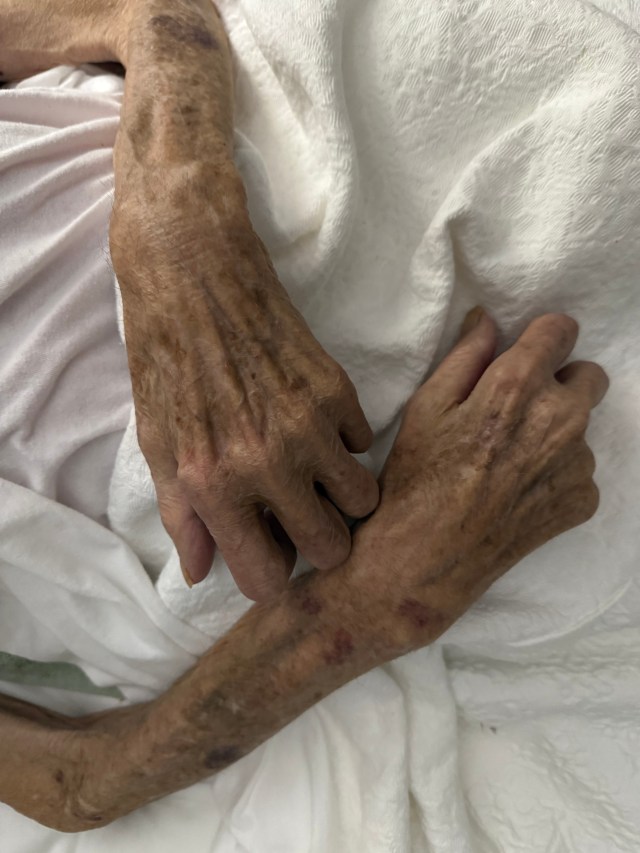
Blotches on hands and arms. Shallow breathing. No eating and drinking very little. Gradually slipping away. Sleeping almost constantly.
Today, my dad’s brother came over. He’s one of the funniest human beings you could ever meet; that this guy is not a stand-up comedian is shocking. At the same time, he’s been through a lot. When he came into the room with Dad, my father was more animated than he had been in days. No real smiles or words, just a little more movement in his face and hands. I left them together and worked on the other things going on…mopping floors and cleaning the house.
Dad’s brother got up to leave and asked me when we thought his brother would recover. Had we been to the doctor? Could we give him some kind of medicine? It was hard to know exactly what to say or how to help him understand the situation. I tried the subtle approach: “You know he’s on his own journey now, and I’m not sure things are going to change.” He replied, “Yea, but I mean let’s make him eat some food! Let’s make him a protein shake.” I paused. “You know, my Dad’s dying. He’s going to be gone in just a few days.” He stared at me for what seemed like an eternity. Tears welled in his eyes. A moment of shared understanding. “Ok well, I’d better get home. I’ll come back over this weekend.”
Standing there in the driveway as he pulled out, I thought about the number of people I had told this information. My dad’s friends, former coworkers, former boss. All were dumbfounded, all at a loss. How?, they’d say. When did this happen, they’d ask. I haven’t come up with a pat answer yet. Most of these people I didn’t know well, and I’ve been a little unsure on how to break this news.
As I shuffled back inside, it was time to wash his body, shave his face, comb his hair, and just clean him up a little bit. To say that this process was comical just doesn’t do it justice. First, he was pissed I lifted him out of the bed. He growled “nah, nah.” I spoke to him in a kind of silly voice, “it’s time for a tubby!” “I don’t want no tubbbbyyy.” I sat him in the chair, and he demanded Mom do this part of the process. After it was done, Mom said, “Don’t you feel better?” and in the LOUDEST statement he’s made yet, he said, “NO!” Then I started shaving him; he didn’t like it, and grumbled. We finished it up, got him back in the bed, and I asked, “Now, that’s better isn’t it?” He looked me straight in the eyes and said, “No.” I couldn’t help but laugh, and my Mom called him Bozo for being so ridiculous. I swear to you, he looked up and gave me a kind of sneaky grin.
He quickly fell asleep. I sat for a while. He no longer wants the TV on in the room. The noise is too loud, the sound too grating. The house is quiet. His breathing is still rhythmic. At the same time, something has changed. It’s subtle, and I feel it more than I see it. The waiting and watching, of course, continues. I’m thankful I’m here, grateful for this moment. In the kitchen, the hum of the refrigerator is the loudest thing I hear.
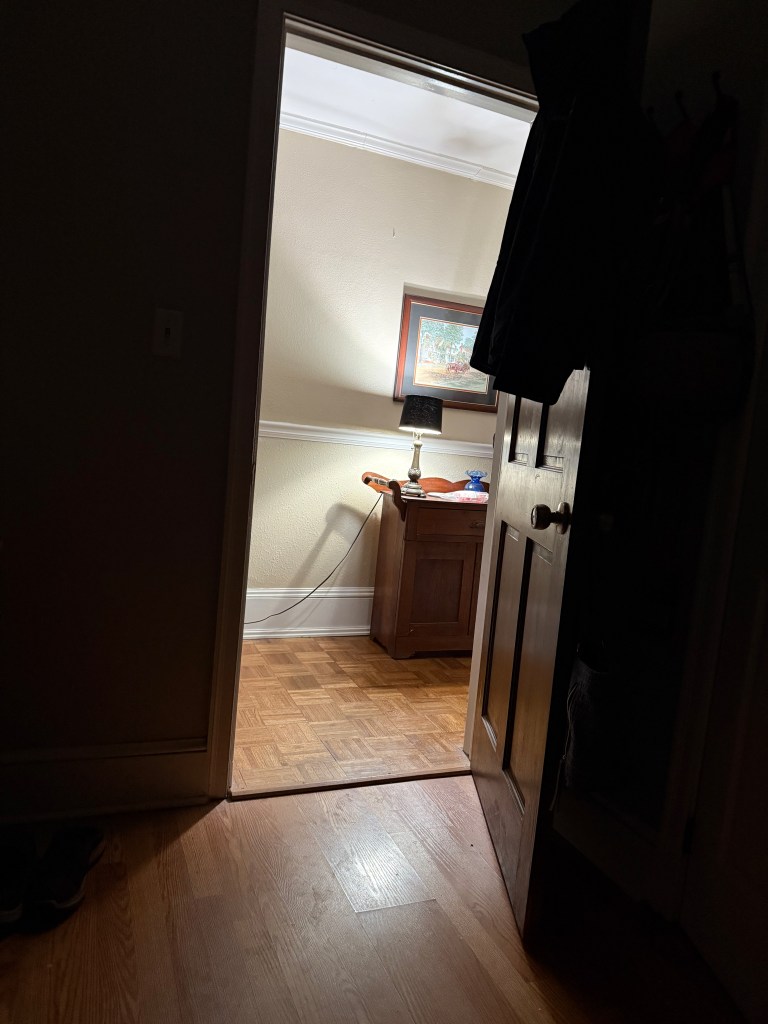
The bedroom is warm, hot even, as I walk through the hallway and into the sauna-like space. Laying quietly on white sheets with a white coverlet is my father, resting peacefully in the late afternoon of a Georgia winter. I grab his hand and gently lift it as he turns to me in a kind of half-awareness. “Oh! You came home!” he says, and it’s all I can do to hold it together. I smile and say of course I did, and after a beat, he says, “Now you can make me get better.” I continue to hold his hand, almost delicate in its frailty, covered in blotches of blue and red. His fingers barely squeeze my hand, and I sit with him for a few minutes. He slowly turns his head. His mouth falls open, and he’s resting again, respiration normal with a hint of a rattling sound deep in his chest. I lay his hand on his chest and turn to consider other obligations.
My mother is glad I’m home and has already planned for us to head to Kroger to get food for the week. She’s anticipated my cooking ever since I said I was coming home, and she’s ready for me to get started. I’m tired, tired in my bones, after a frantic series of flights and car rides to make it to Athens. Still, we go to the store, and I pick out the ingredients for a series of meals we’ll have this week. Chicken and rice, tofu and vegetables, salmon, flour for pizza dough, shredded cheese, and the like. Mom must make two quiches for church tomorrow and we grab the ingredients along with pie crusts, and eggs.
When we return home, my sisters are there in various states of concern and personal struggle. My middle sister is concerned that my dad won’t drink or eat anything. Hilliary, my youngest sister, a P.A., launches into the various needs Dad will face in the coming days. We talk about it all: the many arrangements, financial concerns, and a service. Dad communicated a few days before that he didn’t want ANYONE at his funeral; in fact, he just wanted us to have dinner together at home. As usual, Mom overruled THAT request, and we plan an abbreviated service as I will do the eulogy with contributions from everyone. I’m caught by the mundane nature of planning for the passing of an individual. The logistics feel wrong in the face of the death of a parent. It seems like it should be more, somehow. Of course, and truthfully, it isn’t more. Maybe it needs to be less.
Mom starts the quiches as we talk, and my sister sits with Dad. My youngest sister and I talk about medical issues, and her husband is visibly uncomfortable with our matter-of-fact conversation. He squirms in the chair, looking away, not making eye contact with me or my sister. With side glances, I can see a kind of horror in his face, a deep abiding fear. I completely understand it, and at this moment, there’s not a lot of space for questions of our own mortality. I smile at him and try to include him in the conversation, only for him to stand and slowly walk out of the kitchen.
As the night winds down, we all say goodnight to our dad after giving him his pain meds. He thanks us, kind of formally, for being there, and we file out of the room. My Mom gets ready for bed, it’s 10:30PM here, and we settle into the new routine of waiting and watching.


 Reflections on the Path