Imagine for a moment that your mind is like an overgrown garden. Weeds, tree seedlings, edible plants are all mixed together this this former lush garden. All of the plants combined in a kind of crazy dance of vines and branches, twigs, and leaves, cluttering the once established garden, blocking any view of the fertile ground that once harbored those edible plants.
That overgrown garden is my mind; grown over with old and new thoughts, weeds of various sizes and shapes, roots too thought that go deeply into the fertile soil of my ego-mind. As I sit on my meditation cushion or chair and try to rest in that space of calm abiding my thoughts, those weeds in the garden, take hold of my mind. Their twisted, snarled branches of thought and emotion perfectly intertwined with my mind, almost indistinguishable from the calm abiding I’m trying to cultivate.
Trapped in my own mind.
It takes me a few minutes and soon I see the problem. One particular thought keeps coming into my mind; some negative action or emotion I experienced ages ago, capturing my attention and pulling my mind in that direction. I try hard to cut to the root of that thought and find the source so that I can clear the space….to, in fact create spaciousness. I cut, pull, dig into the rich soil of ego mind, trying to remove the thought at its root and remove it from my mind. It works….for a while; then a few days later, the thought is back, the root remains and my mind is, again, overgrown with the weed from that root…disturbing my calm abiding and sending my mind for the weed-wacker…the tool that will finally and completely end the thought.
What I realize, of course, is that I cannot remove that thought, that weed, from my mind because the lived experience holds that thought in memory and I’m stuck with it. I have to find another method for dealing with those thoughts, those weeds in my garden of mind.
What if I ignore them, I ask. I ignore them…and for a while they go away. Then, at some point, the thoughts are triggered again, rising as strongly as ever, present in mind. I try again to cut them out…only to again fail at my task. I feel, literally, trapped by my thoughts.
Then I come upon another method; focusing on another thought. It works! I can focus on something else and that thought slowly disappears. I’m free, I think, from that horrible thought. I look at the sunset, mountains, trees blowing in the wind, a full moon and think, finally I have an object, a thought, I can attach to and ignore/end the negative thought and emotion! Woot!
Of course, you know what happens. I get sick, illness overtakes me, and the negative thoughts and emotions descend on me with full force. Here I am again, trapped. I HAVE to find another way.
Can I find another object, one more permanent? OR, or, is there a method for ending my attachment to those thoughts?
In recent days popular news organizations in the United States have picked up a story on how mindfulness practice and its benefits are hyped to the point of misinformation. In a series of stories and reactions, people across the internet are weighing in on the question: is mindfulness meditation an effective method for transforming our lives?
In the magazine Psychology Today, Peggilee Wupperman writes about the situation, stating that “It depends.” The article offers insights into the difference between mindfulness training and psychological counseling as methods for dealing with problems in our lives.
The original peer-reviewed article establishes that, in fact, the claims of some mindfulness practitioners are hyped beyond the actual benefits of the training. The article states, “Misinformation and poor methodology associated with past studies of mindfulness may lead public consumers to be harmed, misled, and disappointed.” In a nutshell, claims of a peaceful, stress-free experience through mindfulness meditation is limited and, in some cases, dangerous.
While my limited experience with these topics does not even compare to the thousands who practice mindfulness meditation, what I do know is that meditation does not lead one to some peaceful, gracious place of bliss. Quite the contrary, meditation brings up all sorts of demons hiding in our minds, opening us to some of the worst (and best) experiences that we often relive by breathing and sitting on a cushion or in a chair. Some of the worst mental experiences of my life have been when I was in the midst of some form of meditation.
Too, the benefits of mediation as taught by some mindfulness practitioners are completely detached from the source of mindfulness training and the whole purpose behind it: to become aware and awake so that we can take on the suffering of others. Meditation and mindfulness has as one of its goals the expression helping everyone BUT ourselves. That the entire point of mindfulness is not even our own mind! Sure, our mind does have something to do with it, but the whole point of training is not about our own experience, selves, or, frankly, anything to do with us. It’s about helping those who are suffering.
The truly powerful goal of meditation and mind training is to care for those around us and in the world (all sentient beings). As Dilgo Khyentse said in Enlightened Courage, “Enlightenment will be ours when we are able to care for others as much as we now care for ourselves, and ignore ourselves to the same extent that we now ignore others.” (29) This giving and taking is a central part of meditation practice and is the one thing that appears to be missing from the mindfulness training that so many promote.
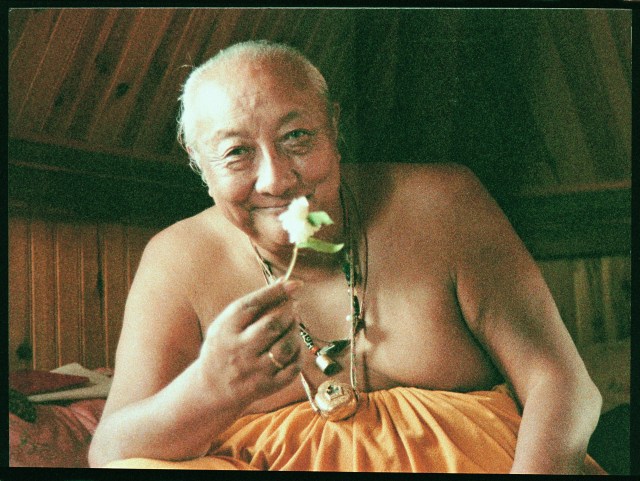
Dilgo Khyentse from Shechen.org
Digging a bit deeper, the root text of this teaching comes from Chekawa Yeshe Dorje. Living in the 12th century in Tibet, this teacher expounded on the view that the heart of mahayana practice and Buddhist meditation was in the practice of Bodhicitta. In that practice one exchanges oneself for others. The idea can be a literal exchange, offering your body in exchange for someone else, or through meditation exchanging someone’s suffering for your happiness. The idea here is that self-cherishing, protecting oneself over others, is one root cause of our own suffering. Once we let go of self-cherishing we can find the freedom we seek. We no longer cling to the idea that we are a unique self; in fact, we become one with those who suffer, taking on that suffering and freeing them from samsara.
This one passage in the root text offers some perspective:
To free yourself from harm
And others from their sufferings,
Give away yourself for others;
Guard others as you would protect yourself.
Chekawa’s description of helping yourself is to “give away” yourself in a very specific and rational way. Stories abound in Vajrayana and Buddhist teachings about people giving away parts of their body to help others; to carve off a piece of flesh for a starving dog, for example. These stories tell us that we can give away ourselves in service to others, thereby aiding their suffering and serving the purpose of reaching a state of being in which “self” becomes meaningless and care of others becomes primary.
Of course, we all struggle with this idea. I imagine that if mindfulness meditation teachers starting espousing the idea that we give ourselves completely to someone else’s suffering many would not attend those meditation sessions. And, the truth is that wouldn’t be surprising. How many of us (me included) are not constantly worrying about ourselves? Our health and well being; hell that’s the whole point of what many of us know as mindfulness meditation! We are helping ourselves overcome stress and achieve a state of calm. What a terrible thought that what we think we are doing is, in fact, the very opposite of what we need to do….to give away ourselves rather than nurture it! Yikes!
As I’ve tried to navigate these waters for the past few years, I take heart in the words of Dilgo Khyentse, Dzongar Jamyang Khentsye and Sogyal Rinpoche who talk about giving and taking, who have taught the tonglen and Lojong practices, and have opened the door to a different way of seeing meditation. I owe a huge debt of gratitude to those teachers who offered a perspective that goes against the grain of mindfulness and actually opened my mind to a process and practice that, while very difficult to accomplish, is nonetheless powerful and transformative.
When we face the threat of serious illness, whether real or perceived, our minds run wild. At least that’s what happened to me in the past week or so. Bronchitis took hold and I ignored it. I had a slight cough that slowly tightened in my chest. I felt worse and worse…but the progression of the disease was gradual so that by the time I was facing more serious symptoms, my body was weakened and the reaction was fierce.
I’ve reflected on such things in the past and this time, my second kind of health “scare” was a bit different than the last. Most importantly, I tried leaning into the illness. Rather than running away, I breathed into it as I lay in bed, PVCs raging in my chest, fear capturing my mind. I breathed into the fear. One morning, I woke at 4:33AM, could not sleep for the racing in my mind and heart, and tried just watching my breath. I lay there until about 6:00 awake, fearful and focused on the breath. I never chased the fear in my mind; it was just a presence, a kind of constant reminder of death. Was this the prelude of a heart attack?
The next day I went to a urgent care clinic wondering if something more serious was going on, but anxious to understand the malady in all its forms. The one thing that happened over the course of that night was the desire to know, regardless of the consequences. Why was my body reacting the way it did? This moment was the second time in my life that I realized that my body was not under my control; not completely. Our bodies are wondrous things and they can and will betray us.
That’s How it Feels.
As I waited in the urgent care waiting room for about an hour to see the one practitioner on duty, I had plenty of time to breathe. And I did. By the time I heard my BP was up and my SAT levels were low, I was ready for the worst. The practitioner came in, listened to my chest, checked me over, and prescribed medication.
Now in day two of recovery, my symptoms are slowly abating and the illness is very gradually leaving my body….or, at least, my body is being given the chance at recovery.
What this moment brought me was a reminder that practice: meditation, awareness, throwing myself fully into my life, is the whole point of it all. As Dzongar Jamyang Khentsye has said repeatedly we have no time to lose. Our time is very brief on this earth and in practice, we have but a few hours before we meet our end. This approach is not despairing in any way; it is a realization that time is short. Let us make these hours count.
Finally, in terms of illness, I found one solace; that breathing into the illness rather than running from it was the key to some peace. The pain I felt, the fear that raged in me were all still present AND the breathing and practice allowed me to cope in the best way I could. I think this lesson has been learned; it’s as if once we face our demons and they do not defeat us or that we do not give into them, we find a place of awareness that, in fact, we are stronger than the malady can ever be.
It may sound ridiculous to describe impermanence as some form of action; however, I’m of the opinion that, in fact, impermanence is an action in our lives. Something like: I am constantly impermanencing…sure a ridiculous word AND I think it suits my purpose of conversation today.
My uncle, Henry, no longer has a mind that is locked into the linear appearance of time and so his thoughts wander from past to present; in reality, he no longer recognizes past and present in his thought patterns….the fact is his mind moves between thoughts without reference to time. So, for example, his mother who died in 1995 is still alive, his father, who died in 1953, is living in a house in his hometown, or he is going to school or work, or will start a paper route tomorrow on his new bike. Simply put, his thoughts have lost the temporal map that is in all of us.
As I sat with Henry and we talked about all kinds of things, the one thing clearly impermanent in his experience was time. I think of time as a permanent stretch of existence moving in a straight line toward the future….but that understanding is based entirely on my thoughts and how they are remembered. Once the mind train goes off the rails and dementia sets in, no longer do we have a fixed sense of what comes next or, for that matter, what came before.
Impermanence, as stated by Dilgo Khyentse Rinpoche (DKR), can be described in these terms, “Our lives are fragile and impermanent, and because death and its causes are uncertain, we may succumb at any moment.” (Enlightened Courage 16) Even the things we think ARE permanent, like time, are clearly just constructs of our mind. Once our mind can no longer hold that construct intact, time becomes just another impermanent piece of our existence.
Too, as DKR said, we don’t really have a lot of time to get our minds together. At any moment we face the challenging questions of our existence: sickness, old age, and death. Stabilizing our minds, establishing a practice that allows our own awareness to reveal itself is key.
I wonder if such a stabile practice can help us work through those aspects of age and mental degradation? Are we capable of creating a mental space for awareness to shine regardless of the disease process of dementia? I tend to believe that our mental state is, like our lives, impermanent. Maybe, then, we have to work hard to reach awareness before the mental deficits kick in and we have reach a point of practical enlightenment for the benefit of ourselves and all beings.
Finally, as I said earlier, we are constantly impermanencing….aging, loosing memory, muscle strength, and on and on. That process is key to understanding our own awareness and bringing that awareness to others. At that point in our practice, we reach a state of compassionate knowing. We understand that, among all human beings, we all face that same ultimate fate of decline and death in various ways. So, I reach out to all fellow humans on this path, offering my compassion, my love, to those facing these difficult challenges ahead. Maybe if we all can recognize that we face the same basic difficulties that we can understand each other and, ultimately, change the way we interact as individuals in this vast sea of humanity. At least, that is my hope.
And, the thing is, there seem to be no rhyme or reason for the thoughts or notions. My uncle Henry is a perfect example: recently I talked to him for a couple of days this past summer. He lives with the family of his former wife and they care for him in their home. A nurse comes to the house daily to take care of his needs. He is able in that he can walk, talk, and feed himself (if food is placed before him).
As we spoke, he made the same kinds of comments over and over again: the time when his caregivers had a house moved onto their land, or how bad Obama was as president, or thoughts about the sorry state of education. Those three topics came up over and over again. When I changed the topic, asked him about the distant past, he remembered, vaguely, events and people. In a couple of cases when we talked about the past, he did not remember his father died when Henry was 14. When asked where his father lived, he commented, “oh somewhere in Athens” (Henry’s hometown).
Henry, Talking About The Weather
I noticed that time no longer locked him into the present. He was young, old, planning to go to school or work, any number of events that formerly existed on a timeline, a sequence of events. Now, the timeline was gone. No sequencing of things from beginning to end; all ideas were tossed together in a whirl of concepts and memories that he touched on given the right trigger.
My experience with Henry, my great uncle Raymond, his sisters, and many other folks have really brought into stark relief what mind is (or is not). Fundamentally, we organize events in our experience in a somewhat sequential reference. Mind then is the great ordering mechanism of our lives. It creates order out of the chaotic mess of human existence.
And…and I have to ask the question: IS IT mind that creates the order? Or could it be that our ego-mind defines the experiences we have and orders them based on their relation to how we feel, think, or respond to those events. For example, some events hold prominence in our minds…getting a puppy or watching a traumatic event or experiencing a sense of wonder and awe. Those moments take on increased meaning in our lives.
Does an event take on that increased meaning because of the emotional connection? What if we say, for a moment, that the emotional connection doesn’t matter…so can we imagine a place in which that traumatic event does not take on the strength of meaning it otherwise would? Can we extract a completely different meaning from an event that appears in our mind meaningless? Similarly, can we imagine a place in which an experience has no meaning beyond that it happened? No significance whatsoever; just something that happened as a result of cause and effect. A thing happened because we were in the right or wrong place in time. That’s it.
If we see those events as just events in our lives, with no attachment to their supposed significance, then how might we be completely different? Would our thoughts be different as a result?
Dementia, Alzheimer’s Disease and the many permutations of those diseases have affected my family for years and years. I imagine we could be a case study for these debilitating afflictions.
Beginning in the 1960s, my family faced a series of crises related to severe memory loss in many members of my extended family. The first person I witnessed facing these diseases was my great grandmother. I watched her slowly loose her mind; she lost the ability to perform daily functions and ultimately was bound to a wheelchair in my grandfather’s family home.
Mama Gee, as everyone called her, was an intelligent, strong, powerful woman, taking on the task of maintaining the family during the 1930s when her husband died of unknown causes. She organized the kids, all twelve of them, into a kind of military routine of tending the fields and household. Her work ethic and desire to give a better life to her her children drove her to expand the farm and sell produce at Farmer’s Markets in Athens, Whitehall, Winterville, and other parts of north Georgia.
When I knew her, in her nineties, she was on her slow decline into dementia. In the end she was either confined to her bed or in a wheelchair most of the time, her voice taken from her with a hemorrhagic stroke sometime in the late 1960s. I was a small child and seeing Mama Gee squeeze a red ball in her right hand while everyone clapped for her was among the most interesting moments of my young life.
Today, all of my great aunts and uncles from my grandfather’s family have died. All of those who survived into their 70s faced the difficulty of mental degradation and some form of Alzheimer’s or dementia. To be specific, of the 12 brothers and sisters, 8 suffered from this disease.
I was raised in this environment, taking care of these people at various stages of disability as they lost control of their minds. My father and mother often were called on to help out one of the aunts or uncles struggling with their siblings in the house.
On one particular day, my great aunt Emma could not reach my parents and got me on the phone at the house. “Tad, Raymond is running around the house outside and we can’t get him back inside. He wants to drive the car.” The last time Raymond drove the car we looked for him for hours and hours, finally finding him at a laundromat, sitting in a chair, dressed in suit and tie, with a green fedora on his head. This dark green hat was a staple of his wardrobe and he never left home without it.
I walked from my grandmother’s house two blocks to my relatives house on Cherokee Drive. Raymond was walking around outside in the yard just past the porch by the side of the house, aimlessly wandering in circles with a stick in his hand, one that had fallen from the massive oak tree in the yard. This late summer day was hot and dry. The grass was a deep green-brown color and the red dirt of Georgia was easily visible between the leaves of grass in the yard. Small acorns were scattered in what was left of the yard and Raymond was clearly agitated as he stomped around, mumbling to himself.
“Raymond? Hey it’s Tad, what are you doing?” His anger rose immediately and without a word chased me around the yard, stick in hand. Raymond, an 82 year old man, was 6’1″, about 160 pounds, wearing his suit and tie and hat, swinging the stick at me. He was remarkably fast. I, at 15, could barely stay out of the reach of the stick. “Raymond! Calm down….I’m here to just see how you are doing!” He didn’t stop. We ran in circles, and I figured in a few minutes he would wear out. His face dripped with sweat, winded, agitated, angry. I kept running.
A few minutes later, my Dad pulled up and got out of the car, calling out to Raymond “stop it!”. Raymond, preoccupied with smacking me, did not see my Dad come up behind him and grab him around the waist. He lurched to a stop and breathed heavily as my Dad grabbed the stick and tossed it toward the street. He related into the strong arms surrounding his and we walked him back in the house.
That one moment, pinned in my mind, stands out as a glaring example of someone who had, quite literally, lost their mind. I was fascinated and awed. What IS mind? How can we loose complete control over its function?
AS I came to understand mind, I found that there was a language, an internal communication we have with our mind. What I also found, however, is the fact that what we are talking to in our minds is, very simply, our ego mind. That ongoing internal language that no one else hears is our conversation with ego-mind. Hmmmm.
My decision to learn Japanese was a gradual one and based on that whole series of problems I had learning Tibetan and Chinese. I felt like I had a toe hold into the language, a means of finding common ground. I grabbed some apps to learn the Hiragana, Kanji, and Katakana. As I mentioned before, the apps helped drill the sound and meaning of the characters and words. I started with hiragana and very quickly mastered the entire set of hjiragana, about 46, in about 2 days! Accomplishment! Success! Victory! Let’s move on to Katakana….Katakana is another writing system used for foreign loan words from all over. Similar to the hiragana, the Katakana has sharp edges and visually shows the reader that these loans words are clearly NOT as elegant at the native language. Two days later 100% success! Woot! What’s next!?
Writing! I’m going to write down the hiragana and katakana! I downloaded forms for writing Japanese script, followed some of the rules for writing, and then began writing everything I remembered. In just a few months I would be conversant!
That’s when, as some folks say, the rubber meets the road. I sat down at a desk in my classroom between classes and started to write what I remembered….a few, a VERY few number of characters came to mind….but I could NOT remember them all, nor could I remember most…in fact, I could not associate sounds with characters in the vast majority of cases.
I immediately went back to the apps and ACED the study again. What was up? Why couldn’t I write the characters I knew from sight? What was happening here? I played around with this problem for a while. When I was in school, I had a photographic memory; I could take a mental picture of a reading or a math problem and remember exactly what it looked like or remember the words precisely. The problem was I could not remember how to SOLVE the problem…I only remembered the formula…not the function. Visually, I could recall the sounds and characters in the app but could not write the characters on paper. What was this all about?
I’m not a neuroscientist, obviously, but even I could see that I had to come up with another way of learning the character systems.
On Twitter I saw an article that talked about ways to learn a language when you are older. In a nutshell, learning a language when you are older requires many different modalities: ways of learning. A learner cannot take one or two approaches; the learner has to use every available option to be successful at understanding concepts in a another tongue. Kill and drill, learning through repetition, was one way; another was exposing yourself to many other sources for the language.
So, I grabbed some Japanese music, downloaded lyrics in hiragana and romanji, and began to just listen. Have you ever changed your iTunes account settings to listen to music from another country? It’s really wonderful. I switched my iTunes account to Japan; used another email address to associate the account, and then listened to clips of songs in every genre of Japanese music. Much of it, on iTunes, is J-Pop, a kind of manicured, stylized sound consistent across groups, musicians, and singers. Backing strings, many ballad-like compositions. I wondered if one person wrote songs for these groups?
Then I stumbled on one band: Kobukuro. These two men sang together on the streets of Tokyo, were discovered, and became a sensation. I bought an iTunes gift card from a Japanese vendor and downloaded an album….the songs were catchy, and, when the layers of strings were stripped away, the voices and music was fantastic. I listened over and over again to tsubomi. At first, the song sounded like a jumble of words, especially when the singer moved faster during the chorus. In certain moments, I felt like I would never understand the individual words…there was one point in which I felt like I would never “get” the language.
Here is the first stanza in kanji and hiragana:
涙 こぼしても
汗にまみれた笑顔の中じゃ
誰も気付いてはくれない
だから あなたの涙を僕は知らない
In romanji:
Namida koboshitemo
ase ni mamireta egao no naka ja
daremo kizuite wa kurenai
dakara anata no namida wo boku wa shiranai
Translated:
When your tears fall, they merely blend into your smile covered in sweat,
that nobody will be able to notice.
For this reason, I do not ever know about your tears.
Yep. I listened over and over again…I mimicked the words, I sang the song, in Japanese, out loud…I copied the sounds. And it to me; layers. In my mind, I reasoned, I’m laying down the layers of sound as a way to integrate the language into my mind so that I wouldn’t be thrown off by some peculiar vocalization. I could hear the words even though I did not know what they meant or were. I’m not sure when the song started to lock into my long term memory, but ehen it did, I could sing without the song playing. I really felt a sense of accomplishment. I heard each word sung in the song…something that is hard when listening to English language songs…all of those songs that people (like me) mishear the lyrics: forever when my daughters listened to Miley Cyrus “Wrecking Ball” I thought the lyric was, “I came in like a Rainbow….” Imagine my surprise when I figured out the “wrecking ball”…not quite the same tone.
The other thing I started to notice about my learning was my mind maxing out; basically reaching the point of saturation. I realized that in some moments I could not learn anything more. I noticed the moment when my mind went blank and could not absorb more information. I started to recognize the signs: my eyes starting to blur, my mind distracted, my attention span short. Depending on the day, my attention was sometimes long (an hour and a ½) or short (20 minutes)…sometimes I could not even start the practice.
I kept poking around for some obvious way to increase retention. The kill and drill sometimes worked, but most often I remembered ideas based on context; reading a word over and over in a lesson. Like hajimemashite; a kind of greeting….”Hi, my name is” kind of greeting.
In that process of searching for a method to my madness, I decided to take the plunge and purchase an online account for Rosetta Stone. The language program has taken its fair share of hits over methodology and I can see the various difficulties in using just this one approach.
The thing that Rosetta Stone did, however, is help me jump right into learning the language. It felt good to remember words and ideas using their system of the language and pictures without supporting English prompts…the system IS emersive. The problem I encountered was in some places, I could not figure out what they wanted me to learn….seriously, sometimes the sentences and pictures did not match up. Where to go? How to find the path?
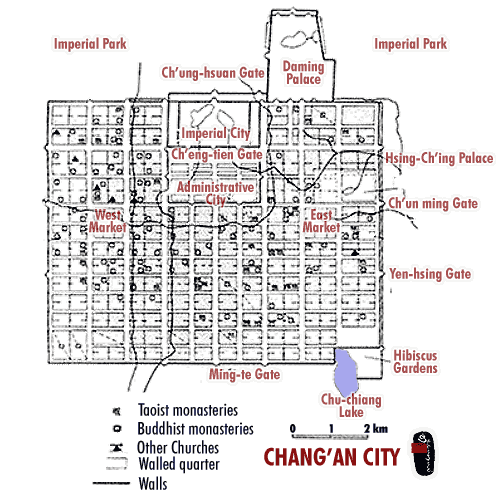
Politically and socially, Japanese leaders adopted Chinese political structure by placing the emperor, already considered a god, into the center of politics and governance. To represent that ideal, a great capital was established in the model of Chang’an…a formal design of the city of Nara that placed at the north, central part of the city the emperor’s palace.
More importantly, the emperor and the court around the emperor adopted Chinese language. One of the more brilliant language adoptions in the world happened in Nara Japan. Japanese scholars took Chinese characters, kanji, and learned the spoken word associated with the character. Then, the Japanese associated spoken Japanese words that they associated with the Chinese characters.
Then, these scholars taught court officials and other folks associated with the court how to read and write these characters. The transformation was something to behold; writing exploded in the city. Historians, poets, court officials, all wrote extensively about Japanese history, culture, the value of products, and life in the court. Two important documents of history and culture included the Kojiki and the Nihon Shoki. These first national histories told the story of Japan’s origins from the religious, legendary past through the Nara period. Also, the Man’yoshu was an anthology of poems collected and published in a single, handwritten source.
Chinese written language was both a practical development in Japan, having a consistent writing system useful to governments and officials, and a means of communicating important ideas from History to Poetry to architecture. As you can imagine however, the language was an awkward fit for spoken Japanese. Listen to a Chinese sentence and then listen to a Japanese one. The differences in spoken language are striking as are the significant differences in grammar and sentence structure. Making Chinese hanyu fit into the Japanese was an act of sheer will to make the fit work. The fit was clearly awkward.
After years of working with the Chinese, a group of women in the Imperial court developed a writing system that extracted the basic structure of Chinese characters and simplified them into a very elegant written language. These characters were closely aligned with the sounds of Japanese language….much in the way that Roman letters are associated with a sound, these new characters represented a sound, or actually a set of sounds, that formed the spoken language in written form. These characters, called hiragana, were a way for women, who were not allowed to study language, to communicate through an alternative system that more closely represented the spoken Japanese. Hiragana, literally meaning “simple”.
Folks who want to learn Japanese often began, like I did, to study the hiragana. At times, during my study, I often just stopped and wondered about the people who developed the writing system. These women, who realized that the Chinese written system was an awkward fit, came up with a way to represent Japanese language that allowed someone to voice the language by learning the written syllable or spoken word. Incredible. Have you ever created a writing system? One that represented sound? Why not try it?
When I started learning Japanese, I mean really learning Japanese, I started with hiragana. My iPhone became my best language friend. I downloaded a series of apps and tried each one…first the free ones (usually not very good at helping with the kind of drill and memorization necessary to remember the sounds and characters) until I settled on Japanese!. This app includes a clever method for remembering the sounds as characters by randomly quizzing you on the sounds once you begin to learn them.
Learning Japanese is a lesson in patience. Not patience with the language but with yourself. You must abandon traditional measures of success; in fact, you have to abandon the success model of learning entirely. The whole idea of accomplishment is the idea that once achieved, you have accomplished, known, possessed some knowledge. Like a product that you developed on your own and can now show everyone how great that thing is.
Studying Japanese cannot be a success-focused type of study. Learning Japanese is a layering process. In some ways like creating a structure, a scaffolding to support your next stage of understanding and development. In 2006, visiting Shanghai in March I saw these massive high rise buildings surrounded by bamboo scaffolding, wrapped around the growing structure. I sometimes think of those bamboo structures: they are flexible, organic, and move together, linked by rope, and wood to surround a edifice. Learning Japanese is very much like that; a flexible support for your study of the language, a organic artiface as a means of holding up your tenuous language building.
One first step to learning Japanese is to practice those hiragana and to grasp the sounds. Interestingly, the sounds are familiar to English-speakers. The sounds are similar enough that learning the hiragana characters becomes a kind of memory game associating the characters to the sound….a sound you may have heard before.
In fact, I think that is why I settled on Japanese over Mandarin and Tibetan. In Japanese, I found a familiar set of sounds that were not in Mandarin. Mandarin, a tonal language, puts the sound of the syllable at the center of language….a very slight deviation from the correct rising, falling, rising and falling, or neutral sound and the word is completely different. The famous example of this is the sound ma. Spoken one way ma means horse, in another ant, in another number, all just based on inflection!
While there IS inflection in Japanese (more on that later), the system is much more restrained and, from my perspective, the rules easier to manage.
Again, why did I choose Japanese as my language to learn? A complicated question. Anyone who has read recent Japanese history knows about the ugly recent past; the invasion of Korea and China and southeast Asia. The abuse of Korean people, comfort women, the Mukden incident, the Marco Polo Bridge fabrication, the horror of the rape of Nanjing, and the Bataan march.
If we are honest, however, my own country of origin has the same kinds of horrible acts of violence and destruction. Salem witch trials, Native American genocide, the Ludlow Massacre, the Haymarket Riots, African slavery, and on and on.
These historical incidents raise a serious set of questions about our role in human society; What role do we play as folks living years after some horrible historical event? How do we rectify past deeds or help to understand the crimes committed by earlier groups of people? Many societies have approached these situations head on like the Truth and Reconciliation Commission in South Africa or the Nuremberg Trials after World War II. The list goes on: the Geneva Conventions, or Germany’s decision to allow one million migrants into Germany in 2015. Those cultural decisions are a meaningful starting place.
OK, but what about me? My grandfather was in the Navy in the Pacific during World War II fighting the Japanese. Throughout his life, he never spoke badly of Japanese people and said, in fact, that war was war and what happened during war is something that we cannot forget and we can forgive.
What would Fred Gentry say about me learning Japanese? He’d probably say something like, “Great job you old rooster!” He pretty much said kind things to everyone.
The question, though, comes back to why Japanese? A few years ago a young man had climbed Everest and was traveling around the country talking to school groups about the climb and preparing for it. He made a comment that captured my attention and imagination: “Find your Everest and Climb It.”
My Everest was learning Japanese. At 50. In New Mexico. Here was an Everest that meant something to me….a decision to learn about the language and culture of Japan. To dig in deep and accomplish something that I can be proud of for myself. Not for anyone else. (In fact, more than one person has said WTF…but I digress.) Learning Japanese at 50 is my Everest.
Rewind to my studies of French and Latin in middle, high school, and college. I studied French for years, making my way through conjugations and esoteric sentence structure. I started Latin in 9th grade and loved the clean lines and very organized patterns of the language. I continued Latin study in college to the point that I could, by graduate school, translate medieval documents in Latin (and get paid for it!). While I was by no means fluent in either language, I had an affinity and grasp of what those languages were like and how to frame basic ideas and sentences.
In Mandarin and Japanese, the written forms of the language were daunting. In Chinese, hanyu (the language of the Han people), the characters represent ideas or images or complex thought. The characters themselves do not relate or refer to the spoken words that are associated with those characters. Chinese characters can be read by people in China that speak very different dialects; for example, Mandarin and Cantonese and Shanghainese.
In Japanese, the written and spoken languages take on very different characteristics. In the 5th century, Japanese and Chinese traders interacted and exposed aa striking difference between the groups; the Japanese did not have a written language. Not having the ability to read in trade relations is a source of a series of historical conflicts; what is that person writing on a tablet or paper? What is the information that is being recorded? What does it mean? We can experience a little of this sensation when listening to people speak in a language that we do not understand in front of us…or purchasing a product and seeing, written on the wrapper or box, words or symbols we do not understand. What is REALLY in a HI-Chew and why is the product even referred to as Hi-Chew? What is THAT?
But I digress. The Japanese brought information about Chinese language back home and, at some point, someone said, “We have to learn this writing so that we don’t get ripped off!” or something to that effect. Ministers from the Emperor, years later, were sent to study in China. They traveled to the capital city, Chang’an, and met with folks in this great city.
Speaking of which, if you do NOT know about Chang’an, you should. This remarkable center of culture, politics, scholarship, and religion was by all accounts an incredible place to visit, see, study, and work. Set up in a grid pattern, the city was divided into districts that included markets, temples, palaces, humble homes and shops. In the center was (and still is) a great Bell Tower that kept track of the time of the day. Imagine, walking the streets of the city, swept clean by workers, wandering through shops that carried a wide variety of goods from as far away as the Mediterranean or Africa? Caged lions and tigers, animals from all over the known world or people gathered from a variety of ethnic origins who traveled to the city to trade. (I’m not advocating for caging animals; it’s representative of the influence of the city as animals are brought from thousands of miles away to be sold or traded in this center of Chinese culture).
As the Japanese emissaries arrived, they encountered not only a remarkable city but also a flowering culture and society led by some of the most remarkable leaders in Chinese history. The Chinese (not really a monolithic group, by the way) emerged from a series of internal wars and conflicts and were slowly brought back together under the Sui dynasty and the Tang. Chinese dynastic history is as interesting and remarkable study in the development of social and political institutions, AND the Tang dynasty is known as a kind of “golden age” of China. Personally, I’d say every society and culture in the world has a series of “golden ages” and the whole idea of a “golden age” implies that things today kind of suck. This whole “everything was better in the past” is, on its face, not true, but folks still ascribe great things to the past and crappy things to the present.
ANYWAY…the Tang dynasty was, depending on the year and the ruler, a remarkable time to be in Chang’an…in fact, the Tang made the city into the center of culture. These Japanese emissaries were in Chang’an during one of the more important periods in the city’s history. Sent to China by the Japanese emperor in Nara, the Japanese scholars and officials studied Chinese culture, politics, society, art, and language. These folks brought back to Japan all of what they had learned and the ideas transformed Japanese society.
Over the years I have read a variety of texts about how to stay on the Buddhist, Vajrayana path. I studies Vajrayana and established a daily practice. Made my way through Ngondro and memorized mantras and chants that deepened stillness in my mind.
I chose to study a language because of what learning that language means to my mind: a single focus on a practice. I brought all of what I learned from Vajrayana and applied it to learning Japanese. I grabbed that first textbook and, much like my first steps into Vajrayana, failed. How could I EVER hope to grasp a language that had three writing systems, that included a whole series of pronunciations? So, I did what any person faced with such an overwhelming task faces. I put the book in a box and ignored it….for three years.
Being tangled up in the daily life of a teacher, father, student, and generally silly human being constantly tugs away at our own need to thrive, mentally and emotionally. We often put the needs of the many before the needs of the few. (one of my favorite Star Trek lines) Of course that approach to life is exactly what we need to do for our families, society, and ourselves. I love Kongfuzi’s Analects and his saying in Book One, #6 as a description of this ideal:
“The Master said: A young man should be filial within his home and respectful of elders when abroad, he should be careful and trustworthy, broadly caring of people at large, and should cleave to those who are ren. If he has energy left over, he may study the refinements of culture (wen).” http://www.indiana.edu/~p374/Analects_of_Confucius_(Eno-2015).pdf
That last phrase has always resonated: “If he has energy left over….” Right? If he has energy, like me who often comes home from a day in the classroom completely spent and then making dinner, cleaning house, or washing clothes, helping with homework, clearly focused on everything other than “the refinements of culture.”
Energy. That is the key, isn’t it? Folks generally assume that having less energy is the nature of being over 50. That somehow you are less energetic and more lethargic than when you were younger. I heard this EXACT idea stated by a younger colleague whose husband wanted kids before he turned 40 because he was facing that “lack of energy” thing that folks get when they pass the BIG 4-0! The slow, inevitable decline of our lives; bodies breaking down, mind numbed by years of toil, broken, tragic figures waiting until the final march toward death.
Good Grief! Seriously? That somehow, we, as humans, lack energy to accomplish even the most mundane of tasks because we are older than we were years before? Here’s the thing: this whole idea of having less “energy” is a myth perpetrated on us by a media driven mad by youth culture. I blame the ideas coming out of the 1960s: “don’t trust anyone over 30”. Jack Weinberg, the author of that quotation, has claimed that the quotation misrepresents his intention. Of course, the quotation stuck and was associated with the idea that youth culture was basically good and the aged were not to be trusted or, better yet, ignored.
I have a message to the world and especially to folks who would perpetrate the idea that energy is a thing in the sole possession of those who are youthful: the energy to accomplish anything is in the hands of anyone willing to step onto the path. Think of the path as a way into whatever it is you want to accomplish or do. Whether you are 15 or 50 that thing we call “energy” is, in fact, motivation. I’ve seen 15 and 50 year olds have no motivation to accomplish anything. The reality is that motivation and intention are key to making something happen…whatever that thing is.
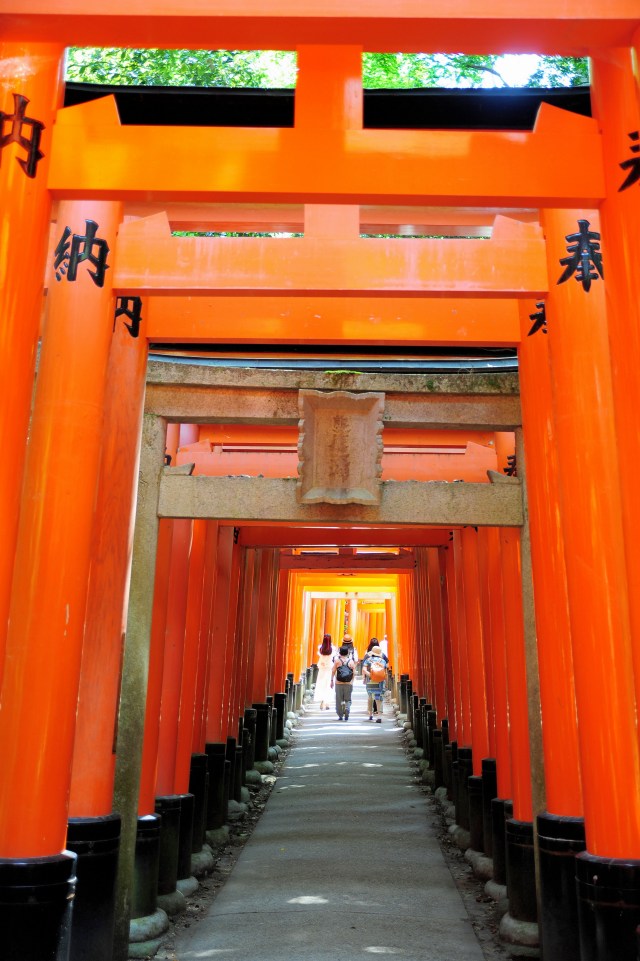
The Path at Fushimi-Inari taisha
Wow. Now I sound like a bad motivational speaker…let’s be clear, folks used to describe motivation as “setting your mind to it” or “stick to-it’edness”. Whatever name this idea goes by, the reality is that the motivation to accomplish anything is based entirely on the focus of your own heart and mind.
So, motivation. Why did I put away that Japanese textbook years ago? Why wasn’t I capable of sticking to that book and the methodology?
Looking back on my mind about 3 or 4 years ago I remember feeling that I could not possibly tackle learning Japanese. The language was beyond my ken…a challenge that, at my age, I was not capable of learning. Too, the work – family balance was out of whack. I was working to the point of exhaustion each day. By 9:00PM, after most homework was done, I was ready to collapse. As an aside, folks that are not teachers in elementary, middle, or high school do not comprehend the challenges we face in the classroom and in school. We welcome these challenges and most of us face the daily classroom as a place for us to engage students and create positive learning environments. That approach in the classroom takes enormous effort both in terms of work (preparing lessons, reading material, creating engaging activities) and in terms of emotional energy and enthusiasm.
As teachers we summon motivation each day, and the difficulty for most of us is that creating that motivation takes a huge amount of energy….really the practice of bringing together our enthusiasm for the subject, students, and parents. In addition, we face an almost constant challenge from those same folks: parents, students, and even some colleagues, that we are not doing enough OR that we have failed, in some way, our mission. A recent email from a parent went like this, “I am not sorry for your difficulties with my son. How hard is it to engage one child in a classroom for 45 minutes? I have no sympathy for you or your work.”
For teachers, messages of support and care are few and far between. We receive few accolades and rarely are given more than a grudging acceptance. Students, occasionally, come back from college or work and say that we made something happen for them. That they NOW appreciated what we were trying to do. In my 20-year career in teaching so far, those messages amount to a handful of students. And those four messages and comments are precious to me and to every teacher that receives them. Since we rarely hear of our influence directly, hearing it JUST once is motivation to continue.
So motivation. When I decided to study an Asian language, my motivation was strong. I planned to take off pieces of the language each day, imagining that within a year I might have working knowledge and then by year two, to converse in this new language, gaining confidence in my new-found ability, offering staggering levels of insight and perspective in this brave new world of language!






 Reflections on the Path