From the Archive: The Beginning of Awareness

My extended family was huge.  Down the street just past a small city park from my grandmother’s house lived the Jones family, a clan of more than twelve siblings raised by a tall, powerful woman I only knew as Mama J.  During the Depression in Alabama, to survive after her husband died from pneumonia, Mama G raised her kids and managed a truck farm.  They sold tomatoes, corn, eggs, butter, and other products on their farm on the side of the road near Decatur, Alabama.   Mama J was the anchor of the family, and she was a woman who, through determination and hard work, eventually was able to buy a house in town and live out her years in the relative comfort of a house in Five Points in Athens.  My awareness of Mama J comes from the later years of her life.  At over 100 years old, she was somewhat mobile and cared for by her children who lived with her. 

My last real memory of Mama J was sitting in a chair in the living room of their house during the annual Christmas party.  The family gathered around her and yelled “Squeeze the ball, Mama!”  Dutifully she would squeeze the ball and smile, her wig slightly askew.  No words crossed her lips and she sat, dressed in a party dress, hunched over slightly due to her scoliosis, holding that red ball, squeezing it on request.  Her daughter Emma, a loud, strong woman was a constant companion.  Emma, nearly six feet tall in a dark green dress stood by her mother during the party.  Emma was demanding, ordering people around.  Her bright red wig didn’t quite fit her head and her gray hair poked underneath the plastic, hair-like cap.  When she spoke to me, she always poked her index finger into my chest to make a point.  Years later when she developed dementia, I would see her walking in the neighborhood, clearly lost.  I’d stop her and she would call me Henry, my grandfather’s name, and ask me where I’d been all this time.  Emma was a story unto herself.

One of Mama J’s many children was Franklin, my mother’s favorite uncle.  Franklin was always in our lives.  He served in World War II and when his brother died in battle in Europe, Franklin was shipped home to take care of the family.  He served in Puerto Rico and talked about driving a supply truck through the jungle.  His stories were not very interesting or exciting, and learning how to drive a truck filled with food supplies seemed like a silly job to a young boy.

Still, Franklin was always present driving my mother, sisters, and me to pick peaches or visit a beach in South Carolina.  His driving, in a dark green 1970 Pontiac Catalina was terrible. The behemoth of a vehicle had a split-grill chrome bumper that stuck out a good 10 inches from the hood of the car.  The car wandered all over the road.  He swerved, cut corners, and flew down the highway to the places we went.  On one outing to a peach orchard, he kept driving off the shoulder of the road, kicking up dirt.  My Mom was constantly badgering him to stay on the road and in the back on vinyl seats, we loved being thrown around, beltless and sliding back and forth.  At the orchard, we picked about two bushels of peaches, a large amount for children to harvest in the sweltering heat.  At one point, Franklin came up to me and said, “I love peaches when they are dead ripe.”  He looked at me and slowly bit into the flesh of the peach, juice streaming down his chin and neck onto his white t-shirt.  The liquid stained his clothing, but Franklin didn’t care; he walked up to a tree, grabbed another “dead ripe” peach, and gorged himself.

Franklin was close to my mother, and she said that he was by far one of her favorite people.  As I got older, Franklin played with me, roughly.  He often punched me in the arm, and I felt the pain and sting of the hit.  He kept doing it until I got angry; then he told me “Punch my fist!  Go on!  Do it!” Against my better judgment, I punched and punched…the pain of hitting his knuckles was too much and I gave up on the game as he laughed. Franklin didn’t stop, however.  He grabbed me and wrestled me to the ground; his muscular frame was hard to escape, and his body crushed my chest.  I started hitting him harder and harder.  I couldn’t breathe and he kept taunting me, “Come on, Tad.”  He laughed and finally got up.  I slowly climbed to my knees, fueled with anger and shame of being pinned for so long.

I always knew something was off about Franklin.  He always wanted to hang out with me and asked my parents if I could go play golf with him.  Sometimes my dad went; other times I went with him to places like Hard Labor Creek golf course or some other activity.  Over the months, I was more and more reluctant to go on these treks.  His comments were strange and his references to men he knew during the war were something that didn’t make sense to me at the time.

During the summer of my thirteenth year, my family was on a vacation in the North Alabama mountains staying in a small cabin my grandmother owned and Franklin came along with my parents, sisters, and grandmother.  The tiny space included a large stone fireplace and wooden floors with ancient windows that barely closed.  Some kind of small insect burrowed into the wood on the floorboards, and you could see these small mounds of sawdust piled on the floor. The tiny kitchen included a small pantry and a gray vinyl countertop that was maybe two feet across.  A refrigerator and stove also took up the rest of the space.  The stove was electric with four burners, the smallest I’d ever seen.  The kitchen wasn’t made for cooking big meals.  

Everything in the cabin felt old and worn out—even the water from the well tasted old.  The smell of the water from the tap was strange and tasted of minerals and earth.  The well was in a small building up the hill about ten feet from the cabin.  Inside the well house was a concrete floor and a hole in the ground covered with a metal lid.  Deep inside the well was a small pump that failed often.  It pumped the water into the house.  The smell in that little structure was moldy, musty, and wet.  The cabin was in the middle of the northeast Alabama mountains that receive hundreds of inches of rain in a year.  It always smelled of rain and rotting plants. Leaves covered the forest floor and walking through the trees was almost silent as sound was absorbed by layers of leaves between the trees.  Later I learned that it was an old house, built in the late 1920s on land owned by O.B. Land.  The landowner had built a small road in the 20s that went around the lake.  The remains of that dirt road, no more than eight feet wide, were about twenty feet below the house.  As my grandmother said more than once, the air surrounding the cabin was “close” meaning the air around the cabin was heavy with humidity and the smell of the forest.  A week in the cabin felt cramped, tight, and isolated. 

Each morning after cereal for breakfast we’d walk down the many stone steps to the boat dock to swim in the lake.  The water was a deep shade of green slightly masking things below the water.  You could make out downed trees, limbs, old car tires, and metal cables.  Across the lake from us in an area we called “the cove” was a hill with a rope swing.  The swing, attached to a tree by a thick metal cable, swung about twenty feet into the air.  To swing, you’d swim over to the far bank, walk through the mud along the bank, and up the hill to grab the cable and swing into the lake.  It was critical to swing far away from the bank as downed trees filled the water near the shore.  It was terrifying.  

On our side of the lake near where we swam was a huge wooden barge used years before to bring lumber to build the houses on this part of the lake.  It sat in the water, chains holding it to rocks sunk deeply into the lake bottom muck.  It was strange and eerie seeing this structure suspended in this green ichor.

During the week, Franklin was always the guy who jumped into the water and splashed or knocked you off a float; if you were relaxing, he leaped into the water with the intent to send you sailing off your repose. Repeatedly he messed with me.  He grabbed my float, tossed me into the water, and threw me off the dock.  By this point in my life, it was getting old.

One night, after dinner, my sisters and I were tucked into bed.  The bedroom was small and filled with two bunk beds.  I was on the upper bunk of a metal frame bunk bed in the cabin.  My Dad and Mom came in to wish us goodnight. Franklin came in a few minutes later.  He pushed each of us around saying goodnight, putting his hands on our arms, and shoving us back and forth.  When he got to me, he pushed my left arm and then, suddenly, grabbed my crotch…he latched on hard and pulled.  I hit his hand, repeatedly, and he tried again.  I jerked away from him and after one more attempt he said “Night, Tad.”

I lay there sleepless and terrified.  This act was the first of many that Franklin would do to me over the years.  My reactions became more and more violent.  So did his.  He was a very strong man, and I had to constantly avoid getting trapped in a wickedly painful embrace.  

These events almost always were when the family was around.  In one case, I locked a door to keep him out by using a tiny hook and eye latch; he taunted me outside the door, and I heard my family laughing.  “Come on, boy, open the door.  What’s wrong little baby?”  I never felt safe behind that door, knowing that if he pushed hard enough, he would push into the room to molest me again. 

My silence about these encounters was deafening.  I’m not sure exactly why I could never tell anyone what was happening.  Maybe it was because I always heard the stories about how great Franklin was.  How kind he was; how he helped everyone.  Maybe I knew that my parents would not believe me.  To them, Franklin was a saint.  They considered me untrustworthy and told me often.

The painful truth was, that I did lie to my parents about little things all the time.  When it comes down to it, I wasn’t a kid who was seen, heard, or accepted.  Let me explain.  I had to conform to some idea of who I was supposed to be.  From a very early age, my mother picked out clothes for me to wear.  For years it was about the way I looked.  Dressing appropriately was important for my mother.  This unwritten dress code was a constant drone in my brain.  Even when I was planning to go to a Homecoming Dance, my mother demanded that I dress a certain way.  It sounds so simple, doesn’t it?  Just dress the way your mother wanted you to dress, what was the problem? 

The problem was that being dressed the way my mother wanted was just one of the many aspects of the control.  More difficult for me was how my mother controlled the way I spoke and acted.  Anger was not an acceptable response; being too loud or too funny was also outside the bounds of behavior.  I faced a narrow path of acceptance.  To be loved, and to be cared for required me to act a certain way.  Outside of that, I was rejected, isolated, and alone.   

In this context of behavior and control, I developed a kind of secret identity, one in which I could be myself.  This self-required that I hide things from my parents….nothing big; it wasn’t like I did anything bad or wrong.  I just had to live under the radar, so to speak.  “Did you take out the trash?”  “Yep!” (I hadn’t). “Did you feed the dog?” “Yep” (I hadn’t)…these small defiant acts were, in fact, small.  I never snuck out of the house, went to parties, or otherwise violated the basic structure of our household.  Years later, when I decided to leave Alabama in my early twenties, my father told my grandmother, “I’ve never told Tad how proud I was of him.  He’s never done anything wrong, ever, He’s been the perfect child. I cannot believe he’s leaving; he’ll come home.”  She related this story months after I’d left Alabama for Montana, I was never able to say to my father, “I’m never coming home to live in Alabama again.”

So, when it came to dealing with Franklin, I did it alone.  I got tired of hearing about him all the time and when I could stop hanging around him at fifteen, my parents scolded me about being “mean to Franklin.”  When it came down to it, I never trusted that they would protect me from this man.  He was brutal, violent, and a child molester.

My last physical encounter with Franklin happened in my parent’s house when I was 16.  My parents were out, and I was making dinner in the kitchen.  Our house was never locked.  I was in the kitchen.  The kitchen had a long counter that ran on my left with cabinets and drawers. At the corner of the counter making a ninety-degree angle was a small counter and a countertop stove in front of me.  I faced the stove, stirring a pot with pasta.  The door to the kitchen, which opened to the garage, was behind me.  As I managed the pot with sauce and the one with pasta, Franklin quietly opened the door and came into the kitchen. He left the door open.  He took two steps and pinned me against the counter in the corner.  It happened so fast that I couldn’t react or turn around.  His arms wrapped around my arms and chest.  I struggled, in vain, against his grip.  I swung my arms wildly as I tried to turn to face him.  In one swift motion, I took my right arm out of his grasp and swung around. I managed to make it ½ way and connected a glancing blow to his chin.  This blow released his hold slightly and I was able to face him.  I punched hard to his rib cage, my hand hurting in the process…he groaned, and then with a little more space I kicked him in the crotch.  He bent over, slightly, and then I kicked him again in the shin.  He backed away.  I threw a wild punch at his head and my hand stung as I connected with his forehead.  The pain staggered me a little.  Franklin slowly walked backward.  I pushed him hard and he hit the door frame.  Just as quickly as he entered, he turned and walked swiftly out of the door and into the empty garage.  I watched him get into his car and pull out of the driveway. 

I turned off the stove and ran out the front door of the house.  In the driveway was my uncle Henry’s car, a blue Plymouth Scamp he said I could borrow.  I saw Franklin’s car on the street, the green Pontiac Catalina stopped by the curb.  In a quick decision, I leapt to the blue car fired up the engine and hit the gas hard.  I pulled out of the driveway, and I sped past Franklin sitting in his car. 

I don’t remember how I ended up at McDonald’s on Prince and ordered some fries.  From there I drove and drove all over the city.  About three hours later I headed back toward the house.  Hoping my parents were home, I approached the house from the opposite direction.  As I came down a slight hill, I saw Franklin’s car slowly coming down the street toward our house.  I hit the gas and drove past him as he looked at me through the window.

I felt disgust, anger, and fear.  I decided, at that moment, that I would never be around him again.  He appeared at family gatherings, and I was never in the same room with him.  I moved around, avoiding his gaze and his attention during his visits.  Once more, many years later, I rode with my father to land he inherited from his brother.  I wouldn’t get within feet of Franklin.  At that point, he was a shell of his former self, struggling with the daily activities of life.  He now drove a pickup truck and I noticed, on the dash of the truck, thirty small bottles of Neutrogena Hand Cream.  The disgust I felt raged through my stomach.  

As he entered assisted living, my mother cared for him until the day he died.  She was his constant companion as his life ebbed away.  He died in a costly assisted living facility.  He inherited land worth a small fortune that allowed an expansive level of care, something I will never see.  His death came late in life, close to ninety years old.  I don’t know who else was tortured by his violence.  I told some of my younger cousins, when I saw them, to watch out for Franklin.  They looked at me quizzically. He was a monster.  

What I discovered in those years was this basic premise of life: some people present themselves as saviors; sometimes those saviors are monsters in disguise.  I came to understand the concept of grooming and how the trips to play golf or to bring ice cream to our house were the ways he used to lure me.  Of course, the lure never worked in the sense that he found a compliant recipient of his violence.  He wore a disguise so well that many today refuse to believe the bitter truth.  In those moments when no one, absolutely no one, believes you, you must trust and believe in yourself.  The only way I made it through was to trust my feelings of unease. I did everything in my power to create distance from the terror.  I had to believe in who I was.  I was sufficient to the horrors I faced.

This incident also led me to another painful and life-altering conclusion.  G-d never intervened on my behalf.  Let me be clear: I prayed and prayed and prayed.  I read the Bible cover to cover, repeatedly.  I used to be able to recite central texts from the Gospels word for word.  I memorized Psalms and knew what they meant.  I asked questions, I read other books about belief.  I heard about the “mystery” the “God’s will” and all about “God’s plan.”  When it came down to it, my devotion did not lead to my salvation.  At the University of Alabama, I studied religious texts and was fascinated by Medieval literature and writings.  I read St. Anselm’s Ontological Argument and studied Ibn Sina and Ibn Rushd’s work.  I was obsessed with Maimonides’s “Guide to the Perplexed” and sought insight and answers through these brilliant scholar’s interpretation of Biblical texts and ideas.  When I found Thomas Aquinas’s Summa Theologica, I thought I had found answers.  His reasoned arguments, borrowed from Ibn Sina, were remarkable proof of the existence of G-d.  I dug into his work, even using my rudimentary Latin skills to read the original Latin text.  I even had a copy of the first Latin Bible, The Vulgate.  I read the Bible in Latin.

None of these actions or attempts at understanding relieved my torture and shame.  I could not believe, ultimately, that some reward waited after death. That suffering in this life had meaning.  Seriously.  Think about this idea: you’re suffering now, but just wait UNTIL AFTER YOU’RE DEAD…it’s going to be paradise.  So, was G-d saying to me to just accept the repeated molestation and possible rape?  That’s what I had to do?  Society went on to say, “Take it like a man.”  Having a stoic response, a distant response to this horrific situation.  The question I faced hit me hard: Why would a loving G-d allow for the kind of suffering I faced?  I kept hearing that G-d was love.  Are you serious?  I’d read about miracles, where was my miracle?  How was this situation representative of G-d’s love?

The truth was that no one came to save me.  No one stepped in.  Not Jesus, not the Holy Spirit, no one.  When I came to realize it was just me that was the one that had to do something, I decided to do something.  I did something.  I finally used my strength and wrath to exact punishment for this horror of a human being. Truthfully, nothing in my experience will ever change my mind that this man, considered to be a good person, was nothing more than a predator, a pedophile, hiding in plain sight.  I no longer blame my parents for not protecting me.  I did learn that the only one I can rely on is me.  Whether that takeaway was good or bad is irrelevant; it was my understanding of how life worked.  No one was ever coming to save me.  Ever.
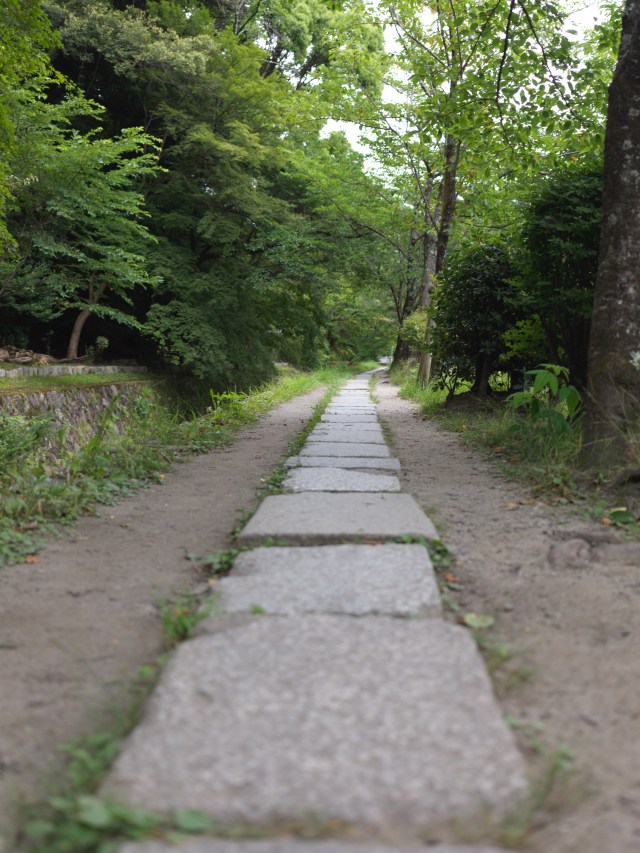
Walking in Japan on a hot, June Day

The walk from the rented house to the Philosopher’s Path is about six kilometers. I wander along city streets and through neighborhoods to climb the short hill to the beginning of the Path. On this day, the sun is out, the sky hazey with no breeze. The humidity hits 88% with the temperature reaching 35 degrees in the shade. I’m walking along the Path, listening to the water in the canal mumble its sweet song as carp swim along the rock and concrete banks of the stream.

As I take my first steps onto the Path, I pull out a copy of Matsuo Basho’s Narrow Road to the Interior. Written in 1689, Basho’s story and the haiku of his travels represent engagement with friends, fellow travelers, and the world Basho dearly loved to write about. While the time and space of this book does not really conform to the time and place I’m in, I try to imagine the poet walking this path toward GIngaku-ji and wonder at how he might express himself on this day in Kyoto.

This rabbit-ear iris

inspires me to compose

another haiku

Matsuo Basho. Narrow Road to the Interior. Boulder: Shamble Publications. 1998, 125.

I read this haiku and laughed a bit at the comedy of this one blurb of writing. It brings a smile to my face and my thoughts. I walk, slowly and alone, on stone pavers spaced oddly for my gait. The path is surrounded by verdant shrubs and bushes as well as small cherry trees that bloom in the Spring to light up the shaded, narrow trail.

The thing is, I’ve visited this place four times before today, and I remember many of the steps along the way. In fact, as I walk, the memories of this place flood back into my mind. I remember a cat sitting on one of the many bridges that cross the canal as well as people walking their dogs along the way. The slight shock of memory always reminds me of other past places and events and, for a moment, I’m taken away back into some past memory. With effort, I bring my thoughts back to this moment and try to revel in this experience.

It’s hard, however, to stay in the moment. So many things try to force their way into my mind: questions about relationships, money, health and well being, my children, and every thing else you can imagine. I try to let these thoughts pass. Working at detachment or non-attachment, I watch a few of these thoughts scoot away. Some, however, stick. That’s when it becomes harder. I shake my mind imagining that I can break free from the tacky, gooey thought. I focus on my photography and use distraction as my tool for letting go. It works.

The Paved Path, June 2023

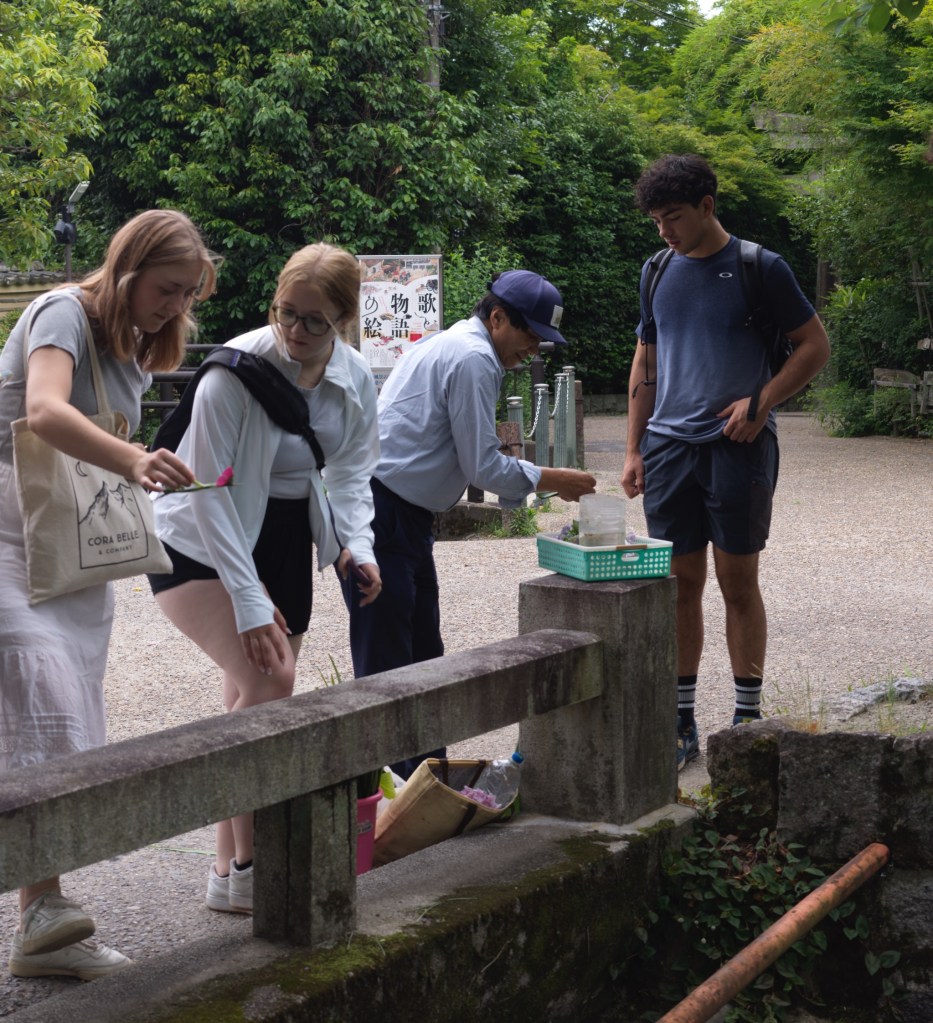
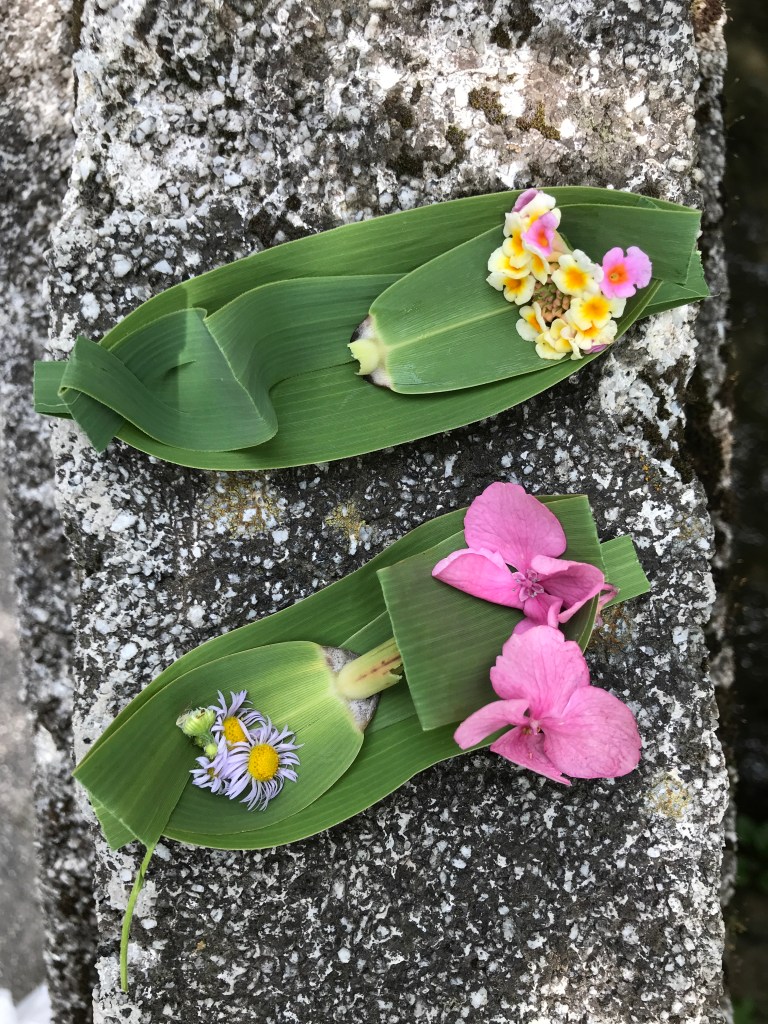
Clouds start to form in the sky overhead and the sun dims. I see in front of me one of the bridges that cross the canal and see, to my surprise and joy, an elderly man I met years before helping children make little leaf boats to drop in the canal. His joy is palpable and I watch as he helps each kid make the boat and then asks to use the camera to photograph the creation. Years before, he helped me make a small boat and he dropped his and mine together to see who would win. It was a wonderful moment.

Boat Creation, June 2023
Boats, June 2018

Continuing on my way, I’m struck by the memories of the past that again rise in my mind. Thoughts of life in the summer of 2018 come with force and again I have to deflect and refocus on the walk. I stop at the next bridge and read another series of haikus. I randomly open the text and read,

Don’t ever forget –

in the middle of the thicket,

blossoming plum

And then, I find another in the same style and tone,

From what tree’s

blossoming, I do not know,

but oh, its sweet scent!

Finding solace in reading someone else’s words, thoughts, and ideas has been something quite important to me over the years and I’m especially caught by the words and thoughts communicated by Basho over these centuries and lifetimes that separate us. I’m aware of the privileged spot I hold in this world and to be where I am when I am and who I am, right now, is a gift I never earned.

I continue the walk and reach the end of the Path, falling into Imadegawa-dori and turning right, I head up the hill to the entrance of the Temple complex. I pass souvenir shops and my favorite Onigiri place in Kyoto here on the road.

A reach the entrance to the temple, pay my fee, and enter the grounds. Seat drips off my head and the heat is strong. My shirt is soaked and I’m sure I look ridiculous with shoulder bags slung across my back, wet from the sweat my body’s creating. The stillness in the air and the humidity doesn’t really allow the sweat to evaporate quickly and so I’m a puddle of humanity walking the dirt trails.

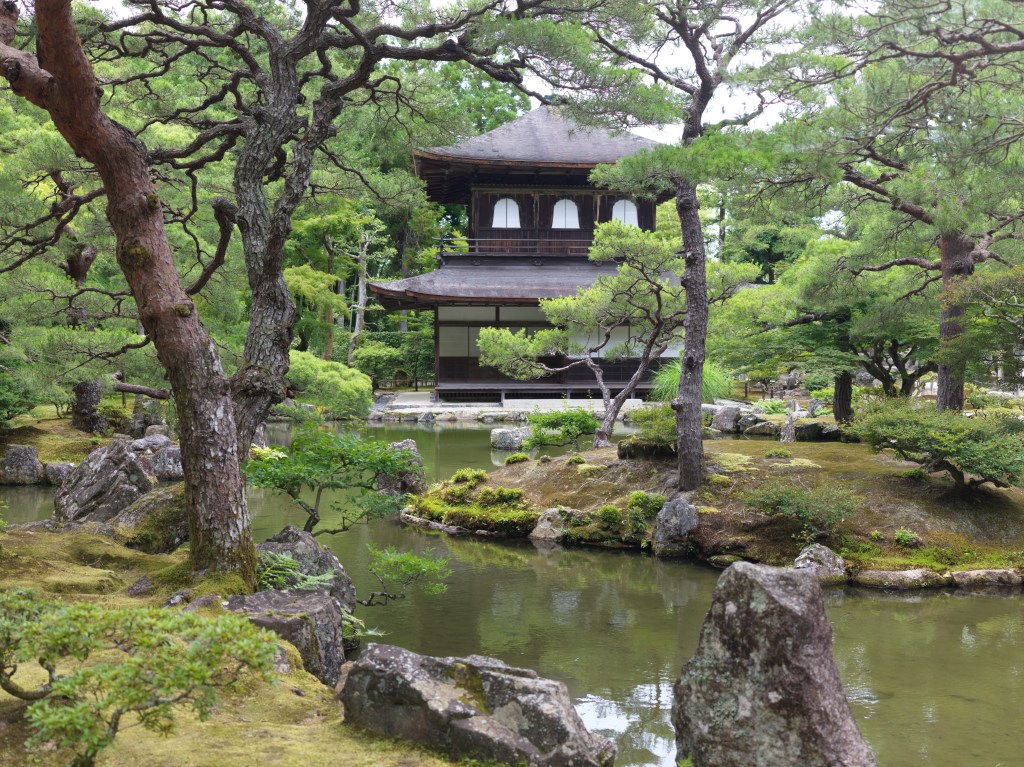
I’ve photographed this temple many times and today I’m determined to shoot more slowly and deliberately. It’s hard because of the sweat and the heat and the people. Still, I stop and shoot. I see this view through my camera’s lens.

Gingaku-ji, June 2023

I’ve stood here before, looking at this scene in June 2018, the last time I visited. The look is similar and I check back into my photos from years ago and find this one; a wide angle view of the same place. I notice the differences – more natural color, less dramatic lighting as the sky is dull in 2023, the sun more present in 2018.

Gingaku-ji, June 2018

After a while, I shoot a variety of places in the area and finally make my way to Onigiri. The day has been joyous and wonderful, quiet, and perfect. Days like these rarely come and I’m lucky to have experienced these moments.

May you be happy, May you be well.

In the Heart and Mind of Suffering

My mother lays in the hospital bed, uncomfortable, shifting around searching for a spot where her physical pain will drift away. She sits up, slowly. I adjust her pillows behind her head and back. She complains about the pain; I understand. She glances at me with the knowing awareness that, in fact, I do not understand HER pain. It’s rough, prickly, and without end. We talk, once she settles, about anything but the pain. Georgia football, the new Offensive Coordinator, her friends, her plans to walk the biggest hill in our neighborhood. She talks about everything that focuses on some future event or passion. She tries to find a way past the pain of her back, her legs, her abdomen, newly opened through a surgical procedure.

I can do little more that sit, offer thoughts and wander verbally with her as she goes from topic to topic as a way to distract her mind. It works. For a while, it works. Then it doesn’t.

I help her stand and make her way to the bathroom. I disconnect the power cord from the wall as she takes her IV unit into the bathroom with her. She moans, unknowingly, at the pain of rising and sitting. She grabs her stomach as she coughs up phlegm. Her coughs are productive and sometimes violent reactions to the mucus that has filled her lungs. I hold back tears as she tries and fails to pull down her pajamas. She’s deeply embarrassed by her son helping her. She feels vulnerable and not the least bit comfortable in my presence. She wants privacy. She wants to be able to do things herself. She struggles with the clothing, the IVs poking out of her upper arm because of the thin skin on her hands.

I help her out of the bathroom and then say, “It’s time for a walk.” Her doctors have ordered walking and getting her to move is no easy feat. As her eldest child, I feel responsible. I try to keep my tone light. “Let’s just walk down the hall and back.”

After a few moments we walk through the door and into the hallway of the surgical recovery ward. The hall is filled with staff in red scrubs at computer systems hooked to al kinds of equipment. Adorned on some of these devices are pictures of flowers and names like “Brandi’s Station” with flowers scattered around the name written in green sharpie and cursive lettering.

As we plod past the stations, my Mom’s mood has changed; she greets each of the nurses and aides. She talks about everything: the busy ward, the other patients. She asks about their wellbeing and how things are going for them. I’m amazed by her demeanor; bright, upbeat, curious. As we wander down the hall, she says, “Let’s go a little further.” We walk to the Nurse’s station and then top the right, down the hallway where a patients in more dire straits are housed. A woman cries out repeatedly, “OH god, I cannot breathe! I’m dying, I’m dying.” Police officers sit in a chair at one room as a man, bound to the bed, writhes to be freed from his velcro straps. His incoherent, shouting nonsense. As we pass, I ask the officer, a young Black woman, what happened. She says, “I cannot talk about the patient, sir.” 

We reach the end of the hallway, and turn around at a blank wall. We walk back to the room and my Mom’s pace increases slightly. She whisper’s, ” I cannot listen to that woman yell.”

We move to her temporary housing, walk into the space. The bland, light green color casts a pall on the space. It feels dank, dark, institutional. The lights flicker overhead. The wall behind her bed filled with outlets of some sort. Red plugs, hose extensions.

I reconnect her various devices to the power and her NG tube to the large container on the wall. It’s half filled with bile, a green, semi-clear liquid. I’ve been asked to check for signs of blood in the sludge. I help Mom sit, carefully, on the side of the bed. She cringes in pain, grabbing, instinctually, her abdominal area. Once she is settled, I sit in the folding chair in the room. It’s small. I’m a tall man. I shift, squirm, move to find some comfort.

We chat a bit more about everything and nothing. Not much to say in these moments. 

My Mom wants to go home. She’s tried of being in the hospital and misses her friends. She talks about walking with Frances, and again brings up the big hill, “It’s on McWhorter” she says and I say, “You will be able to climb that beast!” She smiles, slightly.

Her eyes starts to close. She breathes more deeply. She wears the pain all over her face. It’s on her body and in her mind. I can FEEL the pain sitting about two feet from her bed. Her struggle. Her fear.

As she falls asleep, I watch my mother try to rest in a kind of liminal state of being; not fully asleep and definitely not awake.

Tears fall from the corners of my eyes as I watch. There’s nothing at all that I can do. Nothing. I cannot relieve her suffering, her struggle with her body. I watch. I know that in a very short period of time, I too will face these moments. My children will wonder at what to do. We will both be without a path to follow, a hope to grasp onto. Maybe I will learn this lesson, but right now, I cry. I cry for my mother, I cry for the suffering we all face, and I wish, hope, and pray that no one faces what we face today.  And. And, I know the truth.

May You Be Happy, May You Be Well.

Teaching Meditation: First Steps into a new Practice

On January 3rd, I stepped into teaching meditation to a group of colleagues. Our staff PD day included the opportunity to offer instruction on a variety of topics and I chose something from my background, meditation.

I’ve been trained in meditation and Buddhist practice since 1997. That’s not so long a time to study and honestly after my teaching session, I clearly have work to do. At the same time, I do have some training and knowledge that I brought to bear during this session.

I based my teaching on my recent work by Dodrupchen Jigme Tenpe Rinpoche in his book Transforming Suffering and Happiness into Enlightenment. The book, short, concise, and pithy, offers a lot of insight into meditation and mindfulness. His words offered the perfect counterpoint to my training and a recent workshop led by Patrick Gaffney of Rigpa helped ground my teaching to this group.

I began with a quotation from the movie, The Curious Case of Benjamin Button. The quotation, written by screenwriter Eric Roth and delivered by Brad Pitt, is a wonderful place to start any practice.

For what it’s worth: it’s never too late or, in my case, too early to be whoever you want to be. There’s no time limit, stop whenever you want. 
You can change or stay the same, there are no rules to this thing. We can make the best or the worst of it. I hope you make the best of it. 
And I hope you see things that startle you. I hope you feel things you never felt before. I hope you meet people with a different point of view. I hope you live a life you’re proud of. If you find that you’re not, I hope you have the courage to start all over again.

Eric Roth

As I leaned into the instruction, I followed the practice of my various teachers and informal mentors: Sogyal Rinpoche, Dzongsar Khyentse Rinpoche, and most recently Patrick Gaffney. I stayed close to the source material and offered ways for people in the room to work with their minds.

Included here are the instructions I developed for the teaching.

What The Hell Do I Know About Meditation and Why AM I In this Handbasket?
Are you ready to just sit for a minute? What I mean is to rest this weary mind of ours. While we have just begun this semester, I can say with some confidence that many of us are weary. We came to this day early, by 7:30AM. We’re getting ready for the semester, we’re thinking about what’s to come, we’re inundated with information and new things to consider and figure out. We are, simply put, starting the semester overwhelmed.

So, let’s try to find some space in our hearts and minds for the kind of rest that we all deserve…it’s the kind of rest that allows our weary or troubled mind to settle. In that spaciousness of our settled mind, we can find compassion for those around us and reach out to be heard, to be seen, to find acceptance regardless of the baggage we’re carrying or the struggles we’ve had.

What we will work with today is to expand spaciousness in your mind and heart. We’ll do this by recognizing the gaps between our thoughts. We’ll also open to compassion; compassion for yourself, compassion for those of us in the room, compassion for those in the school, community, and beyond. I want to help you find compassion for all of it…because, from my perspective and the perspective of my mindfulness education, it’s compassion that’s the key to unlock the spaciousness in our hearts and minds….that’s where I hope we can go, today.

  • This spaciousness, this openness, this compassion comes from expanding the space between thoughts and emotions. Here’s the main idea: that between thoughts and emotions are gaps, spaces between the next thought and emotion. If we pay attention, we can experience this gap or space. It’s this space that we want to stretch….to increase the gap between thoughts.
  • That’s one reason why folks who do meditation talk about focusing on the breath. The breath has a gap between the in and out breath. That space or gap is similar to the space or gap between thoughts.
  • So, in meditation or mindfulness practice, using the breath as an object is one way to become aware of that space in both your breath and your mind.
  • We’ll try this experience a little later. Try to just witness the spaces between thoughts using the breath.

So, what ABOUT ME? What makes me an expert in the practice of mindfulness and meditation? Well, first I am not claiming any expertise. I have knowledge and coursework that has helped me in the past and I’m passing on that knowledge to you.

I have specific training in a couple of types of Mindfulness/Meditation practice.

  • I have been in training on the Vajrayana path since 1997. I’ve taken 36 classes on this path and have done meditation and mindfulness workshops on Vajrayana more than ten times. I have done several silent retreats, solo retreats, and meditation training.
  • I have taken classes by Jon Cabot-Zinn using his text Full Catastrophe Living. Those courses have led to certification as a trained student on his approach.
  • I’ve done a series of workshops on Mindfulness as it relates to school and students through Highland University.
  • I am not a Vajrayana teacher nor do I claim any particular knowledge. I have training and that only takes someone so far.

Before I give some instruction, I want us to share something about ourselves; one big part of meditation and mindfulness practice is to have support. Community support is really important – having folks around you you can share your experiences, ideas, or ask questions and wonder about what’s happening and why.

At our school, we tend to live in our rooms, trying to recover from the classes we teach. I think we all understand the drain on our hearts and minds that teaching presents to us; what I’m hoping we can do here in this space is just open, a bit, to the conversation about being mindful. So, if you’re feeling loose and comfortable, let’s start by providing some small piece of information about you…it can be literally anything you want to say in this space.

  • A couple of ground rules: this space is sacred and we’ll keep what we say and experience in this room.  When I say sacred, I want to be clear that sacred spaces are one really important aspect of maintaining and nurturing a meditation and mindful practice….so, this space is sacred.
  • Second, we can share anything at all.
  • Third, we can listen without judgement….as my instructors said, we listen with our hearts and not our rational mind…that means we hear without questions…someone says something and sometimes our urge is to ask a question or want more information.  Today, we listen without that part of our mind…we listen with our hearts…the open, vulnerable place in our spirituality.

II. Approach of This Workshop

I’ll base this workshop on the instructions and teachings given by Dodrupchen Jigme Tenpe Rinpoche in his book Transforming Suffering and Happiness into Enlightenment.

While this approach sounds very friggin Buddhist, it’s not about Buddhism. If you know something about Buddhism, you know it’s a social-psychological system rather than a religion. Rinpoche’s book is a practical guide on how to accomplish a meditative state of mind with some tools we have available to us. He and we are working on awareness.

So, that means you won’t need to have any knowledge or background to understand what I’m going to say. It also means that you don’t have to understand, know, or even accept Buddhism as a practice or belief system. Knowing Buddhism can be a hindrance to understanding this approach…so my recommendation is to forget what you think you know and just listen.

If this approach doesn’t work, forget it and find something else. Only use an approach that you think can work for you…that may involve trying and rejecting many approaches to get to the point that you can find something that works for you.

III. What are we going to do today?

First, I’m going to give you some of the background and the instructions Rinpoche provides in his book. This information I learned in courses I’ve taken over the last year. For me, this approach is not unusual or unique.

Second, I’m going to help you understand the ways in which meditation and mindfulness can work. Meditation and Mindfulness relies on your existing spirituality. As all my teachers have said, you cannot have mindfulness without a spiritual practice. They are quite clear in their perspective that meditation and mindfulness must be based on a spiritual practice like Christianity, Judaism, Islam, Buddhism, Hinduism or anything else. Without that ground, your practice generally does not progress.

Third, I’m going to teach you ways to meditate that are not just sitting….bringing meditation into your daily life involves integrating practice into things like washing dishes, walking, the gym, folding clothes, etc. Every single practice can lead to awareness…the ultimate goal of meditation.

Finally, we’ll finish with a guided meditation that helps you see a way to allow your mind to settle and thoughts to slow down. We’ll try to reach a place of spaciousness….basically gaps or spaces between thoughts.

II. The Basic Teaching

We have incidental layers of ego – thoughts, feelings, and emotions – that cloud our understanding of what’s really going on around us.

Things just keep popping up in our lives that distract us from just living our lives. These things can be anything from getting the flu, injuring some part of your body, a child or friend yelling at you, frustration that it’s taking 20 minutes to get coffee at a coffee shop, your car battery dies….literally anything that happens.

We can’t get rid of all these things that just seem to crop up all the time. As much as we want things to just be easy, they’re not. Frustration grows, anger grows, or sadness overwhelms us as we again must deal with ONE MORE THING.

Our struggles come when we try to reject those things in our lives – we experience AVERSION – simply put, we want to run away from that stuff. We try to come up with ways to reject those experiences…maybe we try to mask them or DO something to distract ourselves. Maybe when we experience sadness, we just try to push it away. For some of us, our main means of distraction are podcasts, books, TV, movies, or filling our mind with more and more information. Those distractions are sooooo good. We grab on to those distractions not realizing that we’re avoiding the thing that we need to somehow deal with….our mind and its discontents!
e. Too, many of these events are completely beyond our control – weather, other people reacting to us, etc. So, many of us want to just run away from these experiences or moments. We isolate ourselves, and thoughts fester in us around these experiences. Maybe we hang on to those experiences for decades, as expressions of sadness or anger.

We try to hang on to happiness, grasping at the idea that if I can just keep this moment here, I will be OK. Trying to extend those happy moments if we can. That can lead us to feelings of regret or sadness as the happy moment becomes a distant memory and we try to hang on to those moments.

  • For me, I remember the relationship I had with my grandmother. It was truly remarkable, and I find myself feeling deep sadness for her passing and the lack of that unconditional love in my life. I can feel such longing for that missing experience. So, a thing that was happy for me becomes sad. My mind took a wonderful experience and made it a struggle. Simply put, our minds can, in a moment, deceive and delude us.

III. The Hard and Good Things can be a source for our meditation or mindful practice

So, what can we do? What is possible? How can we figure out a way to move beyond these mental traps, these conflicting emotions or thoughts? Dodrupchen said that we can take a challenging event or moment and use that as an object, a way to find mindfulness or meditation. He used the term AWARENESS. To find some Awareness about what that event, situation, feeling means, and then to let that thing go.

Second we can apply our spiritual teachings from our lives as a means of recognizing that even the bad stuff can be turned to good. For example, if we come from the Christian spiritual tradition, we might apply the idea of forgiveness toward that bad situation. We might focus on what that forgiveness looks like; we might imagine going through the actions of forgiveness; we might call someone on the phone and start a conversation about that thing that happened.

My teacher Sogyal Rinpoche would say NOT to dig too deeply…because that always brings up the kind of dirt that sticks to you even though those experiences are years behind us…so, you can use your imagination and go through the process of forgiveness, saying, in your mind, what that forgiveness looks like. Maybe you don’t call that person you were hurt by; maybe what you can do is to imagine the conversation in your mind and then release the feeling, offering forgiveness in a way that feels real and substantial.

Third, anything, any practice can be a way to awareness….a state of being that allows us to roll with the punches; to go with the flow, so to speak, and not get bogged down into a mess of emotional baggage. Those practices can be something as simple as when a bad feeling arises, saying, “Thank you for being here and helping me learn how to let go of my attachments, my grasping, my fear, etc.” Any thought, emotion, feeling can be a tool for finding awareness and compassion.

Fourth, our ultimate goal is to expand our hearts or as Dodrupchen said it, to expand our compassion. To recognize that any event, positive or negative, can be seen through the lens of compassion. Compassion for ourselves, those around us, even those people who hurt us.

So, , you must have compassion for every single being. Dzongar Khentsye Rinpoche said that itdoesn’t matter it it’s Donald Trump or that mean neighbor next door. Everyone deserves your compassion. Of course, that does not mean that you have to accept their actions; you can have compassion for an individual but not their actions. You can wish someone well “may you be happy, may you be well..” Too, having compassion for yourself is at the center of it all. Being kind to yourself.

To keep us from being self-centered, meaning compassion only for ourselves, we need to bring into our practice everyone. Friends, family, etc.

Too, one of the struggles is to avoid negative thoughts and actions. We’ve all experienced negative thoughts on any given topic or idea. We get stuck, sometimes, on those negative situations. I’ve been absolutely wound up in negative thoughts about all kinds of things. We all do; sometimes we kind of revel in that experience, sharing our thoughts with each other. Too, letting our minds spin into those negative places is absolutely a natural experience….the way to deal with that moment is just this: bring to your thoughts: Can I change this situation? Is it at all possible for me to do anything to make a different outcome?

  1. If Yes, then make your plan; If No, then let it go. Let whatever you’re holding on to end. It’s a difficult process to work through and it is the path to awareness and compassion.

IV. The Practice

We take any bad moment, event, experience and use that as an object to meditate.

We take any good moment, event, experience and use that as an object to meditate.

  • In reality, they are all just moments, experiences and we can use those experiences as an object…a focus of our meditation.
  • The thing about suffering is that we can see suffering everywhere. It’s all around us. To begin, we start by saying to ourselves, all of these bad things that happen are terrible and we have two choices:
  • Can we do anything about them? Yes or No? If Yes, then develop a plan for dealing with the problem or issue. What specific actions can you take to resolve the problem, whatever it is? Are those steps that you can take something you are willing to do? If not, drop it. If you are willing to move forward, develop a plan for actualizing these steps.
  • If No, drop attachment to it and recognize that you can do nothing about it. The attachment is the grasping at the problem or situation. The work we need to do is on attachment to the problem or question. Worry is that attachment to the problem or question. We worry, think, feel, all kinds of things related to experiences.
  • First, with this problem or question that you cannot change, why are you attached to it? What about the problem are you concerned about. If you can do nothing, what keeps the thought in your head? Are you worrying about that event, thing? What will that worry accomplish? What is it doing to you? Does it make feelings rise in you in the moment? Do you want to feel those feelings of pain and loss? Is it possible that those feelings are somehow misplaced; that they are directed at another situation, person, or event?
  • Second, keep the thought in your mind, for a moment; is it possible to see the thought as nothing more than an object? Like a cloud…something that has no substance. Because, as you already know, thoughts are insubstantial….as real as they can feel and seem to be, they are, in fact, without substance.
  1. Imagine that, for a moment, you turn off the self-critical voice. That’s voice that is questioning your purpose, focus, attention, etc. This voice is one of the main limits to meditation practice; it’s the “You should be doing something, NOW.”
  2. It’s no longer telling you to do something right now…the object, the cloud, is just there…now, imagine this idea is getting more and more diffuse…it slowly disappears….in its place is space….see that space as something like an open field, the blue sky above you…you can see into the sky the deep blue of the afternoon sky…cloudless, still.

So, if you experienced aversion – fear or loathing of just dealing with the problem, that’s OK…what you want to be able to do is recognize that aversion…and then focus on that…what’s causing me to be so resistant to thinking or even dealing with those moments?

We want to help our minds reach the point that there is a positive in considering the hard stuff. Too, to recognize that we can accept that some crappy things happen and we don’t have to feed that thought or idea….we can just let it be. Nothing lasts forever…nothing. That impermanence, the passing of experiences, can be a source of freedom.

Realize too that always reflecting on suffering and maintaining thoughts of suffering in our minds is a kind of mind sickness, according to Dodrupchen. He called this in Tibetan semne – literally mind-sickness. We get stuck in those and feelings and cannot seem to escape them.

It leads us, he said, to being on edge all the time – Zere or lacking in joy. We may have anger and resentment rise in us and we hang onto it. We are literally trapped by our own thinking. We cannot even imagine joy.

Think about the things we’ve raised:

  • Uselessness of thoughts about suffering
  • That suffering/bad experiences happen – change your focus
  • To do all of this takes real courage and determination. The determination to bring real mental change and to find the courage to let go of what Dodrupchen called small-mindedness…being stuck on one or two thoughts over and over again.
  • Our minds are infinite and spacious. To rehash the same problems over and over again keeps us from being spacious; we close our mind to awareness and to compassion; it’s really hard to have compassion for anyone with our thoughts turned inward.

Our goal, then, is to try and leave our mind undisturbed. To avoid discursive thoughts about things.

  • Let the mind rest.
  • Change the environment of your mind
  • Transition to meditation – we’re looking for ways to change the way we attach to thoughts and emotions.
  • We’re going to be attentive to our mental environment
  • Don’t focus on details.
  • Use humor as a tool to break free from those discursive thoughts

If negative thoughts occur, welcome them in by saying the phrase in your mind “how wonderful you’re here today!” Welcome!

  • Be OK with your own limitations or struggles…it really is OK to say this or that is too hard. Being kind when struggle happens can lessen the struggle…NOT ONLY that but the struggle can take on a more nuanced, and less prominent place in your experience.

Practices of Meditation that are actually not meditation

  • Sitting meditation is a great thing AND developing that kind of practice takes time, undisturbed space, intentionality, and focus. If you can do it, great, if not, use small, very brief practices to settle your thoughts.
  • Walking, Biking, Skating, Running, any kind of movement meditation. Any kind of movement can lead to a meditative state. Think about when you were playing a sport as a kid; you were in the moment, passing the ball, running, jumping, whatever. In some of those moments, thoughts left you and they were replaced with action. That action can also be knitting, painting, drawing, any of those physical action.
  • In movement meditation, your focus is on the movement…when you are walking, focus on your movement – feet, legs, arms, etc. focus on those movements. Try to get into the very small motions that cause movement. While drawing, the feel of your fingers on the pencil, pen, etc. While walking or running, the feel of your feet on the ground, your toes in the shoes, etc. look down the bridge of your nose in front of you. Direct your vision about 4-6 feet in front of your feet. Allow your mind to focus on that spot. Just walk.
  • When washing dishes, look at each dish as you wash it or put it into the dishwasher. Pay attention to each action in the process. Your thoughts will slowly come to a stop, replaced with just this awareness.

The information included in this workshop was created and developed by Thomas Gentry-Funk for the sole use of Thomas Gentry-Funk. Use of this information and workshop is available by request. Want to borrow my ideas? GREAT! That means contacting me and communicating with me both in writing in through live voice connection directly with me. Use of this material may incur costs that are required to use this material. As always, make contact with the owner of any information they post and have a conversation about these ideas. Too, keep in mind that many of these ideas were communicated in a public setting by trained individuals. I encourage you to communicate with those folks for a deeper understanding of these ideas.

May you be happy, may you be well.

Social Media: The Modern Samsara

It started as an innocuous post on Twitter. The reaction to it was phenomenal and almost entirely negative. In seconds my post was attacked, I was dragged for the comment, and personal attacks were sharp and vicious. As I watched the comments spread and the negative nature of the comments increase, I made a snap decision: to delete all of my tweets and close my Twitter account. It was the best decision of my recent life.

While there is nothing inherently wrong with social media and the information presented on those sites, I found that, for the most part, the creation of online communities promotes and enhances the constant delusions that we live with and promulgate in our lives. I used my social media as an outlet for my ideas, outrage, and often jumped on a personal hobby horse about one idea or another. The reactions to my posts from friends helped sustain my engagement and I enjoyed the feeling of getting “likes” and “retweets”. It was somehow satisfying to receive positive feedback from people I did not know personally. My ego thrived in this environment and I felt good.

That is, of course, until someone took offense and that reaction spread like wildfire. I was vilified and the positive strokes I had received were now turned into negative attacks. In that moment, I realized the fundamental truth of social media: it is simply another tool of ego and my ego mind. I was, in some ways, addicted to the frenzy and the thrill, and as soon as I recognized the trap, I escaped it….at least for a while.

What I learned about social media and the instant gratification that it can bring is that media posts are an extension of ego and, strangely enough, a kind of balm for our thoughts and ideas. We seek out people who support and promote that ego-centric world and we gain a sense of meaning and purpose that is, to put it bluntly, a dangerous delusion. As the current saying goes, social media is a kind of “honey trap”, a way to spend vast amounts of time and energy on something that has no substance or real purpose. In a very real sense, it represents and extends samsara in ways that we can’t really understand until, for some, it’s too late and we are hooked or addicted.

This modern form of samsara creates a kind of alternate world in which we can create an avatar, a representation of ourselves. We can alter photos, present a more perfect version of ourselves for the world to see. Or not. We can create the worst possible representations of ourselves as kind of alter-egos spewing bile and filth for the world to consume. We can use the format to attack and rage at those who are in the virtual space. It becomes as kind fo hellscape, a place of horror and misplaced identity. We can become the worst versions of ourselves.

I know, sure, online media can provide an outlet for those who have no close connections to those around us; it can be a refuge from the horror that our lives can become. It can be a kind fo balm for the world we actually live in…an escape. That is, of course, the real problem: many of us are in places and relationships that are truly terrible and escape is the one thing we need. Social media gives us that outlet. I guess the question I have is simply this: what is the cost of creating and maintaining an online presence? What damage is it doing to our lived experience?

My lightly maintained social experience, an Instagram photo post, a “like” on someone else’s post, is about all I’m doing right now. Staying connected to friends and acquaintances through these minimal interactions is one way I still engage in social media. That being said, my social media presence is not entirely under my control. With family members and friends posting something about me occasionally, I’m left with a series of questions about what level of engagement I actually have on these platforms. In some ways, all of use are connected to those who post information and ideas about us without our approval. My daughter, for example, will post something that includes me. Do I ask her not to post that photo, idea, or thought? How much control do we really have over the things posted online about us?

Finally, I wonder, too, about the search histories that are collected and processed without our knowledge. What information can be gleaned about our private lives in online forums? Certainly, my life is not influential or consequential so any knowledge gained is limited and not very useful to AI engines processing that data. Actually, I find it kind fo funny to think that some bot out there has scooped up the false references to me online….for a while, I posted absolutely inaccurate representations of myself online. Birthplaces, schools attended, jobs held. I created a whole series of false identities with the intent to confuse and befuddle those nefarious bots online. Who knows if it had any effect on my online profile and I laugh at the idea that someone thinks I’m living in Toronto working at a Subway.

When it comes down to it, I learned a lesson from the Twitter screed I experienced. First and foremost, don’t post your ideas online in 140 characters. Write at length and avoid posting something that you are not willing to support with details and evidence. Avoid reaction; support dialogue and conversation. Those are some of the lessons I’ve learned. At least I think that approach will keep me sane.

May you be happy, May you be well.

Ivermectin, Hydroxychloroquine, and Anti-Intellectualism in the United States: A Path to Compassion

The origins of anti-intellectualism in the United States can be found in the distant past and in the modern present. In Puritan societies established in the 17th century, fear of intellectuals was baked into the societies established in New England. Ministers in the Puritan church decried intellectuals as individuals who promoted the ideas of “Satan” and equated intellectuals, scientists, economists, philosophers and other scholars, as potential threats to Puritan society. John Cotton, a member of the Puritan clergy in Massachusetts Bay colony, was considered a scholar of the church until, in later life, he decried the transformation of the Puritan church in the colony and lashed out at those he saw as a threat to the community. These people, often referred to as “learned individuals”, were part of a conspiracy to undermine the Puritan church. He claimed, “the more learned and witty you bee, the more fit to act for Satan will you bee…” His anti-intellectualism represents a movement in American society and continues to impact society today.

Fast forward to 2021 and Cotton’s antipathy toward intellectualism and, in this case, science is widespread. Distrust of current vaccinations for COVID-19 represent modern examples of the fear of and perceived threat of intellectuals. Logic, reason, and research have been turned on their head as people claim secret cures and alternative treatments for prevention of and cure of COVID.

A casual visit to a grocery store last winter is testimony to this strange approach to research and reason. I entered the store, masked, following the requirements of both the community and the store. The store limited the number of people who could enter, and I quickly walked through the eisles grabbing what I needed. As I went to check out, a family of six were unmasked, an adult woman coughing loudly as she scanned items at the self-checkout. Around her, people stared and one person spoke up, “put on a mask to protect us all, please.” This request promoted a tirade, “DO YOUR RESEARCH! I’ve had COVID and I’m immune as are my family! We are not a threat to you!” The phrase “Do Your Research” is often shouted by supporters of groups like QANON as a kind of threat to those of us who might question their approach. Of course, the research and data always reveal their particular delusion. As I listened, I heard the rage and the undercurrent of fear that comes with not knowing what is going on in the world and how to navigate it. I walked away wondering at the complexity of talking to folks who are driven by these kinds of emotions and decisions.

The truth is, we are all subject to some form of delusion and folks driven to avoid vaccination are subject to pseudo-science passed off as factual information. As many folks are aware, that false narrative and false information is nothing short of delusion.

The most recent examples of such delusions are the use of off-label prescription drugs to help fight off a COVID infection. The fascinating thing is that fear of a vaccine is trumped by acceptance of unusual and bizarre claims that some drug or chemical is equally effective.

The use of Ivermectin, an animal dewormer and anti-parasitic drug, represents one of the more extreme and strange currents. It’s easy to find people hawking these so-called “cures” and this acceptance of “alternative therapies” speaks to the long tradition of people making money off of another person’s misery. Snake oil salesmen at the turn of the 20th century were a common sight in towns and villages. My own great grandfather was one such vendor, claiming that his particular solution combining alcohol and cinnamon was a cure all. In fact, all he seemed to do is invent Fireball, a whiskey drink in modern American society.

I’m raising these issues and this topic on this page because it has become clear to me that many people are living in fear. COVID is a terrible virus and as new variants take hold, they worry people who might, in another situation, make a more rational choice (like taking a vaccination as opposed to chomping on a Horse Dewormer drug). Compassion for those individuals who seek out these alternative therapies is one key to overcoming anti-intellectualism. Some people are trapped in their own delusions and the only thing we can do is offer our support and suggest actions that are based in rational thought.

This bit of analysis and perspective leads me to reflect on the words of Jamyang Khyentse Rinpoche. He has said, repeatedly, that compassion cannot stop with just those people who makes us feel accepted, welcome, or proud. Compassion must extend to those individuals who challenge our perceptions. He famously said that we have to extend our compassion to people like Donald Trump even though many folks find the man offensive. Similarly, reaching out to those refusing to aid in the end of the pandemic is a huge challenge and a worthy cause. Recognizing that all beings are deserving of our compassion is one way to unlock the fear that many of us experience.

So, when you find someone taking horse dewormer, ask them to explain the reasons for their actions. Listen carefully without applying our own perspectives. Simply put, reach out to those in need. That approach remains my goal in combating anti-intellectualism in COVIDland.

May you be happy, May you be well.

Nostalgia and Its Confidants

As I cleaned off my Nikon FE, a stiff wind of nostalgia blew over me and I was emotionally transported back to the summer of 1979. I was working at our family business, a dry cleaning and laundry started in 1926 and still humming. Summers in Georgia are HOT and this summer at the New Way Cleaners was scorching.

Nikon FE ready to shoot some HP5

In a laundry business, at least in this one, everything runs on steam power. The shirt and pants presses, the hot water that washed the clothes, the steam used to remove creases from clothing, all of it used a powerful furnace that produced steam in this warehouse-sized building.

The heat indoors was incredible and thinking back on it, it was almost unbearable. I checked the thermometer hung on the wall in the rear of the building and it stood at 107 F on this mid-June afternoon.

On this June day, my uncle, Henry, let me use his credit card to call B&H Photo in New York and order a new film camera. I already purchased a Nikon FM the summer before, and imagined that the new iteration of the camera, a partially automatic one would change the way I took pictures. I gave him the $220.00 for the camera and grabbed his card and the phone. I placed the order, gave out the credit card number, and the shipment was placed that day, said the representative on the phone, and I almost squealed for joy at this new found luck! The incredible ability to order something over the phone and have it delivered to my door was a completely new phenomenon to me.

All of the feelings of that experience rushed into my head as I dusted off the camera for a run at some 35mm film photography.

After a few years of neglect, the camera was no worse for wear, having been stored in a cool, dry place. The battery was still functioning and I loaded the camera with some ILFORD HP5 to begin wandering the area around my house to find shots to take. I’m starting small, here, working back up to the street photography that I loved. I attached my 105mm lens and began the process of composition.

As I used the camera, all of that nostalgia again swept through me and I was a 14 year old kid in Georgia, finding places to take pictures. I don’t have any of those B&W negatives from those years, but I do have hundreds of slides. I look back at my work and some of it is remarkable…my vision was spot on and the images are so interesting. Much of it is nature photography, and my various street shots captured a moment or two.

What I want and what I need right now is to recapture some imagination and the feeling of seeing things new, for the first time. To experience the wonder and joy of a moment through the lens of a camera and to express that moment in the way I see it. That deep desire for self expression has driven me for years and getting back to the 35mm film camera after all of this time is the right thing at the right moment. It’s my attempt to see the world again after hiding from it for so long (more on THIS topic in another post).

If you haven’t used a film camera or wonder at the process of taking pictures that requires manual focus and exposure, capturing the image to film is an involved and beautiful process of negotiation. As a film photographer, you’re always negotiating with yourself, the camera, the light around you, the film you’ve chosen, and the placement of the camera in the world. This process is short-circuited in the age of digital capture in which seeing and shooting is a matter of point and press. (Yes, I am simplifying here)

With film, a lot of the work comes before you even raise the camera to your eye and focus on the object. Setting exposure and focus comes first before you’ve even created the shot. The fun is when you learn that you can play around with exposure, focus, and placement. You can blur the background, changing the depth of field and isolating your subject. On lenses with a wide aperture (opening for the light to come through the lens), you can isolate objects in such a way that they almost jump off of the image into life.

As I take these photos, I will post them here to reveal some of the world I see. It doesn’t really matter if anyone sees these ramblings…it’s the act of taking pictures that makes it so wonderful.

May you be happy, may you be well.

TGF

Into the Deep End of the Lake: Retracing my Path to the Dharmakaya (and diving in)…

On this path I’ve trod in the past few months to dig a it more deeply into my practice and understanding, I’ve returned to where I started: emptiness and spaciousness. As I opened the pages of the Uttaratantra Shastra, the words spilled off the page and into my mind as I read about the Fifth Vajra Point: Enlightenment. I have covered this well-trodden ground before and struggled with understanding and meaning. In some ways, I reached the end of my journey as I hit a kind of brick wall in my knowledge and struggled to ascertain what exactly I was reading.

When I first came across these words in this Mahayana text, I struggled to grasp the ways in which the instructions complied with my understanding. Honestly, it was like reading a foreign language written in the words of my tongue. I was taken back to my days reading Gayatri Chakravorty Spivak and her understanding of Marxist thought and feminism. Her essays were sometimes impenetrable and I had a hard time understanding the basic concepts. In fact, it looks YEARS for me to grasp the basics of her analysis. Those days in graduate school came back to me as I grappled with this new text, the Uttaratantra Shastra.

However, this time, something in me woke up. I’m not sure why or how, but as I read, and did more reading and research on each point in the commentary, I started to grasp the ideas. It was like origami unfolding and I slowly gained some knowledge and what it all meant. In particular, I focused my study on two terms and two ideas in the reading: vimulktikaya and dharmakaya.

I’ve read and heard extensively about dharmakaya and knew, basically, what it meant. I didn’t understand it or, frankly, didn’t attach to its meaning. I had read the words, but, clearly, did not understand. What changed? Personal experience.

Years ago I took a course called Full Catastrophe Living and practiced meditation each class of this eight-week course. At the end, during a long silent retreat weekend, I sat in the meditation room and experienced emptiness in my awareness/mind. I can only describe the sensation/feeling/view as being able to see forever….to have a sense of infinity or forever in my mind. The emptiness was not, as the texts tell us, fearful and nihilistic; it was glorious and I remember so clearly having taht moment and laughing out loud in the silent retreat. Joy filled my body and I truly felt at home in this fleeting moment. As the meditation came to an end, the awareness ended and my mind was back to the thoughts and emotions I had felt for so long…the awareness, that brief glimpse of complete stillness, was gone.

In my meditative fits and starts, I’ve worked to go to a place that allowed for the rise of that spaciousness. For a long while, it eluded me and I’ve recently realized my fault: you cannot desire and seek out that experience. It comes to you when your mind is prepared.

Now, I’m better prepared for meditative awareness. As I sit in a quiet space, that sense or awareness can now emerge and reveal itself. The question I have is simply this: is THIS the dharmakaya that I’ve read about? Is that emptiness and clarity what the texts refer to?

Here’s what I do know; I cannot maintain that spaciousness without meditation. It simply ends. It’s my understanding, in the Uttaratantra Shastra, that awareness can only be maintained by one who is enlightened. Now, I can see a glimpse of what enlightenment could be; I also know that enlightenment as defined by the Buddhist texts and teachings I’ve read or heard, is difficult to grasp for someone in my position: a householder deep in the complexities of samsara.

The cool thing is that these personal changes have set me on the path, again, to awareness. It has taken a damn long time to get back to this moment and now I understand that what it takes is not effort, exactly, it’s discipline. In fact, I’ve come to believe that effort is the one thing that prevents me from progressing on the path. With effort comes desire and with desire comes all the negative crap that hangs on to that idea. I cannot operate within a place of desire and reach awareness. Strangely, I don’t think you can desire enlightenment, nor do I think you can work toward enlightenment. It emerges on its own when the ground is properly prepared. At this point, I wonder if that dawning of true awareness will come at the moment of death? So interesting and kind of wonderful as well.

Where does that leave me now? I’m pushing forward with some study of vimuktikaya or “the kaya of complete liberation.” While it’s mentioned in the Uttaratanra Shastra, the text is vague. What I keep reading is basically this: that as the clouds (representing thoughts and emotions) in your mind part, the two kayas will be revealed. The key, it seems, is that the vision of the dharamkaya has to remain stable…once a stable awareness forms, then the kayas are revealed. Based on my current state of meditation, I do not have a lot of what can be called “stability”….the sensation comes and goes.

Finally, I feel…different, somehow. I’m not really sure why; maybe it’s another ego clinging thought telling me to stay here in the feeling! “Don’t abandon me! “(says the ego mind) I wonder? I do know this, I have a real sense that I need to meditate….that sense has become powerful, formidable, in fact. I guess we’ll see where this all leads!

May you be happy, May you be well.

Into the Uttaratantra Shastra: On Buddha Nature

I’ve read, a few times, the Uttaratantra Shastra and go back to this root text as a means of understanding and analyzing my own behavior and life. The text provides me with some insight into my own actions and helps me be aware of the things I am not always aware of like the bad choices I make in the heat of a moment that sends my life spiraling in a crazy direction. The reding, although sometimes dense and hard to comprehend, is helped along by the commentary provided by Jargon Kongtrul Lord Thaye and Khenpo Tsultrim Gyantso Rinpoche. The insights on the text provided by these scholars help illuminate the writing and provide a keen perspective on the practical nature of these words.

Today, I return to this text after reading the three Upanishad texts and incorporating their ideas into what I understand from Buddhist texts. It really feels like these texts offer a kind of dialogue between ideas and without being in a community that carries on such conversations, I guess it’s up to me to organize my own thoughts and debate myself in ways that challenge my perceptions and silly notions.

For this post, I’m focusing on something very specific: the nature of mind and the relationship between the five skandas, eighteen elements, and six senses. What I’m interested in is how it all works; for example, why do I make dumb choices that reverberate over years of my life? What’s going on? Why does it seem that I cannot break free from my ridiculous decisions?

The Uttaratantra Shastra provides some help or guidance on what’s going on in our minds. I’ll try to explain, from my perspective, what I think is going on and relate that to the text. Feel free, in comments, to destroy my analysis or understanding. The section I’m reading is the Fourth Vajra Point: The Element. On page 27, the text delves into how skandhas, elements, and senses are based on karma and mental poisons.

For the record, the five skandhas are briefly defined as form (your physical body), feeling (the sensations from your body, perception (that comes from your body’s organs like eyes, ears, etc), mental formations (thoughts, ideas and the like), consciousness (your awareness of your body perceptions, etc). Recognizing that these skandhas rise and fall, and even cease to exist is one step to awareness of our buddha nature.

The elements the text refers to are also referred to as the eighteen dhatus. They are comprised of six sense objects (sounds, smells tastes etc), six sense faculties (the act of smelling, tasting etc), and the six sense consciousnesses (your awareness of smell, taste, etc).

Finally, the six senses are defined as the base of consciousness and all awareness that comes from those senses form our understanding of the world around us. The senses are as you understand them now: seeing, hearing,tasting, and smelling. Touch is included in the body sense and the sixth sense is the mind or awareness of the other senses.

Our awareness from the skandhas, elements, and senses are formed, in some ways, by our previous karma. Those actions we took in previous lives make an impression on us and carry on, lifetime after lifetime, as a kind of cause and effect; we make a choice and take an action that impacts what we do and how we act; think of it like hiking a trail. We make tiny impressions in the dirt as we walk. Overtime, as we walk the same trail, those steps form into deeper and deeper ruts in the dirt, eventually forming well-worn paths. Those well-worn paths are representative of the karma we have; previous choices limit future choices and we follow the same path, over and over again. We are, in a sense, trapped by our own choices or karma.

That karma shapes our understanding of the world, and we begin to see things and hear things based on what we think is real based on those karmic footprints. It becomes so hard to step out of the karmic trail we’ve made over lifetimes and so we get stuck, in a sense, in patterns of previous choices. The Uttaratantra Shastra says that once we become aware of those choices, that karma, those negative thoughts and actions, we can begin to step OUT of that karmic trail and find a new way of being that does not keep us stuck on that one path.

In fact, what this section of the text tells us is that we have a spaciousness, an awareness, a nature that is not at all attached to those previous actions. It exists beyond that trail we have trod; imagine it as the sky, pure, cloudless sky that is not even a part of the karmic trail we have traveled for eons. The limits we have placed on ourselves do not apply to this spacious nature, and is completely free from the cares of this experience and this world. Once we recognize that true nature, we can be released from the well-worn path we’ve carved.

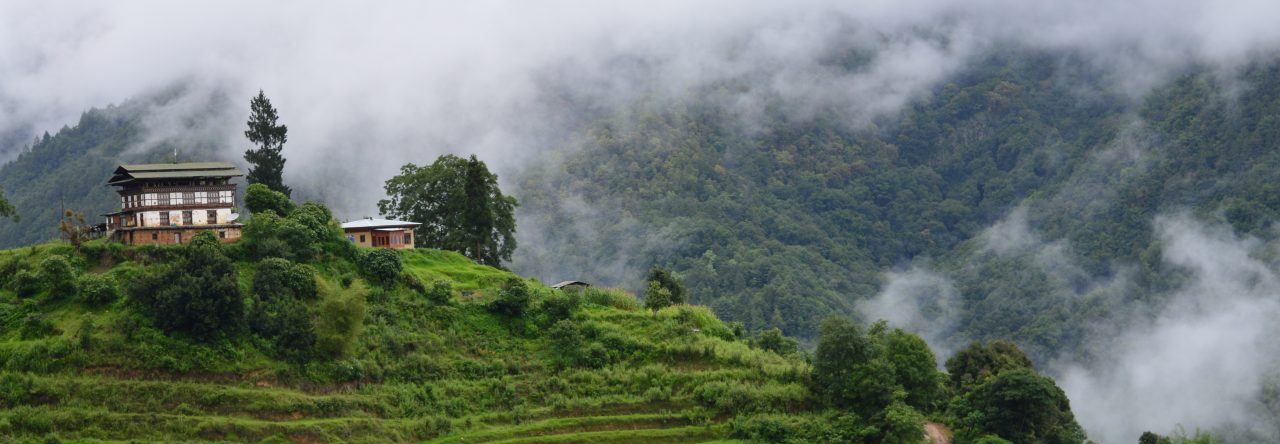
Trongsa Dzong, Bhutan 2016

As the commentary called the Unassailable Lion’s Roar states, this true nature of mind “does not depend upon productive causes and it does not depend on active conditions. It therefore does not depend on the gathering of these causes and conditions.” (133) Simply put, our true nature is not bound by the previous choices we’ve made, regardless of how terrible those choices were. We are not, in fact, the sum of our bad choices; we can be completely free from those decisions. Wow.

Practically, then, how do we find this kind of freedom? Where is the possibility of finding such a true nature? As it turns out, it requires us to seek beyond the choices we’ve made and the life we are leading. It means that we have to become aware; that awareness is based on a very fundamental concept – that what we know as the Self is just a construct of those choices we made. Once we realize that we are NOT that construct and that we are not bound to those negative thoughts and emotions, we can seek understanding by becoming aware of our true nature in the stillness of our minds; the calmer mind let’s that awareness arise…it’s pretty much always there anyway; all we really need to do it help remove the clouds or part the curtains for that awareness to rise.

OK, so how do I practice this method? For me it works very simply like this: find the gap between thoughts and focus on that gap. Every single thought rises and falls; between them there is a gap just before the next thought rises. At first, I used breathing as my support; finding the place where my breath switched from in to out or out to in. Now, I sit, walk, ride, or wash dishes or whatever and rest in taht place where I can be aware of my thoughts and the spaces in-between them. That is, in fact, the place I start.

May you be happy, May you be well.

Reflection on the Upanishads: Katha, Brihadaranyaka, and Chandogya

I started this process as a means of deepening my understanding of the fundamental concepts on which Buddhism is based. Going to source documents and ideas, I hoped, would help enrich and expand my understanding of the tenets of Buddhist thought, and, in particular, my understanding of Vajrayana Buddhism. What I found is this: that the foundations of Buddhist thought are deeply connected to the ideas in these Hindu texts and that they do, in fact, open my understanding of Buddhism and my Buddhist practice.

The feeling I had, going into reading the Upanishads, was one of loss and sadness. I dug deep into commentary on the Heart Sutra, an essential Buddhist text, and came away with a sense of emptiness (NOT the emptiness that leads to wisdom, but one that leads to nothingness). My practice wasn’t going anywhere, and I found my mind trapped in a dark place, formed by my own thinking mind. I needed some way through this place and that led me to reread the Upanishads and, in particular, to focus on the Katha Upanishad. That text, I hoped, would bring me out of the fog that surrounded and infused my mind.

The Katha Upanishad is an absolutely wonderful document for someone who enjoys the back and forth, give and take of academic conversation. The student Nachiketa and his teacher Yama, the King of Death, go back and forth in a conversation about the nature of death. Nachiketa is offered a variety of temptations to distract him from the path to knowledge and understanding. Take 1000 cows, gold, or music, Yama says, instead of learning about Death. Staying true to the path, Nachiketa denies the pleasures of life that he knows are fleeting, and demands and answer to his questions about Death.

Yama relents and finally explains to Nachiketa that self-realization is the key. Understanding that the Self is the non-dual understanding of all things. We are, Yama says, one with all things. Awakening to the Self is awakening to the understanding that there is no “us” and “them”; we are all timeless and one in this universe. Yama says,

“The all-knowing Self was never born

Nor will it die. Beyond cause and effect

This Self, eternal and immutable.” (78)

As I finished the text and the teaching, my mind’s fog began to relent, and I started to see through this strange mist I created for myself. Through various thoughts and emotions, I had taken myself into a place of depression and sadness. My reading of the Upanishads helped me slowly come out of this feeling and sensation, finding a place in which I can breathe again. With this renewed sense of spirit and interest, I moved into the Brihadaranyaka Upanishad to broaden my perspective.

Reading the Brihadaranyaka Upanishad (B.U.) has been a revelation for me. The text repeats, over and over, the process of renunciation. To not seek for external attainment and, instead, for focus on the “Self.” As I’ve written before, I’m thinking that this eternal Self is more akin to the Buddhist concept of Rigpa or “true nature” than with an identifiable Self. The Self is part and parcel of a unified, non-dualistic concept. The Self we have in us is the same as the Self in every one else. I was particularly struck by this statement,

“He who is dying merges in consciousness,

and thus consciousness accompanies him when he departs,

along with the impressions of all that he has done,

experienced, and known.” (113 – 114)

Now, in Buddhist thought the consciousness does not tag along into the next life as a kind of eternal, individual self. However, in later passages in the Upanishads, I get the sense that this “Self” is merely and expression of the Brahman, the unified whole that the Upanishads speak of. Buddhist thought, it seems, is an expression of that idea: the idea of a non-dualistic whole. Interestingly, most of the Buddhist thought I’ve read doesn’t dig too deeply into the source of that Rigpa or true nature. In future writing, I’ll explore that idea, Rigpa, as it relates to the whole idea of Brahman.

As I finished the B.U., I decided to follow this path into the Changdogya Upanishad (C.U.) and the origins of Self, the Universe, and the essence of all things. This text really helped illuminate the ideas I’d read in the previous Upanishad and drew me in with this wonderful story,

“Place salt in water and bring it here Tomorrow morning.” The boy did.

“Where is that salt?” his father asked.

“I do not see it.”

“Sip here. How does it taste?”

“Salty, Father.”

“And here? And there?”

“I taste salt everywhere.”

It is everywhere, though we see it not.

Just so, dear one, the Self is everywhere.

Within all things.

This story (136 – 137) from the passages entitled The Story of Shvetaketu is a glimpse into the idea of the non-dual Self. Here, the Self is a much broader concept than the one we often imagine in our lives. Here, it is beyond the boundaries of the body and mind, expanding beyond the nature of our daily existence.

This story in the C.U. reminds me of a similar story/phrase from my own practice. In Tibetan and English it goes like this,

“chu ma nyok na dang,

sem ma chö na de”

“Water, if you don’t stir it, will become clear;

the mind, left unaltered, will find its own natural peace”

The unaltered mind is representative of the Self, in some ways, as the C.U. says. The connection, while a rough one, helps me understand the origins of these ideas from Hindu thought into Buddhist texts. The differences are present and reading them both has helped me get through my own complex mind, the one that spins ideas out if control until I’m in a difficult place. These readings in the Upanishads have really helped open my mind, centering my practice and allowing for a welcome shift in the ways I see the world.

May you be happy, may you be well.