Buddhist practice, personal transformation, help for all sentient beings.
Author: tgentryfunk
Who am I? Waking up in the morning looking out the tent door seeing the beauty and grace of a frigid wilderness morning listening to the song of birds, the rustle of squirrels, and the feel of a day just beginning. That moment of peace and reflection and stillness is who I am.
Man #1 collects the dead during the plague, pulling a cart: “Bring out your dead!”
Man #2 offers a body for the cart: “Here’s one!”
Person #3 being offered to the cart: “I’m not dead!”
#1: “He says he’s not dead.”
#2: “Yes he is.”
#3: “No, I’m not. I’m getting better.”
One day, my dad is completely out of it..very little movement or communication. Then, SURPRISE, he’s communicating. This morning, Mom says, “Let’s bake some cookies today!” Dad says, “You can do it, I’m not.” I say to him, “You don’t want any cookies?” He says, bluntly, “NO.”
The brief banter over, I supply liquid morphine to ease his pain. We’re told about once an hour is OK. We’re only at once every four hours right now. A consistent cough is happening now, and he’s no longer comfortable laying in bed. He’s moving around, obviously in some distress. We talk to him, and he responds, “Don’t ask me anything.” He wants us to leave him alone. My Mom doubles down, reading from a magazine about cookie recipes. He doesn’t like it when she asks him “How does that one sound?” He groans.
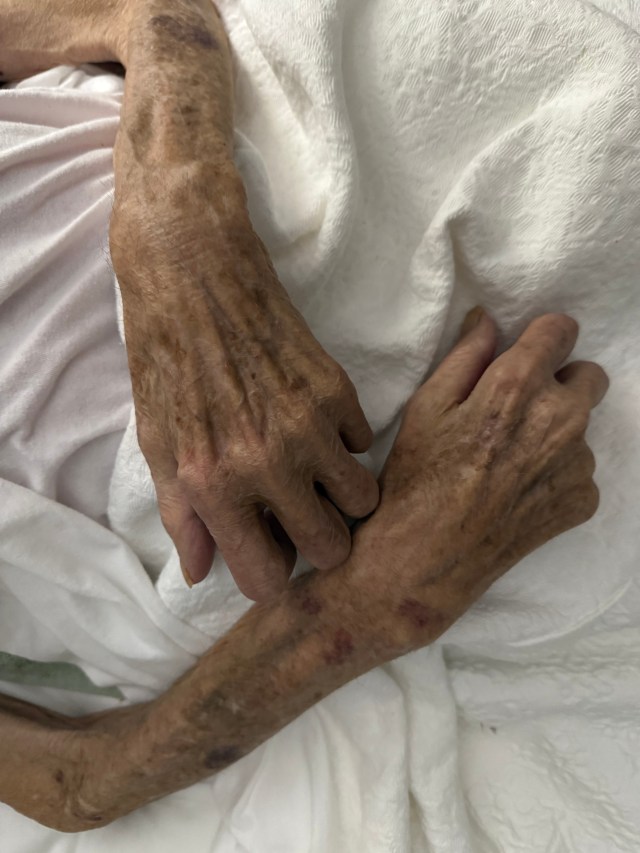
I rub cream on his legs. His skin is loose around his legs and I can barely feel a muscle. His femur is the dominant shape as he lays on his side. I can feel his bone just beneath the skin. “My leg hurts,” he says. As I put the cream on his skin, I notice that it looked completely normal, smooth, a single color, as if he was 30 years old. It’s a very strange, counterintuitive moment. How is he dying when his skin looks like this? It’s clear I don’t know much about the human body or this process. By contrast, his arms are covered in dark blue and deep red blotches, the skin stretched thin, almost translucent on his hands and arms.
After that initial flurry of activity and energy, we sit in the bedroom and notice he’s out, sleeping again. His breathing a bit more ragged, a bit more forced. You can see his rest is fitful, and he’s more uncomfortable in bed. Still, he rests.
Blotches on hands and arms. Shallow breathing. No eating and drinking very little. Gradually slipping away. Sleeping almost constantly.
Today, my dad’s brother came over. He’s one of the funniest human beings you could ever meet; that this guy is not a stand-up comedian is shocking. At the same time, he’s been through a lot. When he came into the room with Dad, my father was more animated than he had been in days. No real smiles or words, just a little more movement in his face and hands. I left them together and worked on the other things going on…mopping floors and cleaning the house.
Dad’s brother got up to leave and asked me when we thought his brother would recover. Had we been to the doctor? Could we give him some kind of medicine? It was hard to know exactly what to say or how to help him understand the situation. I tried the subtle approach: “You know he’s on his own journey now, and I’m not sure things are going to change.” He replied, “Yea, but I mean let’s make him eat some food! Let’s make him a protein shake.” I paused. “You know, my Dad’s dying. He’s going to be gone in just a few days.” He stared at me for what seemed like an eternity. Tears welled in his eyes. A moment of shared understanding. “Ok well, I’d better get home. I’ll come back over this weekend.”
Standing there in the driveway as he pulled out, I thought about the number of people I had told this information. My dad’s friends, former coworkers, former boss. All were dumbfounded, all at a loss. How?, they’d say. When did this happen, they’d ask. I haven’t come up with a pat answer yet. Most of these people I didn’t know well, and I’ve been a little unsure on how to break this news.
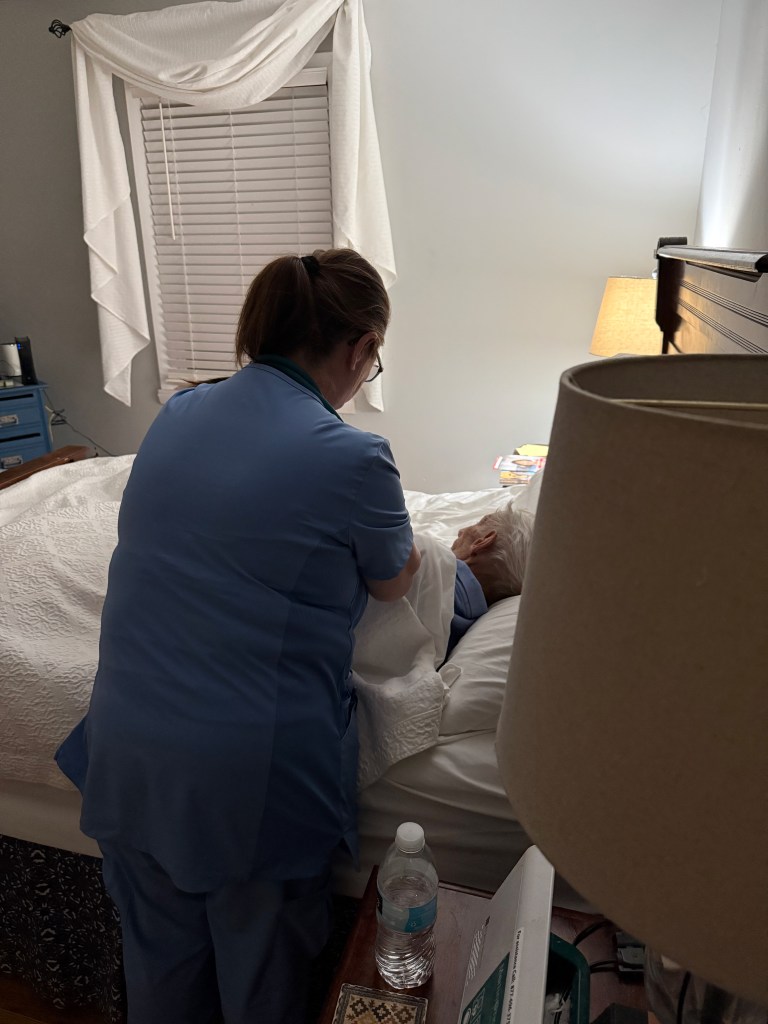
As I shuffled back inside, it was time to wash his body, shave his face, comb his hair, and just clean him up a little bit. To say that this process was comical just doesn’t do it justice. First, he was pissed I lifted him out of the bed. He growled “nah, nah.” I spoke to him in a kind of silly voice, “it’s time for a tubby!” “I don’t want no tubbbbyyy.” I sat him in the chair, and he demanded Mom do this part of the process. After it was done, Mom said, “Don’t you feel better?” and in the LOUDEST statement he’s made yet, he said, “NO!” Then I started shaving him; he didn’t like it, and grumbled. We finished it up, got him back in the bed, and I asked, “Now, that’s better isn’t it?” He looked me straight in the eyes and said, “No.” I couldn’t help but laugh, and my Mom called him Bozo for being so ridiculous. I swear to you, he looked up and gave me a kind of sneaky grin.
He quickly fell asleep. I sat for a while. He no longer wants the TV on in the room. The noise is too loud, the sound too grating. The house is quiet. His breathing is still rhythmic. At the same time, something has changed. It’s subtle, and I feel it more than I see it. The waiting and watching, of course, continues. I’m thankful I’m here, grateful for this moment. In the kitchen, the hum of the refrigerator is the loudest thing I hear.
It’s two hours later in Georgia, and I find myself awake deep into the night here in this southern town. My father’s condition hasn’t really changed at all since I arrived. I sit with him, watching his breathing as he rests, eyes open, unresponsive. After a while, he moves, looks over at me, and a flash of recognition happens. I ask him if he’ll drink some water…sometimes no, sometimes yes. When he takes a few sips, I physically sit him up. The bones on his back protrude sharply into my hand and arm as I raise him to sit. I hold him there, and he tries to grasp the cup, shaking, slightly. A few drips of water cross his lips, and he’s done. I lay him back and set the cup down as I do. In this clear plastic cup, maybe he consumed an ounce. Maybe.
As far as the rest of the day is concerned, it’s all about logistics and finances. My parents have limited funds, and every expense is a question. One by one, my mother and I check off the things she’s done: paid this bill, made this decision, planned that appointment. It is an endless series of choices to be made and considered. In one surprising turn of events, a friend of my father’s has offered to cover the expenses of transporting him from home to a funeral home for cremation. I had no idea how expensive such a simple task could be. His gift of transportation makes our lives so much easier in one of the most impactful ways.
The other challenge is my mother’s mental health. She moves in and out of inconsolable grief. One minute, we’re talking about the Georgia Bulldogs and the upcoming football season, and then we’re talking about death and dying. She still hasn’t fully grasped the end, and talks about plans with my dad in the future. Gently, I offer that she stay here, in the present, and focus on what we need to do next. It’s an hourly struggle to maintain constant focus and attention. Combined with the problems she has with technology (my iPad’s not working!) and the phone ringing off the hook, trying to swipe to open the iPhone, it’s a hilarious and complicated dance.
Then there’s all the work I do, fitting it into the mix, classes, grading, communicating, uploading video presentations, and instructions to students. Truthfully, being in the daily class mode has kept me sane. It’s a welcome distraction.
Now, as I finish up this post and settle into a meditation on death and dying, I’m brought back to moments from childhood and my father’s involvement in my life. Reflecting on those moments is both wonderful and sad. It’s easy to get caught up in positive experiences, and, in fact, things were often not so great. Struggling to pay rent and concerns about food on the table, those moments also come back to me. The stress of parents working six and seven days a week, my sisters and I at home with a sitter or on our own. It’s all a strange mix of emotions. In moments of clarity, I find myself drawn to a fundamental understanding that all that has passed is past. All I need to be is in the here and now, focused on this moment.
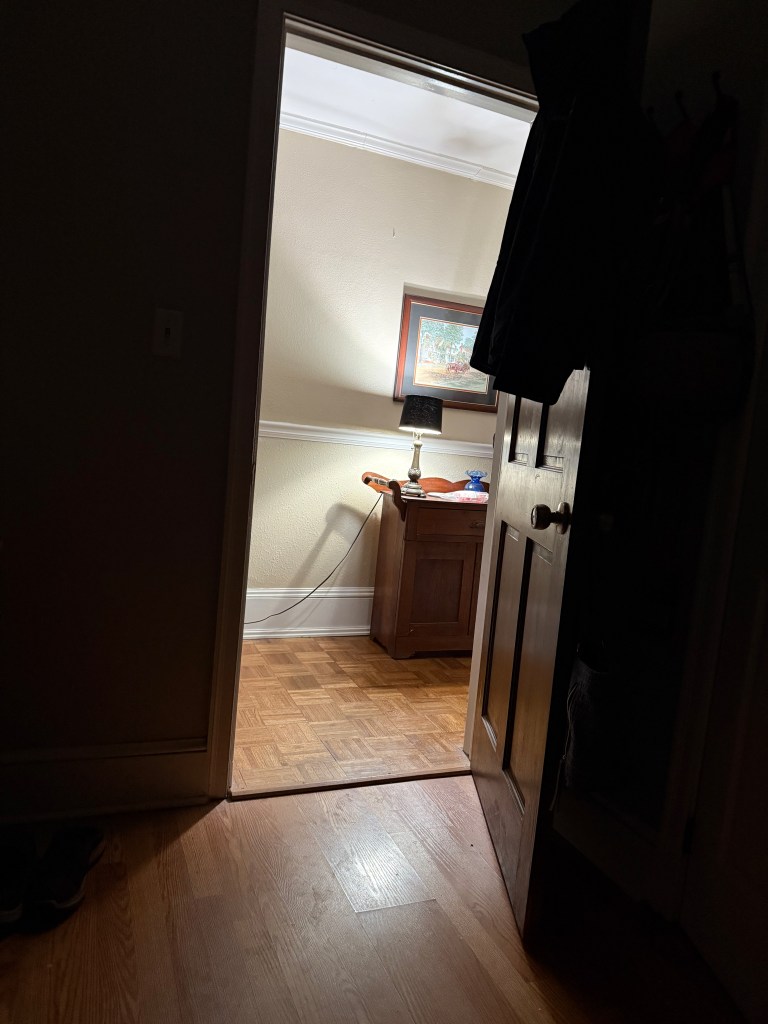
The bedroom is warm, hot even, as I walk through the hallway and into the sauna-like space. Laying quietly on white sheets with a white coverlet is my father, resting peacefully in the late afternoon of a Georgia winter. I grab his hand and gently lift it as he turns to me in a kind of half-awareness. “Oh! You came home!” he says, and it’s all I can do to hold it together. I smile and say of course I did, and after a beat, he says, “Now you can make me get better.” I continue to hold his hand, almost delicate in its frailty, covered in blotches of blue and red. His fingers barely squeeze my hand, and I sit with him for a few minutes. He slowly turns his head. His mouth falls open, and he’s resting again, respiration normal with a hint of a rattling sound deep in his chest. I lay his hand on his chest and turn to consider other obligations.
My mother is glad I’m home and has already planned for us to head to Kroger to get food for the week. She’s anticipated my cooking ever since I said I was coming home, and she’s ready for me to get started. I’m tired, tired in my bones, after a frantic series of flights and car rides to make it to Athens. Still, we go to the store, and I pick out the ingredients for a series of meals we’ll have this week. Chicken and rice, tofu and vegetables, salmon, flour for pizza dough, shredded cheese, and the like. Mom must make two quiches for church tomorrow and we grab the ingredients along with pie crusts, and eggs.
When we return home, my sisters are there in various states of concern and personal struggle. My middle sister is concerned that my dad won’t drink or eat anything. Hilliary, my youngest sister, a P.A., launches into the various needs Dad will face in the coming days. We talk about it all: the many arrangements, financial concerns, and a service. Dad communicated a few days before that he didn’t want ANYONE at his funeral; in fact, he just wanted us to have dinner together at home. As usual, Mom overruled THAT request, and we plan an abbreviated service as I will do the eulogy with contributions from everyone. I’m caught by the mundane nature of planning for the passing of an individual. The logistics feel wrong in the face of the death of a parent. It seems like it should be more, somehow. Of course, and truthfully, it isn’t more. Maybe it needs to be less.
Mom starts the quiches as we talk, and my sister sits with Dad. My youngest sister and I talk about medical issues, and her husband is visibly uncomfortable with our matter-of-fact conversation. He squirms in the chair, looking away, not making eye contact with me or my sister. With side glances, I can see a kind of horror in his face, a deep abiding fear. I completely understand it, and at this moment, there’s not a lot of space for questions of our own mortality. I smile at him and try to include him in the conversation, only for him to stand and slowly walk out of the kitchen.
As the night winds down, we all say goodnight to our dad after giving him his pain meds. He thanks us, kind of formally, for being there, and we file out of the room. My Mom gets ready for bed, it’s 10:30PM here, and we settle into the new routine of waiting and watching.
The lights on the stone shimmered as rain fell on the Kaminarimon Gate and Senso-ji Temple, wind blowing through the city canyons as I shivered against the gale. It was early in the evening, maybe 9:00 PM, and I kept trying to grab a shot.
Kaminarimon Gate, tightly cropped and shifted
My camera fought me as the rain splashed drops of water on the lens making focusing hard in the dim, wet light. I tried again, holding the camera in front of me to capture the feel of the night: windy, cold, wet. I couldn’t focus on the scene and the shot looked stupid. I pulled out my phone and tried to grab a shot more quickly. The wind pushed me slightly sideways, and I had to take a small step with my left foot, my shoe plunging into a puddle, the water soaking my pant leg. I groaned and tried to steady against the pressure coming from the Sumida River not more than 500 feet from where I stood. I shuffled, took a picture, turned slightly, and took another. These were grab shots, off-kilter moments of photography that had become too common on these first days in Japan.
Headed to Senso-Ji
Rain-soaked Asakusa
As I grabbed another, I wondered at my luck – or lack of it. I’d planned a solo trip to Japan, a trip I’d wanted to do for so long and here I was failing at photography at every turn. My shots were pedantic, frozen, and lacked any kind of sense of place or reality. Since I had arrived just a couple of days ago, it all felt silly; nothing was working out and I wondered why I was even here. What WAS I doing? Tears came to my eyes as I felt a wave of deep, dark sadness. I questioned everything in my life up to this moment and it all felt so pointless.
Waves of sadness splashed over me as the wind whipped around and through me. The worst part, the very worst part in this moment, was my failure at photography. I’ve been taking shots since I was a small child, introduced to photography by my uncle Henry. My first camera, a Kodak 110, I used all the time. I took photos of the dumbest things and Henry insisted that I use only Ektachrome or Kodachrome for my shots. I still have piles of tiny slides from the days I used that plastic Kodak.
Thoughts about Henry and photography flooded my mind, and I was transported to a conversation we had about using his Nikkormat camera. Henry was particular about how I used the camera and was worried I didn’t have the understanding or skill to make it work. We talked about it and I brought the camera to my eye. It was heavy and holding it up was a chore. We were at an old lumber mill that was collapsing near the Oconee river in Georgia and I was trying to capture the strange patterns of wood in various states of decay all around me. Because I had trouble holding the camera, the shots that emerged were slightly blurry. I only got one good shot out of the six or so he let me shoot. The rest of my photos were from the 110 and we walked around the area, the smell of rotting wood strong in the moist Georgia air.
I gave into the rain there on Kaminarimon-Dori and started to walk to Ichiban Ramen just around the corner. This famous ramen shop was downstairs off the sidewalk, a tiny spot popular with tourists and locals alike. I held the handrail as I walked into the bowels of the building. Water was running down the stairs from the outside as no door was closed to the inclement weather. I made it to the landing as a short line of people gathered to purchase their ramen from the machine in front of me. The machine took Yen and I inserted the bills into the machine and chose my selections – spicy, thick noodles, no pork, and extra onions. I shuffled forward filled out a form confirming my choices and was directed toward a seat – only one available in the tiny, crowded space. I sat, my bulk occupying more space than two people in this restaurant. Most folks were half my size and the spaces were small….the seats were much smaller than ones in the U.S. and sitting here was more like perching on a wooden stool rather than seated in a comfortable wooden chair. So, I squirmed a bit as I waited the four minutes for the food. The noise was a constant drum of sound with an occasional tight laugh. Everyone in the room on this night was Japanese and the tones and sounds were muffled. It was a relief to be in the space and among people who were generally quiet and contemplative. I looked around and rose to get some water from a container. Squeezing through the space between the tables and chairs required me to move sideways, a practice I was comfortable with. I made my way, got two glasses, and returned to my table. Once I sat down, the ramen bowl was brought to me and I offered my thanks “onegaishimasu” and then a more quiet, “Iradashimasu” in gratitude of the hot food on this cold night. It’s not common for folks to linger in restaurants in Japan and so I ate efficiently. Not quite cramming the food but eating. It reminded me of reading Zen Mind, Beginners Mind years before with the statement, “When you are eating, eat.” So I ate. The warmth of the ramen and the chewy noodles comforted me and I left behind my sadness for a moment and reveled in the fact that I was sitting in the restaurant, a place I visited not more than nine months before, enjoying the moment in Japan. A sense of well-being settled over me and I sat, for just a minute, in the awareness that I was so lucky to be here now.
I didn’t want to leave this space but the tiny seat and the constant flow of people into the restaurant made me move my things…camera, umbrella, rain jacket. I rose, slowly, and donned the jacket as a few water drops fell to the ground around me. I steeled myself for the upcoming storm outside and made my way up the stairs, a slippery mess from the water on the slick, maroon linoleum. I stepped under a roof that sheltered me from the deluge and I walked a few feet to the crosswalk. The streets were relatively quiet and I walked across the street as the light shone giving me a series of dots marking the time to make it to the other side. Wind whipped between the buildings in my face and I turned a corner toward the Sumida and across the Azumabashi bridge over the river. As soon as I got ½ way across the bridge, the wind was brutal. My umbrella was no use, and I pulled my hood down around my face and pushed across. I was staying in Taito City in a small hotel called Rakuten STAY. It’s off the beaten path and as a result the cost is reasonable. I walked past the Asahi Brewing Company headquarters. A few people passed me headed home after work. I found my way between buildings and to the Hotel. The rain had subsided a bit and I made it into the lobby with iPads that summoned employees via video. I headed up to 606 on the top floor and got ready for a blast of wind that I was prepared for this time. The doors of the hotel rooms faced outside, and rain and wind pounded the walkway. As the elevator doors opened, the wind hit me and I walked quickly to the room, pressed the code on the door, and entered the room. As the door closed, the quiet of the room was noticeable and I grabbed the remote for the heater and punched 74. Within minutes the room was warm.
Inside the doorway I removed my shoes and placed them in a small closet with my jacket and umbrella. The sound of the storm, a distant hum outside my room. As I took a single step into the space, I noticed why I chose this space: cartoon pandas painted on the walls next to my bed. The space made me feel light, less heavy, less taking myself so damned seriously. I sat on the bed and took off my pants and shirt (wearing layers against the wind) and headed into the tub/shower for a quick, warm douse of water. I dried off and dressed for bed even though it was only about 10PM. I snapped on the TV and watched Japanese Variety shows in their grand silliness.
As the sound of the Japanese jokes spilled over me, my mind went to work, trying to make sense of the day, the trip, my life, and just about everything else I could cram into my head in this tiny room. I quickly settled down the mess by breathing deeply a few times and relaxing into a meditative state that came easily. I lay there (no real space to sit comfortably on the floor) and let the thoughts rise as they would. The sadness quickly took over and I wondered at my choices. My self-criticism was strong, and I was so frustrated by my photography. Judgment raged for a moment in my head, and I told myself to slow the fuck down….to relax into moments rather than seeking them out. The photos would come to me…gradually. The thought dissipated and another arose: what am I doing here? What is my purpose? Before I decided on this trip last year, I made myself a promise: I was not going to go to Tokyo with a purpose. Aside from taking photos, I did not want to DO anything…I planned to wander through the city hitting parks and streets, letting photographs come to me, and deliberately not being any more purposeful than that. No touring, just seeing.
I lay there in my mental struggle, those thoughts came back to me, and I let these feelings wash over me…it was OK to not have a single image to share or hold. It was OK to just be in these moments in this massive city.
My mind cleared, my thoughts collapsed, and I was in a meditative state. The energy of the mental struggle exhausted me and I slowly dozed off to sleep, turning off the TV as I lay on a buckwheat shell pillow, the crunch a kind of murmur in my ear.
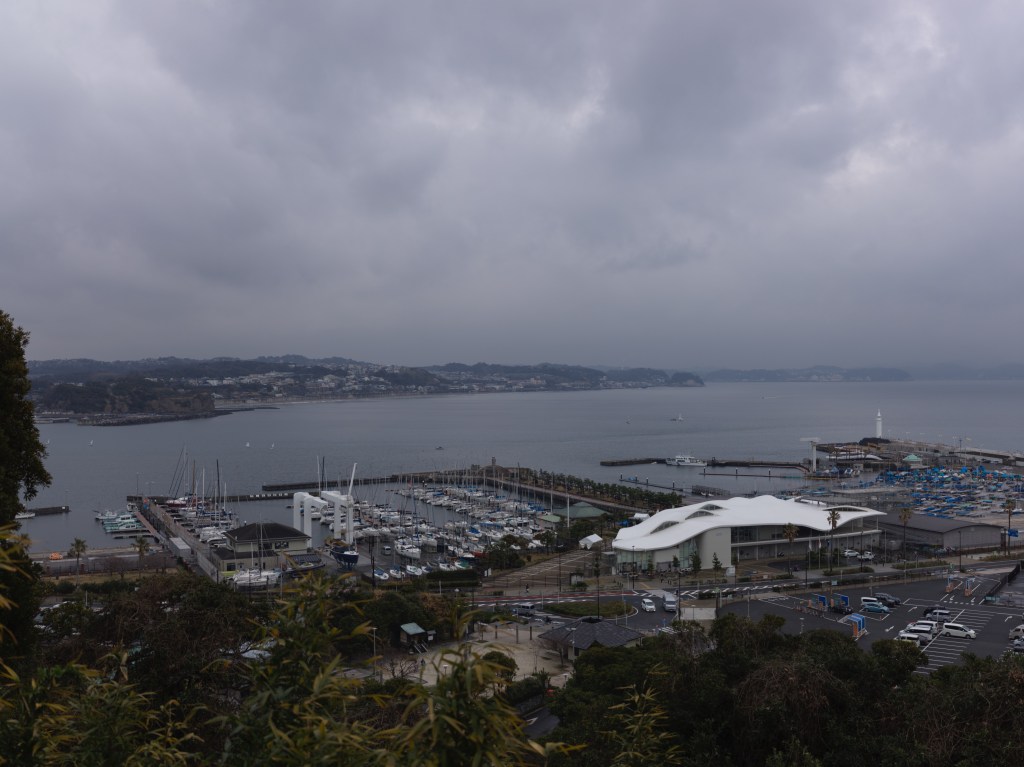
I took another step and the light rain increased intensity once more. While the stairs felt stable and I had a decent grip on the concrete structure, I felt frustrated and a little lost as the stairs winded around Enoshima Island. I looked out at the marina, the dark clouds hanging over the coastline and wondered if this was the day I get drenched by a soaking rain. One more step up. Two. Three. Wait, am I counting steps now? The breeze blew into my face and rain came at me sideways. I had no idea how close I was to the top of the mountain and the stairs, right now, felt interminable.
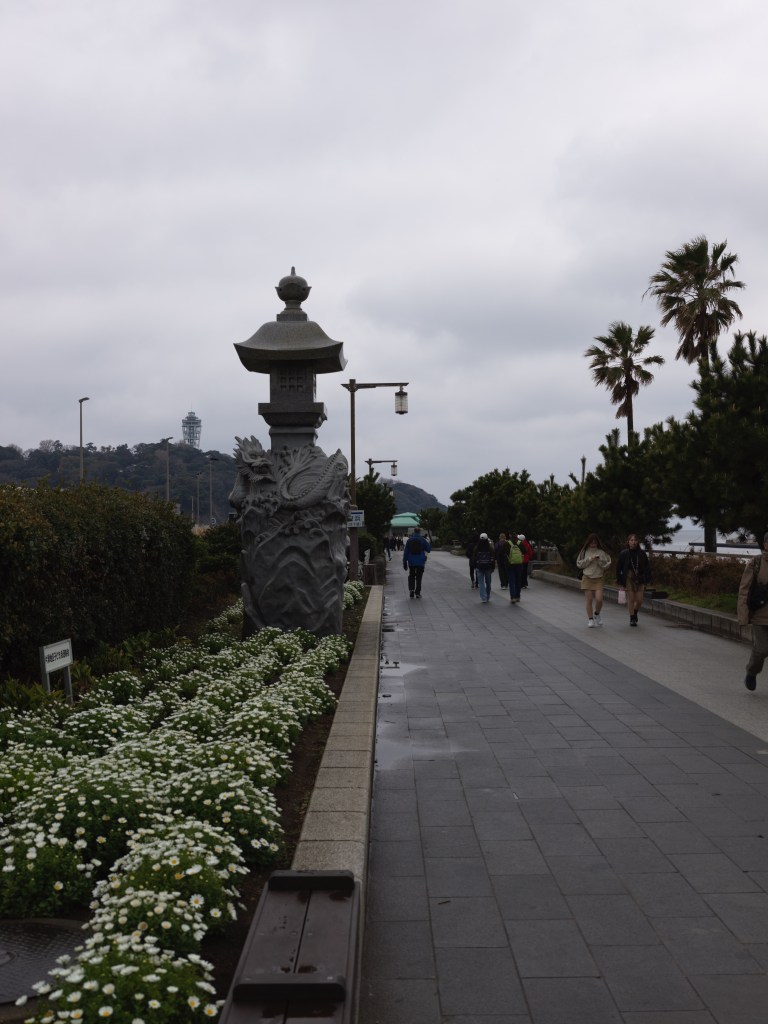
Enoshima Island is a place linked to the mainland by a long footbridge. The cliffs of the island rise right out of the sea, and you don’t see any surrounding beaches or flat land around the island. As you walk across the bridge toward this expanse, below are dark, wet sands punctuating the remaining land as you walk across the bay in front of you. Looking back on the town of Enoshima, high-rise hotels beckon guests onto those dark beaches in sunnier, brighter times. On this day, no one is on the beach and the rain falls all around.
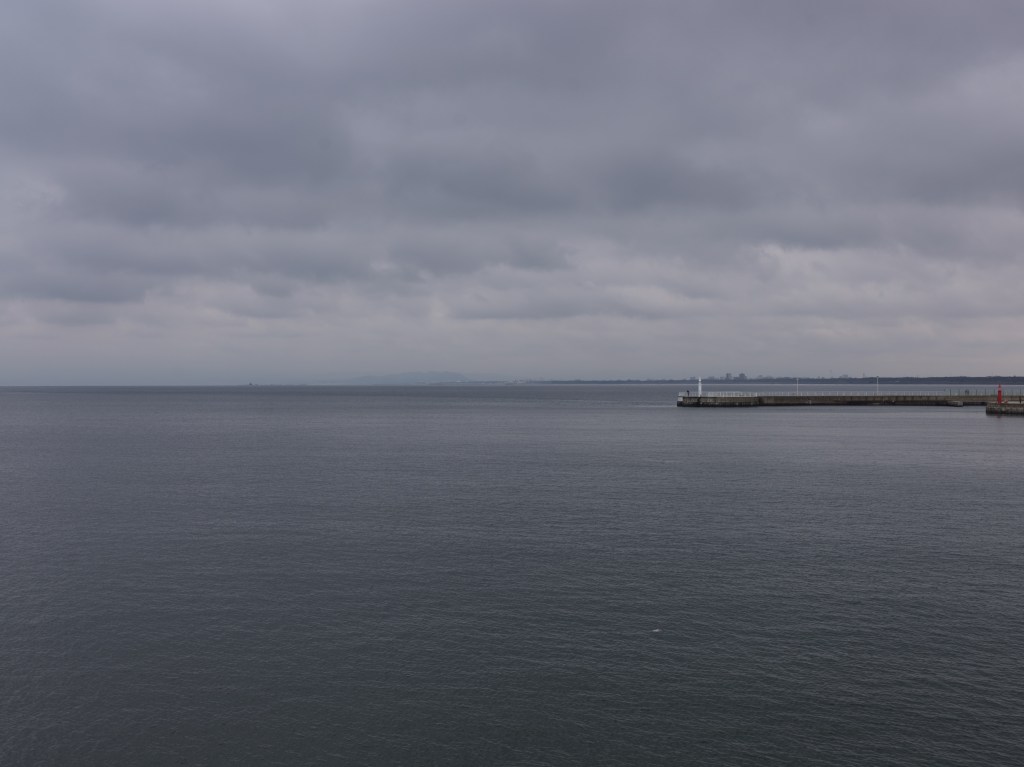
About halfway across the bridge, I look out over the water to try to peer through the dense cloud cover at Mt. Fuji. Sadly, the view is hidden from me, and I’m lost in a wet haze that surrounds me and the island. I keep walking in the hopes of finding something interesting and unusual on this day. Will Enoshima bring me some kind of luck?
The darkness shadowing Enoshima
While I walked across the bridge with a few fellow travelers, once on the island, the crowds were dense in the little street that headed straight into the trees that covered the hillside. I pushed past the tourist shops and small food stands to make my way through the torii gates on onto a flat, level spot where stairs climb to the right and left. The rain is constant now, and my little umbrella forces me to walk more deliberately to keep most of the rain off my body. See, I’m a tall guy, 6’3” on a good day, of a size that creates problems for the tiny umbrella that I hold in my right hand. As I turn to the left and begin walking up the stairs, I already have ten miles on my feet and am now wondering about my choices for this day.
Mt. Fuji is right over there! Trust me!
My days in Tokyo have been wonderful in their way and I’ve had to push aside some of my more grandiose plans to do street photography in the city. The rain, wind, and cold have kept me cowering under an umbrella, and trying to capture scenes while avoiding rain has been a chore. Still, I persevered and decided to head to Kamakura and Enoshima as a way of shouting at the sky, “I’m walking through any maelstrom you throw at me!”
So, I take steps up the north side of the island and quickly see that these steep steps will be my companion for a while as I make my way to the top. I pass an escalator (WHAT?!) that propels tourists in three sections of fast-moving stairs. I stop and think about the idea…should I take an easy path? Nah, I say confidently, not realizing my mistake until far too late in the walk/hike/struggle.
Overlooking the marina
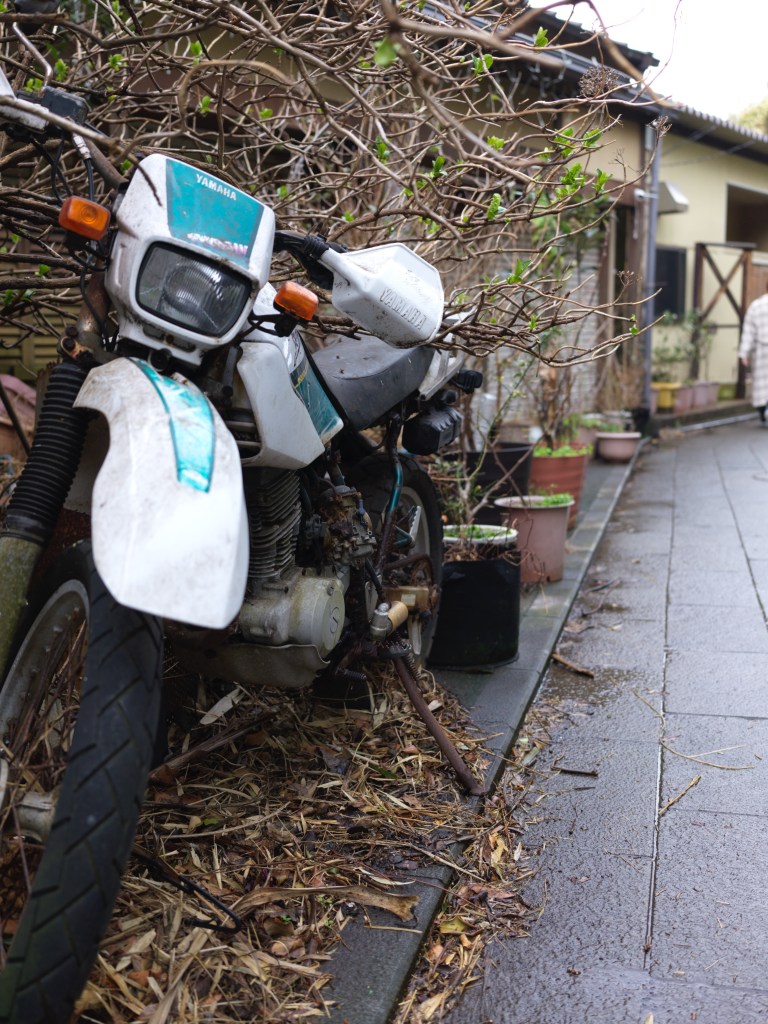
As I make my way, a fence on my left has locks hung in places. These kinds of tokens make me wonder at the meaning, thinking back on stories about locks on bridges like in Paris over the Siene. I’ve never been to Paris. Never seen the locks or the bridges. Here, locks are linked to a metal fence overlooking a marina. Right now, however, these views are covered in clouds, and I begrudgingly continue up. The thing is, I live at more than 5,000 feet elevation in the U.S., and walking at sea level has given me a bit more energy as I climb. Still, the stairs are steep in places, and I’m walking through the rain sometimes wondering if I’ll slip and fall. The stairs wind up and up and up. I’m reminded of Fushimi Inari and the walk through the forest up the mountain. This hike, while similar in some ways, is not the same. This climb leads up toward a shrine and caves, and nothing quite as spectacular as the red torii scattered along a hillside. On this path at Enoshima are small souvenir shops, restaurants, and vending machines. If you look carefully, you’ll find abandoned food stalls, motorcycles covered in vines, and the remains of shop signs.
As I walk, my enthusiasm wanes and the rain is a melancholy companion on this journey. I lost track of time and the cloud cover slowly inched closer as I climbed higher. The weight of the clouds or the constancy of the rain finally pushed me to frustration, and I wondered if any of what I was doing at that moment was worth it. As my mileage ticked closer to 12, I entertained turning around and heading back down the mountain. At the time, I THOUGHT that the path would slowly wind its way back to the beginning in a loop and so I kept plodding forward.
On and on I went, stopping occasionally for a brief view or to get another green tea out of the ubiquitous vending machines. As I came to the caves perched near the top of the island, they were closed and so I continued as the stairs finally descended toward the south side of the island. The stairs got steeper and steeper, heading down until I turned a corner, and I met their end in rocks just at the edge of the water. I looked at people taking pictures in the gloom of the day and searched around for a path to the other side of the mountain. It did not exist. I turned around. I looked up at the stairs I had just come down. WTF.
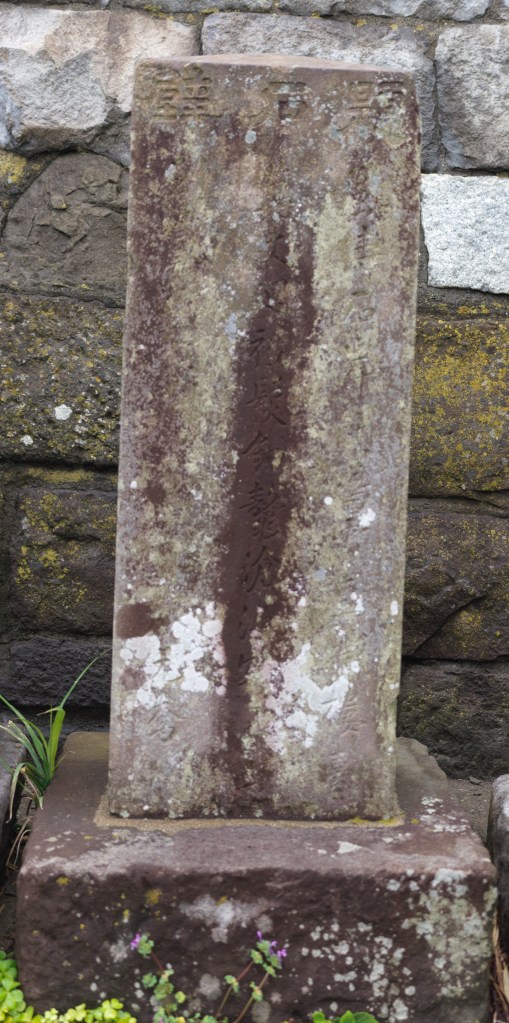
As I glanced around me, I saw five stone markers…a sign placed in front of them told a brief story. One of these stones was inscribed with a haiku by Matsuo Basho who had visited here 500 years before. Wow. Here he was again just like he was at Ueno Park a day before. The carving was obscured by moss and lichen. I stayed for a minute and the rain fell. It was a moment. Wet, and sweaty under my jacket, I stared at the stone, squinting my eyes to try and make out the characters carved into the granite. I couldn’t see a thing. This moment in time, like this day, was obscured, its meaning lost, and the effort expended seemed pointless. All of it felt pointless.
Without a doubt / flowerlike sea spray is / the spring of the bay (Matsuo Basho)
I turned and sighed, slowly forcing my tired legs to climb the stairs again. Up I went. An elderly woman walked past me, smiled, and continued. I pushed my weary body forward and soon caught up and passed her. She smiled again and I made it to the top feeling defeated. I stopped to check out the Enoshima “Candle” a tower on top of the mountain that, in clear weather, would give you quite a view of Mt. Fuji. Not today, of course. I grabbed another green tea, and just wandered around, a bit. I felt lost internally and externally. Where was I going, literally, and where was I going, metaphysically? I concluded: F-ing nowhere.
I tried to make the best of it all and started the long walk back to the bridge. I picked my way downstairs as rain spilled from step to step. I didn’t need to worry. The steps were solid, and the surface had plenty of friction. I returned to the locks on the fence and then to the flat concrete where I started my journey. I walked through the still dense crowds of people and came to notice that I was the only non-Asian person in the mass of folks. I noticed this situation earlier when I was seeing the people on rocks at the edge of the ocean on the north side, and now I was struck by how outlandish I must look. A giant of a human walking through groups of people speaking Korean, Japanese, Vietnamese, Mandarin, and a couple of languages I couldn’t make out. I suddenly felt so alone.
Walking back through Enoshima markets headed to the monorail and, eventually, Asakusa
Here I was in this crush of humanity feeling desperately isolated. I stopped on the way down, interrupting the crowd, and took a few quick photos of the scene. I could tangibly feel the loneliness of being one out of many. It’s a fascinating feeling. I noticed this circumstance back in Asakusa that same day. On the monorail from Enoshima to the main JR train line to Shinagawa, I was the only white person in the car. I noticed the gentle stares. As I made it into the chaos of Shinagawa and all the construction, the white folks I saw there had luggage boarding a train to Narita and to their homes.
Basho, covered in lichen and moss
On the train to Asakusa on the Ginza line, again I was among Japanese folks coming home from work or elsewhere. My thoughts collided as I tried to make sense of the day in Enoshima. What had I experienced? What had happened? I was lost in thought when the train pulled into Asakusa station, a station a bit more derelict than others in Tokyo. I had become very familiar with the place and chose my exit strategically to get me close to food. It was about 8:30 PM. When I exited the station fierce wind hit me and I made my way across the bridge over the Sumida into Taito City and toward a small pub below the Asahi building. The black glass and golden steam represented on the top were comforting as I plopped my body down onto a seat at the bar. I ordered octopus in a basil sauce, and a new dark beer, and just pondered it all. Enoshima. Stairs. Rain. Basho. My journey, today at least, was done.
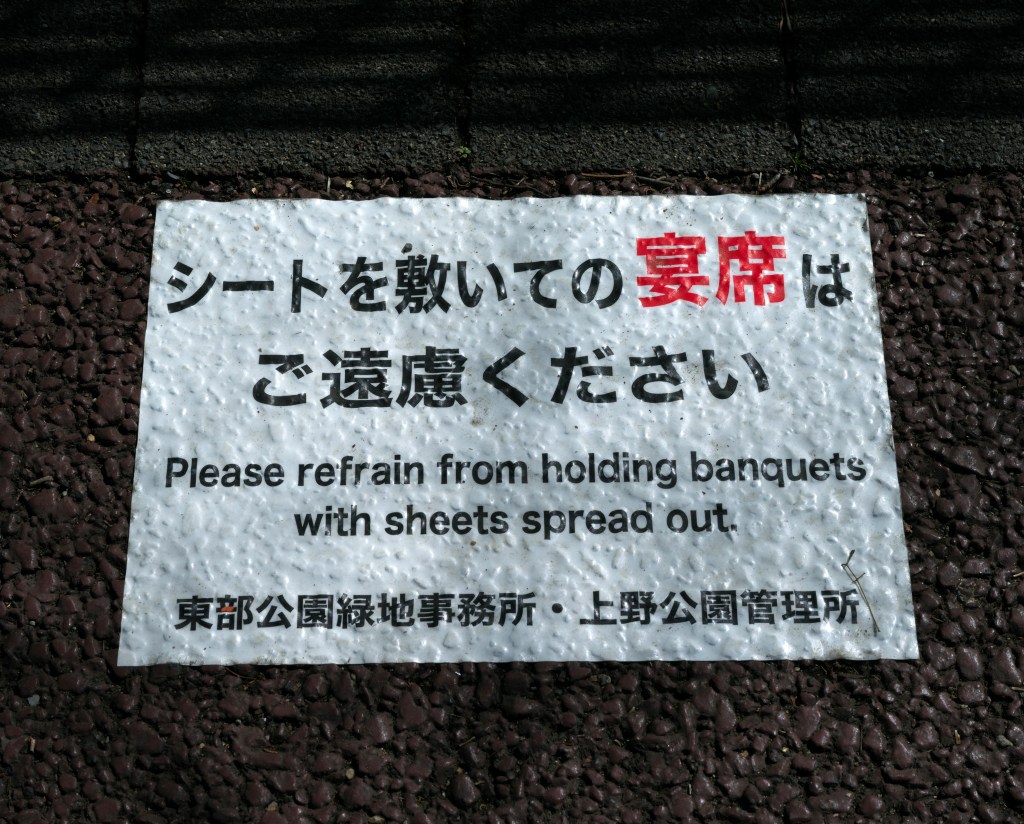
As I walked through Ueno park, I couldn’t help but recall Basho’s journey through this same area, five hundred years before. The cherry blossoms were about a week from blooming and families spread tarps and blankets on the ground in anticipation of the event. Games of Go and drinking happened alongside laughter, and some bold, angry interjections that eventually spilled into laughter and tears. A young woman looked on both horrified and smiling as two men embraced in tears after a moment of fierce reaction.
Clouds of cherry blossoms! / Is that temple bell in Ueno/ or Asakusa? (Matsuo Basho)
The day was cloudy and a light rain sprinkled along the concrete pathways. As I passed the empty baseball field, children ran past me laughing hysterically and their mother demanding for some compliance. They ignored her calls and ran fearlessly into a huge crowd. Soon, they came back around with Mom exasperated at the brief trauma.
At times I raised my camera for a shot and then walked slowly through the stream of onlookers and people seeking their own bit of solace in the trees of the park. I was almost brought to tears seeing so many emotions on display, and especially feeling the laughter of adults and children, not so far separated in their common state of joy.
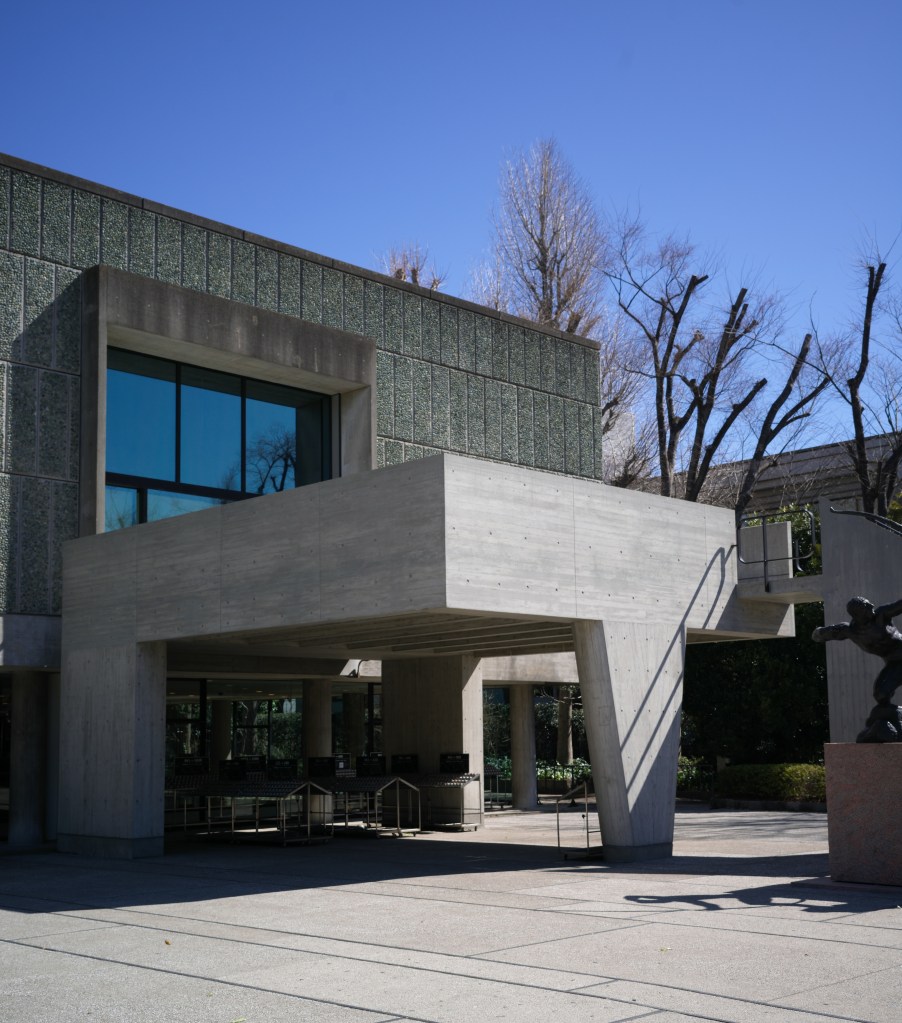
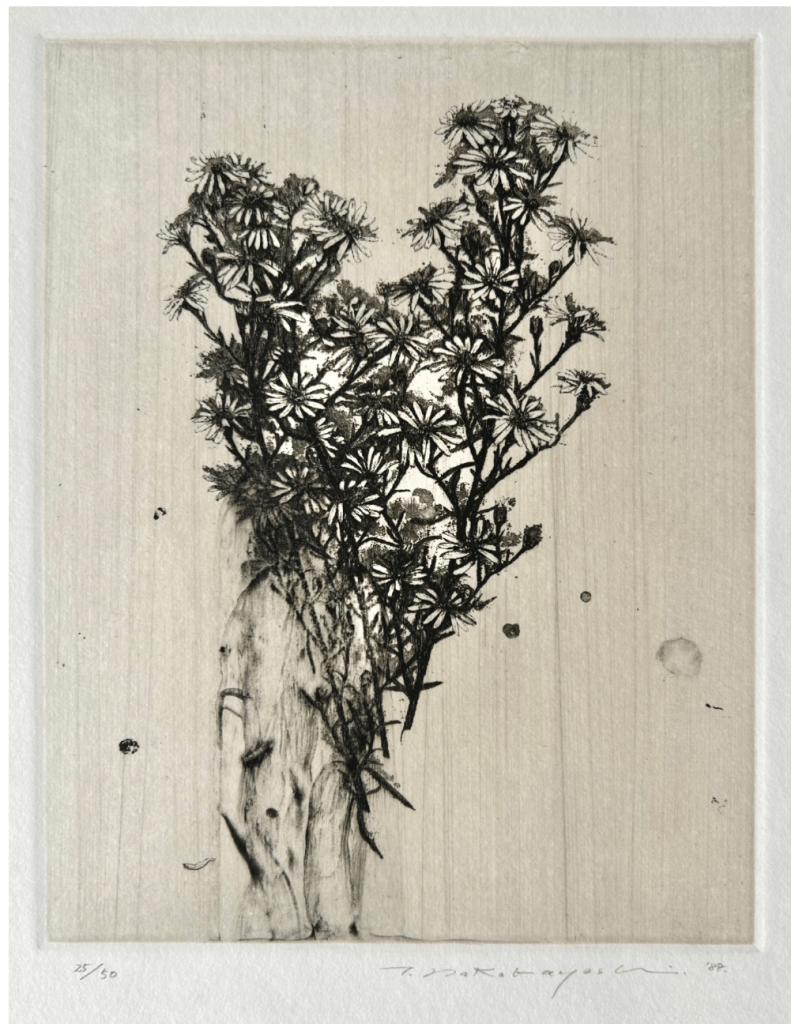
I was drawn into a museum, pulled by something beyond this mundane experience. I walked to the kiosk and purchased a ticket for a special exhibition called Does The Future Sleep Here? The silence of the museum invited contemplation and a brief jaunt down the stairs into the exhibition immediately swept me up in a moment of quiet reflection as I was struck by the intaglio prints of Nakabayashi Tadayoshi. The effect of these images was melancholy and I felt drawn into the artwork. The series shows a detailed image of flowers wrapped in a ribbon and progressively ending in a final panel of an ink blot on paper. The disappearance of the image into ink on paper represented to me the dissolution of ego and expectation.
Does the future sleep here?
I struggled with a load of expectations about traveling to Japan even though I promised myself I would absolutely NOT grasp onto the experience. And yet here I was trampled by my own mind and wandering through an exhibition a bit unmoored as I wasn’t sure exactly what I was doing here. To say I was led into the exhibition might feel a bit ridiculous from my rational, thinking mind, and the fact that I ended up HERE rather than THERE spoke to me.
A representation of Nakabayashi’s work
As I reflected on this one choice, this one moment in time, it’s was easy to dismiss the choice as a simple binary; yes or no, zero or one; forward or backward. The pull away from the spiritual to the rational is strong in all of us and I too wrestle with these ideas. My Buddhist training tells me to question; to see but not label; to hear but not question. As soon as we place a label or feeling on a anything that comes through sense, our mind begins the process of dualism; separating what we see and hear, etc into discreet ideas and images. In that moment, we are grasping and our mind gets carried away into a whole series of thoughts, feelings, and emotions built around something that is just an object. An object, any object, has no inherent meaning unless we apply some meaning to it. Here I was, at the beginning of an art exhibition, creating a whole story about why I entered the building what I was seeing, and how what I was seeing related directly to me. I immediately put ME at the center of the exhibition. It was, in essence, about ME.
Of course, my critical mind kicked in and I realized that while the exhibition wasn’t about me, it spoke to me. Yeah, I get it. There really is no ME in this scenario and I’m forming ideas based on experiences and thoughts collected over a lifetime. These collected notions I assembled into a form of meaning as I walked into the exhibition and formed into a coherent narrative of something along the lines of “I’m experiencing an exhibition that is speaking to me and that helps me understand where I am spiritually, thoughtfully, and emotionally.” Almost immediately the narrative emerged in my mind in moments after walking into the exhibition hall and seeing these prints in front of me. I was in awe of the skill and vision of this artist and was emotionally drawn into the images and the feelings of these prints. The experience was magical in a very real sense of feeling a resonance with the artist and the artist’s work.
Of course, I don’t know Tadayoshi or his intentions. I do know what my experience of his art was and his art shaped my thoughts. I guess that’s what art is all about, isn’t it?
As I felt through all of these competing ideas and emotions, I continued through the exhibition, now drawn into the idea that these artists and the artwork they presented were some kind of representation of my ideas. In each gallery some art resonated more or less. I was completely caught up in the feelings I expereinced as I met each of these artists through their artwork. As I walked out of the exhibition and into a room with vending machines, I grabbed a green tea and sat in this small room drinking the cold tea from a plastic bottle and thinking about the experience. Soon, I walked upstairs to the gift shop and purchased the exhibiiton catalog written entirely in Japanese with the forceful idea that I would read this book in its entirety. Maybe it would take me years, and I would start as soon as I got home. (…and I have…)
Walking out of the museum back into the mass of humanity filling Ueno Park at around noon, I moved more deliberately, slowly bringing together the various thoughts in my mind as I stayed with the feelings that arose. At that moment, I thought back toNarrow Road to the Interiorby Matsuo Basho. Basho’s travels through Japan and his haiku that punctuated his journey came to me in a rush. As I walked through Ueno I thought about his journals again and his brief remarks about cherry blossoms in Ueno. More specifically, I thought about his play on words in the journal’s title, “Narrow Road to the Interior” meaning the interior of Japan and into his interior = his mind. Captured by that idea, I delved into what I had seen and experienced and how those images were stirring me into deep thought about my journey, here, in Tokyo.
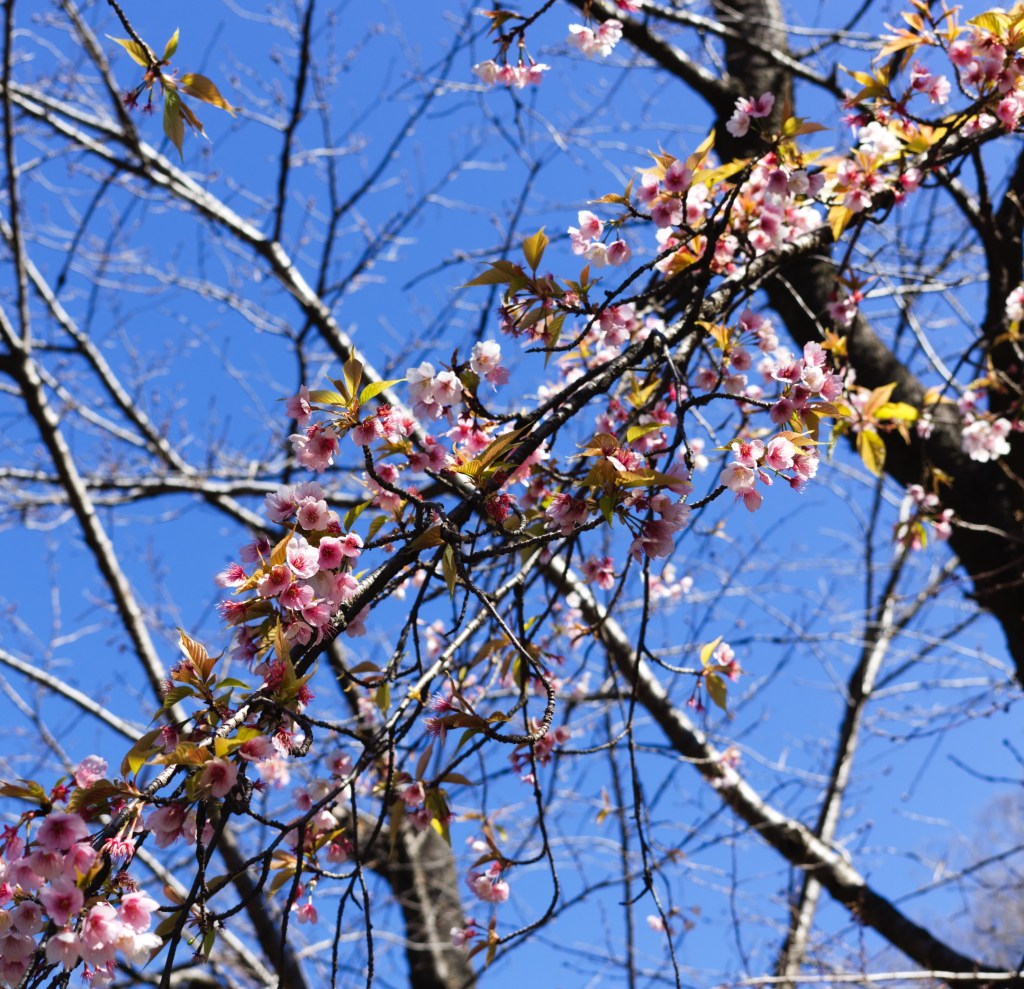
The first cherry blossoms in Ueno, March 2024
You see, nothing went the way I planned. I found myself wondering at what I was missing and where I needed to adjust. As Basho’s journey came to mind, I let go of the expectations about what I orginally planned and paid attention to what was in front of me. In his Knapsack Notebook, Basho commented, “The first task for each artist is to overcome the barbarian or animal heart and mind, to become one with nature.” (65) The bustling streets, the people sitting against a wall looking into their hands, a mom and baby strolling along the street, in a hurry for something, and me, seeing it all pass me by. Finally, I settled into an idea I read in Basho – it’s really not about the destination. I didn’t need to go looking for something; it would find me.
From what tree’s / blossoming, I do not know / but oh, its sweet scent! (Basho 101)
As I opened up for a different kind of experience, those moments unfolded in a myriad of ways. I stopped trying so hard to do something and just walked. Actually a better way to describe it is that I wandered. Not lost and not in a direction toward something…of course, I wasn’t headed into a wall or anything…I was walking around, generally in the direction of Asakusa. Moments came and went as I walked past shops and alleys, people of various types and in various styles. I took few photographs, even with camera in hand. It was just me walking. I felt like I was on the narrow road to the interior and in this case, into a kind of walking meditation. The light rain finally stopped, and a cold wind blew from the west, and soon I was cold. The cold roused me from some kind of stillness and I thought about eating some hot ramen. As that feeling rose in me, I decided to make my way to a private booth at Ichiran. All of my noisy thoughts stilled, I realized exactly what I was experiencing: a beautiful day.
The search continued as the sun dawned bright on an unexpected cloudless day. I woke with a mission: to head toward some out-of-the-way parts of the city to locate cherry blossoms.
I started by trying to navigate to Hie Jinga located in Akasaka. I rode the Ginza line to Tameike-Sanno Station and hopped off. If you haven’t visited Tokyo, it’s easy to wander in the wrong direction when leaving a subway and that’s what I did on this day. I walked out of the station and THOUGHT I was headed for the temple. My iPhone Google map sent me in a direction and I walked, dutifully, toward the shrine…or so I thought. The map led me astray, and I soon realized that I was going in the wrong direction. Once I figured this out, I looked around. I was in the middle of some large buildings and structures, and I couldn’t quite place my location.
Then, I saw a Japanese sign pointing to the temple. It was small and once I recognized the characters, I started walking in that direction; soon enough, I turned a corner and was the grounds for the temple. The lesson was THIS: use your eyes and look around to find out where you’re going. From that point onward on this trip, I looked at a map on my phone and avoided using the guidance from the system! The Hie Shrine sits on a hill and a series of steps leads to the main complex. On this day, a food ceremony was happening and I stayed to watch as the priests performed the ritual.
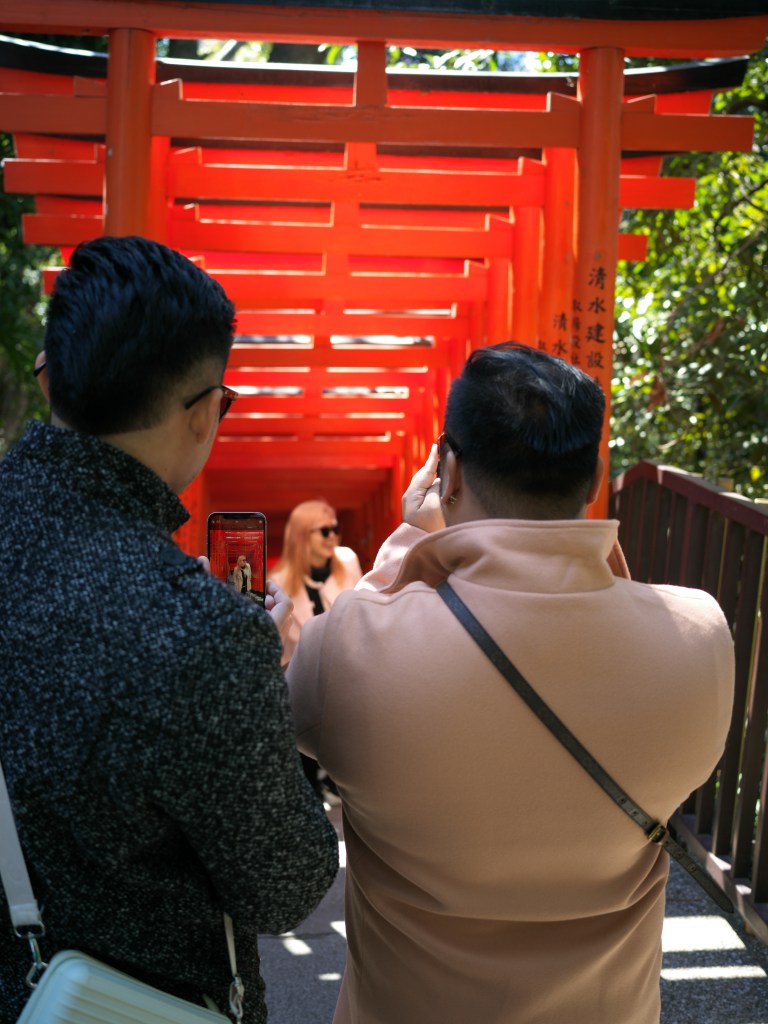
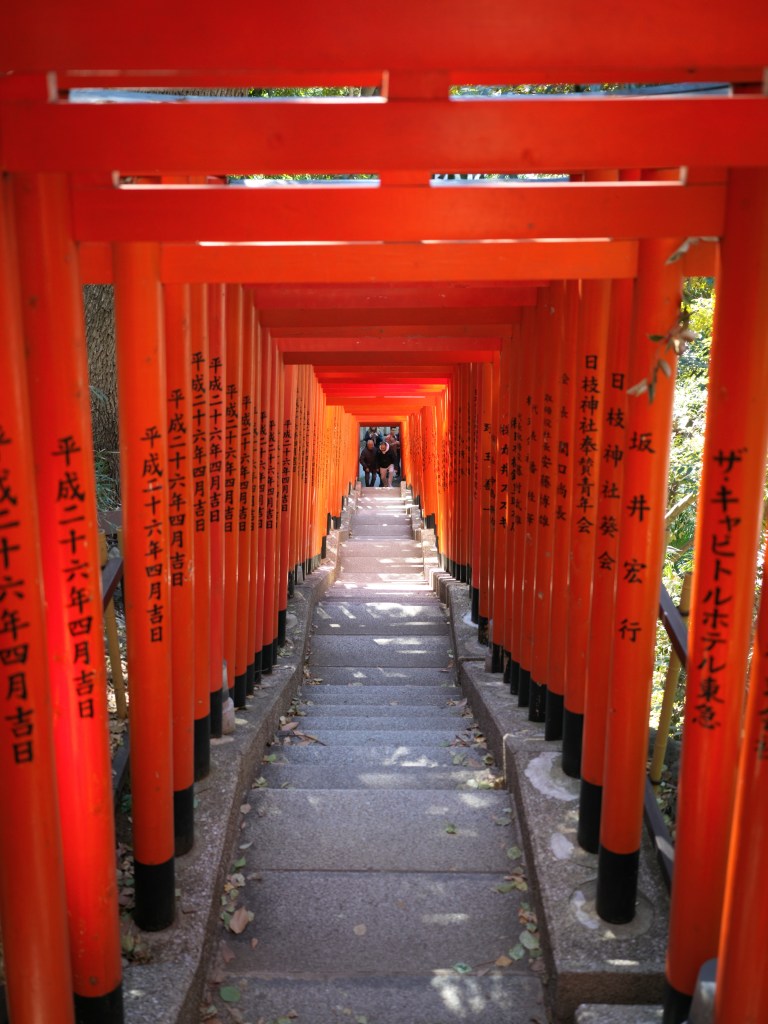
From there I located the Inari – the red torii gates that are reminiscent of Fushimi Inari. The gates are around the back of the shrine and a small group gathered to take pictures of themselves in various poses on the steps. These tourists, like me, were intrigued. Unfortunately, their interest led them to attempt climbing on the posts and trying to balance between the spans. More than once one of the group fell to the ground with the rest laughing. They changed their approach and just started photographing each other in suggestive poses. A small group formed trying to make their way down the stairs and through the torii. The group angrily refused to budge and blocked the way. At some point, another person simply pushed their way past the photographers.
Photography at its finest.
The walk through the gates….really a wonderful spot in central Tokyo
The cherry trees were sealed shut and so I decided to find another location. The wonderful Hamarikyo Park was my new destination filled with the ancient Yoshino cherry trees. The game was afoot (literally, because I was walking).
Walking all the way to this Park was a haul. The miles I trekked took me past the Imperial Gardens and through Asakasa all the way to the Shiodome area.
Crossing the bridge over the Sumida and into the park, the grounds were filled with ponds whose levels changed with the tides. Originally a home to shoguns and later Meiji leaders, the buildings were destroyed and never rebuilt. In their place were trees of various types and the cherry trees, while few in number, were present near the entrance.
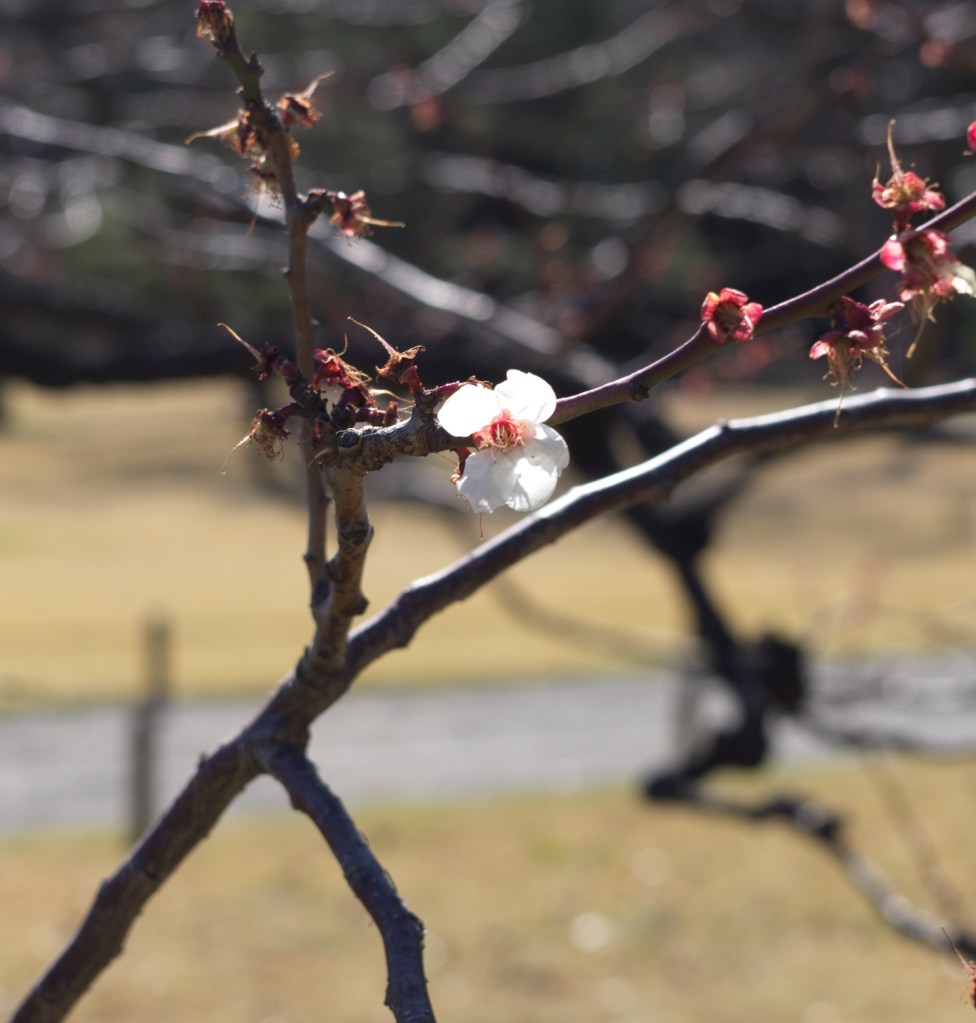
As I walked to my right after the entrance, I saw a group of Yoshino cherry trees and they were old, twisted symbols of ancient Japan. As I walked around the trees, I noticed a single blossom. I grabbed the shot.
First blossom in Hamarikyo Park
It may seem like a small thing, and this blossom changed my perspective in some way. Going into the park I was anxious, worried even, about my time in Japan. I had been led astray by the Google Map, felt like I was lost on the subway more than once, and just had a sense of unease as I walked through the city.
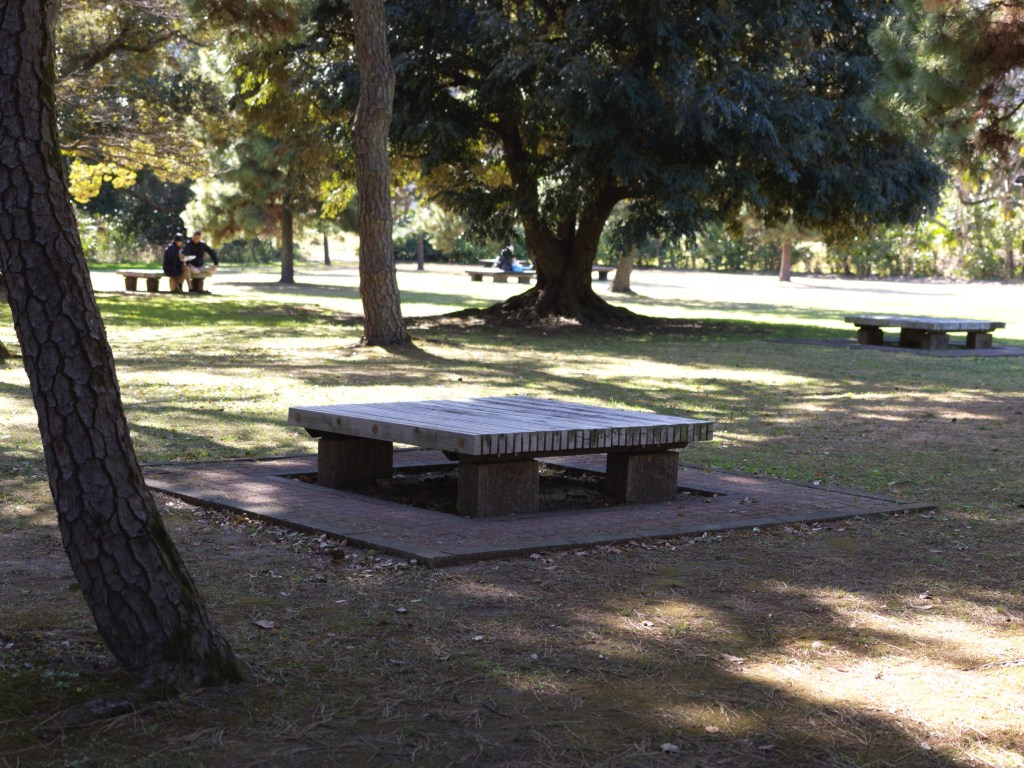
All of that sense and sensation dropped away when I saw this one bloom on the tree. Not far from this spot, groups of small tables were scattered in the trees and I found a place to sit and just be in the moment. My meditation began effortlessly and the crazy mind I had wrestled with for hours slowly dropped away. I watched, sat, and stopped. I’m not sure how much time passed as I sat there. I noticed the wind and chill sitting in the shade of a pine tree and a shiver passed through me more than once.
A place to sit at Hamarikyo.
As the day passed, I walked through the rest of the gardens and marveled at the simplicity and attention to every detail. The grounds are remarkable.
The Tea House at Hamarikyo
Shadows and Pine
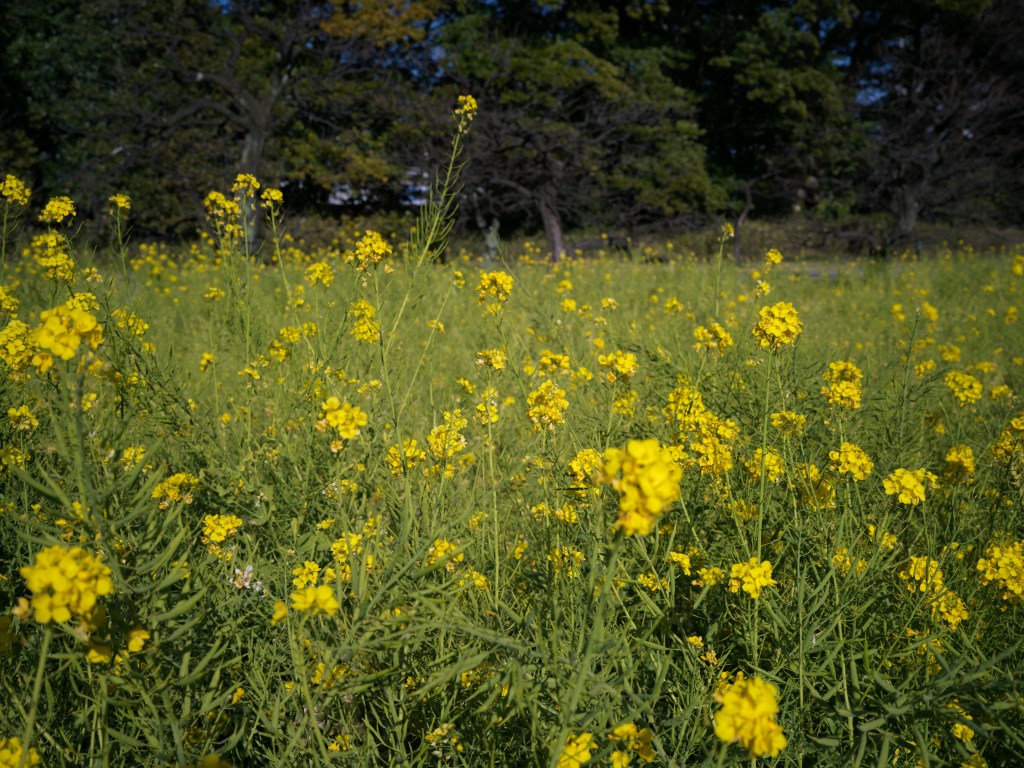
Flowers cover a meadow at Hamrikyo
I walked out of the park as the sun descended and the light cast interesting shadows on the ground. The walk back to the train station was quiet and I boarded the Ginza line to Asakusa. My day was amazing and in small ways, transformational.
It’s cold. The wind is blowing hard and my umbrella, purchased at iSetan is not doing its job very well. The rain comes in at a sharp angle and as I walk, I stumble as the umbrella is pointed directly in front of me partially blocking my view. I imagine I look ridiculous, umbrella facing forward as the wind and rain pound my legs and feet. The chill starts to take hold and I search for some indoor space and stumble into a crowded coffee shop. I looked outside through the glass and noticed people making their way through the storm. So, here I was in Tokyo not really prepared for the maelstrom in front of me. Hmmm.
I came to Tokyo in part to see cherry blossoms. The wonder of finding very inexpensive flights and a very cheap room made the trip possible. I couldn’t believe my luck!
As I landed in the city, rain soaked clouds filled the sky and the darkness at 3:30 PM made for a very solemn arrival.
I made my way quickly through customs and to the Keikyu line to Asakusa. The rain poured from the skies and I wondered about walking from the station to the hotel. Would I be soaked? I left my umbrella at home by accident and now wished I had one handy. No matter. I’d be fine as the walk was less than a 1/2 a mile.
The wind and rain battered me as I walked onto the busy sidewalk. I hurried across the street and down an alley I remembered as a shortcut to the hotel. I made it into the building just as the wind nearly blew me down! My expectations of sunny days and cherry blossoms were slow fading.
As morning dawned on that first day, I woke early, dressed for the rain, and walked the short distance to Senso-ji temple and the cherry trees all over the grounds. It was a cold, cloudy day and the wind crossing the Sumida River was fierce. As I made it to the Haruman Gate, it was early, about 7:00AM and few people were gathered. I grabbed some coffee and wandered around, just looking for some shots of the trees and the temple. As I approached the first tree just to the right of the main shrine, the buds were tightly closed. The cold weather of the past week had slowed their bloom and I caught the trees just before they opened.
I headed up the temple stairs and had the room to myself as few people were awake to see the sights. The quiet was remarkable, having seen this sample place literally filled with people in the past. I relished the time spent and decided to head toward Ueno Park, about three miles away. Surely I might find some blooms open in that location!
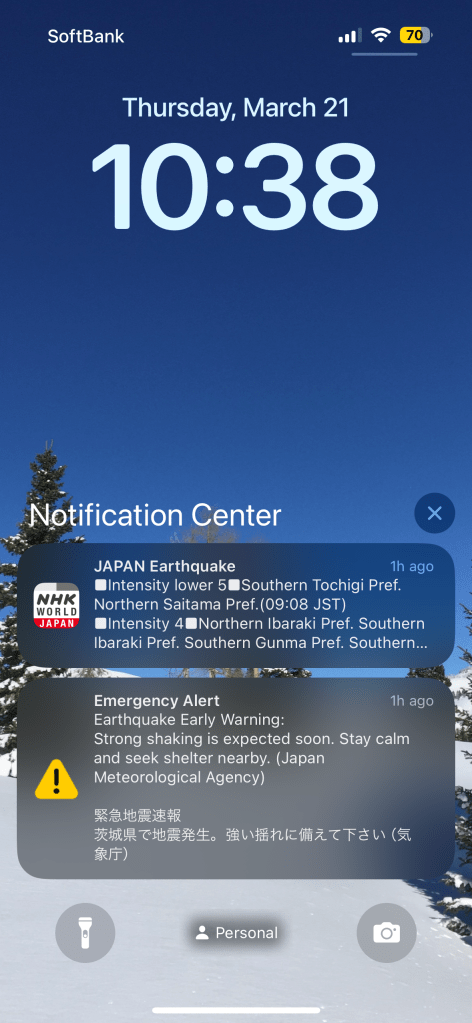
I chose sidestreets and neighborhoods to walk through to the park and was soon alerted to my phone buzzing an earthquake alert. I looked around and people were going about their routine. Some stopped for a minute to see what would happen. A mother and daughter biked together to school and they paused for the alert and kept going. Workers in an alleyway kept loading a truck with trash, and an elderly man glanced at his watch as it buzzed, and then kept shuffling along.
Earthquake, Tokyo Time
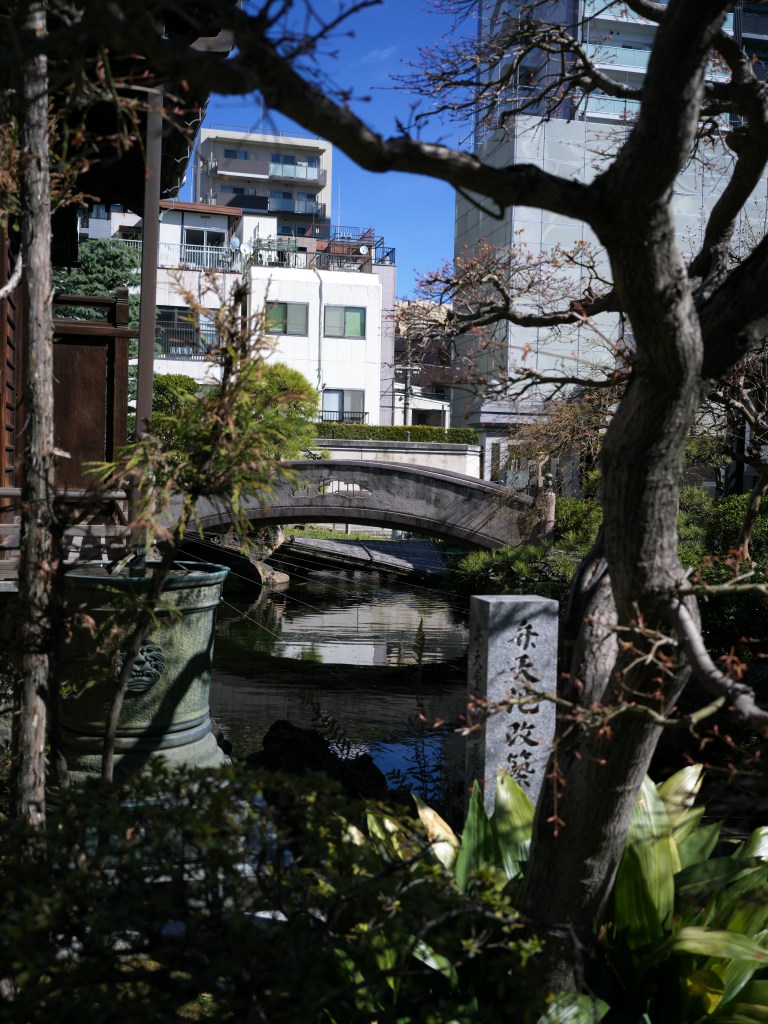
I’ve been in small earthquakes before and wasn’t too concerned, but the message caught me off guard and, as it turned out, a earthquake refuge was nearby, a small Buddhist temple. I went through the gates into the garden and looked around…photographing the grounds. A strange silence descended on the city and the birds I heard a few minutes before were silent. I wondered if they knew something I didn’t? As I looked around, I saw more signs of the day progressing normally and no one was obviously affected by the sirens and alerts. So, I did what everybody else was doing: I went about my day.
A refuge in Asakusa from the earthquake.
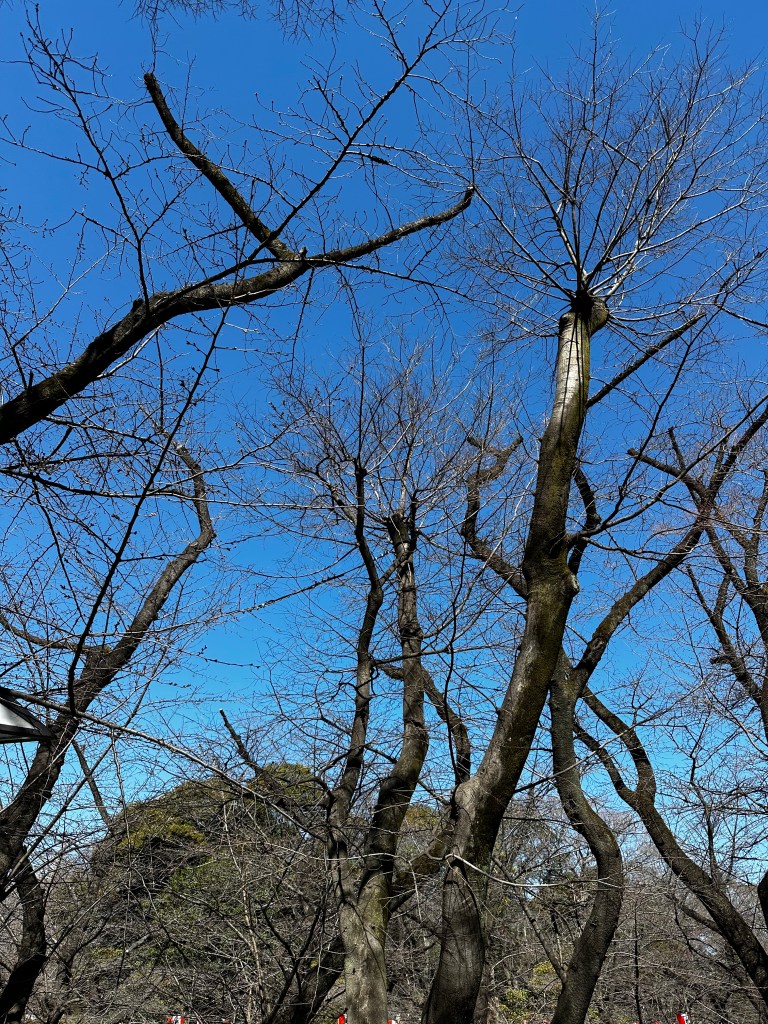
As I walked, the wind crashed between the tall buildings in near Ueno and it was intense. It pushed me around as I walked past an elementary school. Once on the main street, I could see the walking bridges that rose above the train tracks and city streets. I climbed the stairs and walked toward Ueno park in anticipation of finding the elusive cherry blossoms. Long lines of people made their way up the stairs and into the dedicated lanes for foot traffic into and out of Ueno. Lining the path were cherry trees, none of which had bloomed yet. The light rain and chill temperatures were testimony to their quiet and slow awakening.
Blossoms firmly closed in Ueno Park
As the day passed and I made my way to sushi and the hotel, I reflected on the situation I was in. Many of the things I wanted to do were rudely pushed to the side and what remained was me trying to recreate and reform what I wanted from this trip. That led me to rethink a few things:
I had to brave the storm, no matter what.
My choice of locations needed to change to accomodate some new ideas I had about what and where to photograph.
To just let it all go…to allow these changes to happen without regret.
I decided to go on the hunt for cherry blossoms the next day, sure that I would happen upon a cache of these illustrious blossoms in some corner of Tokyo.
One of the biggest tests of my practice has to do with my mind in a crowded space. What happens when I’m confronted with the incessant bombardment of noise, people, movement, and lights? In Tokyo this past March I walked into this environment wondering how my tortured mind would handle the impact of the mass of humanity in this huge city.
Once you arrive at Haneda airport, the walkway into Customs is almost silent….after the blast of jet engines for twelve hours or so, the silence is welcome. THat silence, of course, is fleeting as everyone gathers in a hall that processes your entry papers. I chose to use the Japan web online form for entry and it was flawless. A picture of my face, a QR code, passport, and then finger prints sent me into the country. Once out of the customs area, crowds press on all sides as many exhausted people try to find their way into the city.
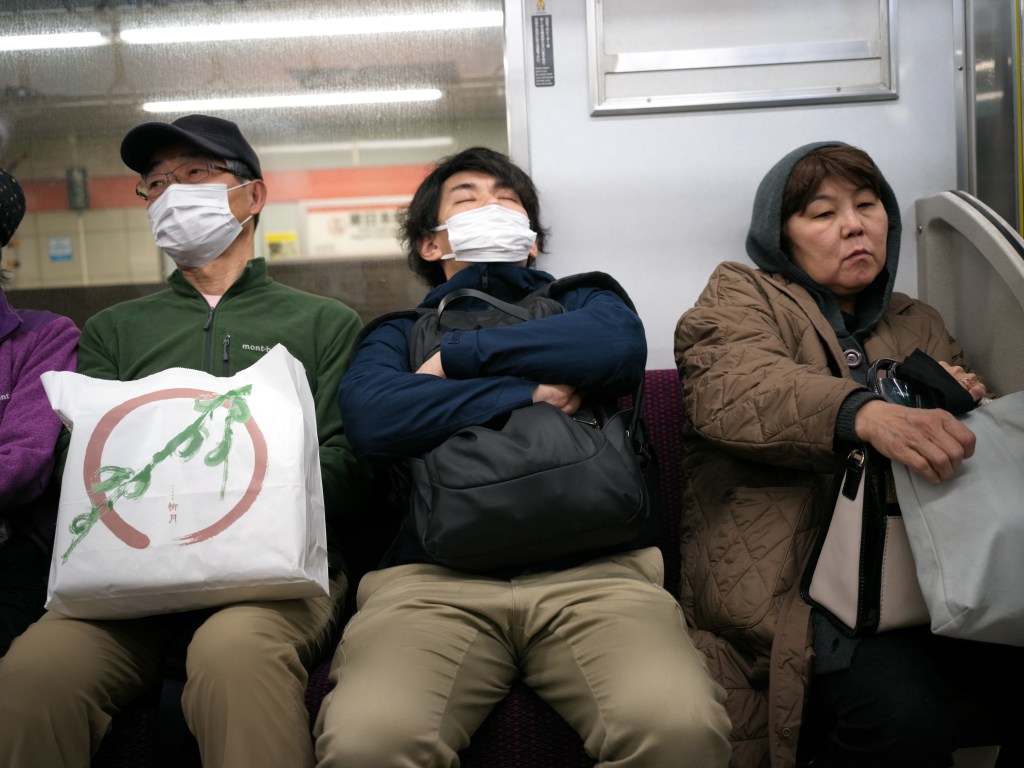
On this trip, I knew what I was doing and had preloaded my SUICA card with credits for subway travel. I hopped on the Keikyu line and headed directly to Asakusa. The crush of people on the train meant that I stood for about 30 minutes until my stop came around. The noise of the train, the movement of the car on the tracks, and the shoulders touching almost constantly with the sway of the train were distracting and my mind was both foggy from lack of sleep and my mind trying to adjust to the sound of Japanese over the loudspeakers alerting travelers of the next stop.
As I slowly adjusted to the situation, my mind relaxed. I could focus on my breath and could pick out sounds that were masked before my awareness expanding. The heavy breathing of a passenger sitting near me, a child whispering to their mother, the shuffle of feet on the floor….all of it came into my awareness. Then, my mind settled and I was quiet.
The above description is representative of what I experienced in those first few minutes of being in Japan, a densely populated country. On this trip, I encountered thousands of people during my walks around the city, and found moments of reflection and solitude in a place filled with people.
In some of those moments, I sought out places that would contribute to or enhance my experience. In the caves of Hasadera Temple and Shrine, I met my quiet mind in the dark, chilly spaces above Kamakura.
Hasedera caves near the temple
In the main shrine room of the temple complex is a massive gilded wooden statue to Kannon, the Bodhisattva of Compassion. In the form depicted at Hasedera, Kannon has a feminine or androgynous look which aligns with the broader interpretations of Avalokitsvara in China and Japan as a female figure. Inside the shrine room, the light is dim and the ceiling rises above you as Kannon stands tall in a temple that originates from the 8th century C.E.
After the caves, I walked into the shrine room, past the souvenir kiosks. When I visited the room was silent and I fell into a deep meditative state. This change happens sometimes when I am in a sacred space and it certainly happened here. The quiet and lack of noise definitely contribute to the sense of spaciousness that I think is necessary for me to be meditative. It was a wonderful moment as I stayed for about 1/2 an hour.
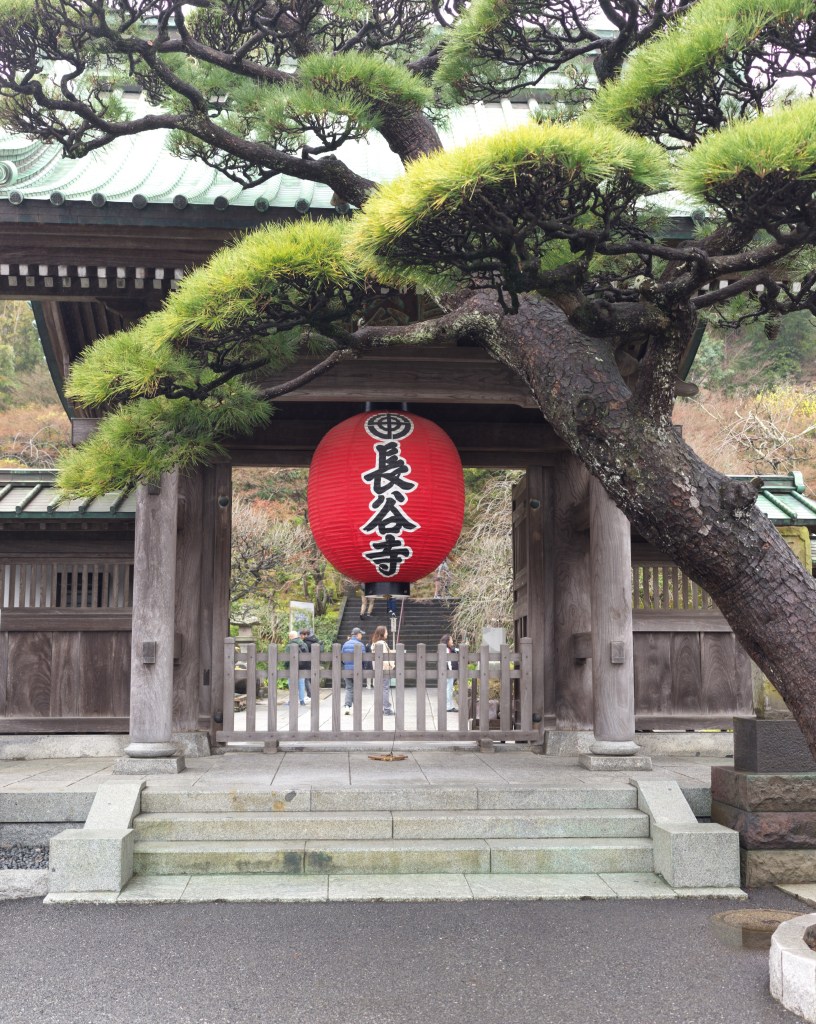
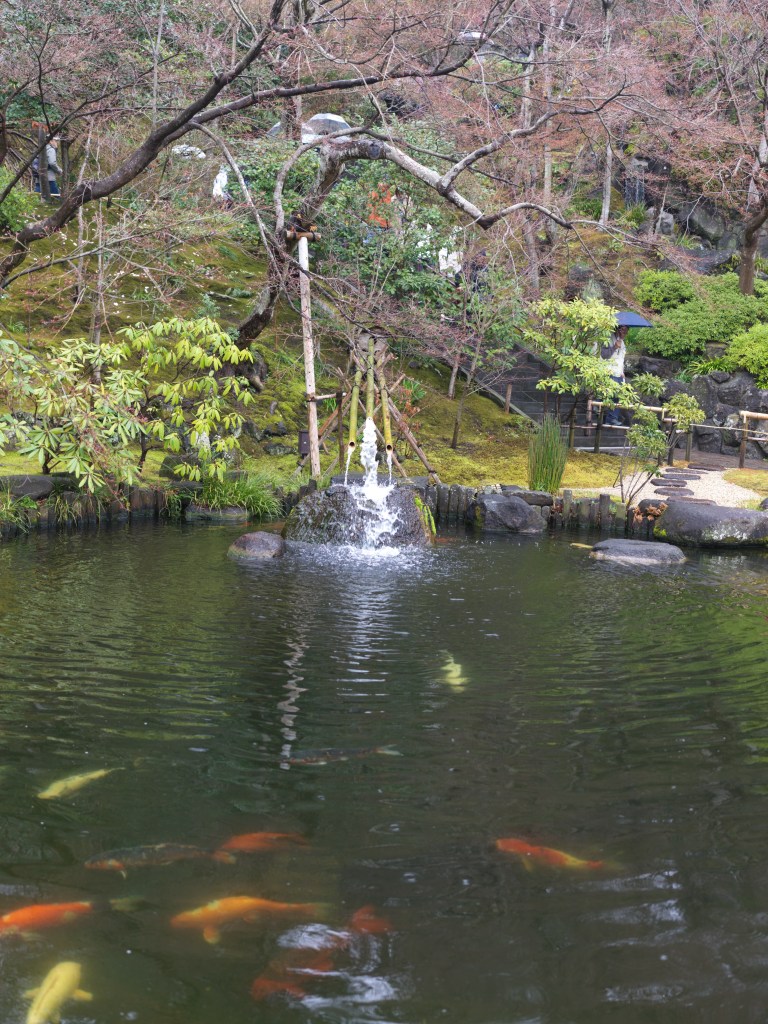
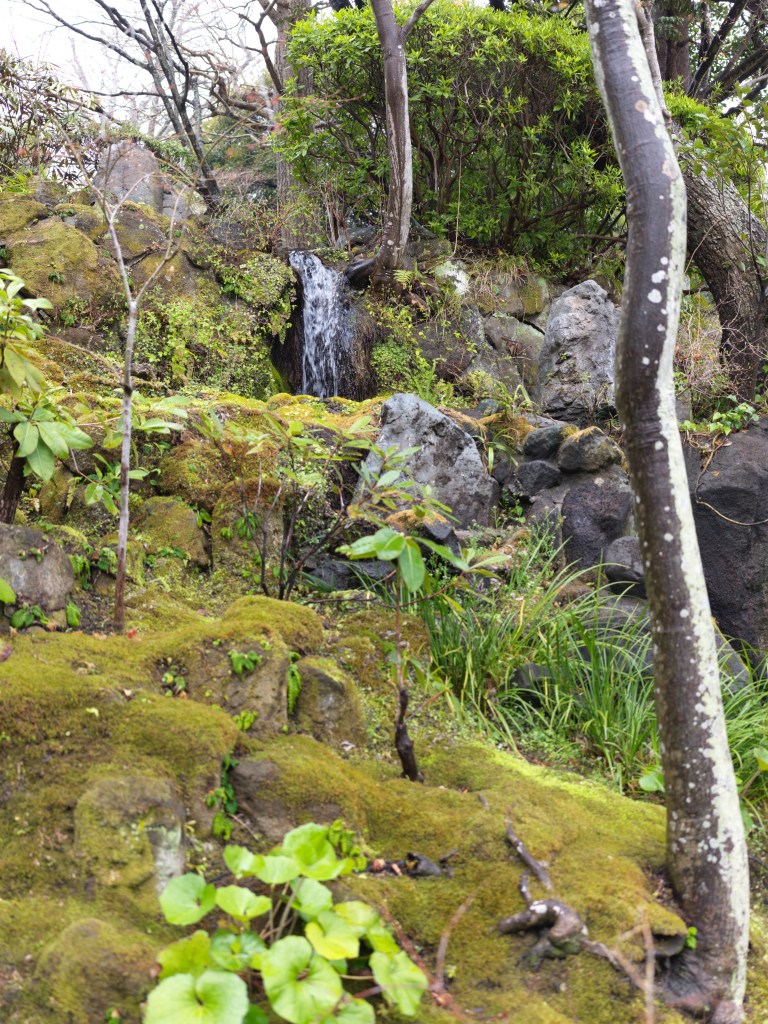
The grounds around Hasedera on this wet, cold day, were still spectacular. The koi pond, waterfall, and gardens are remarkable and the weather kept the crowds away on this day.
The way to Hasedera.
Koi pond and waterfall.
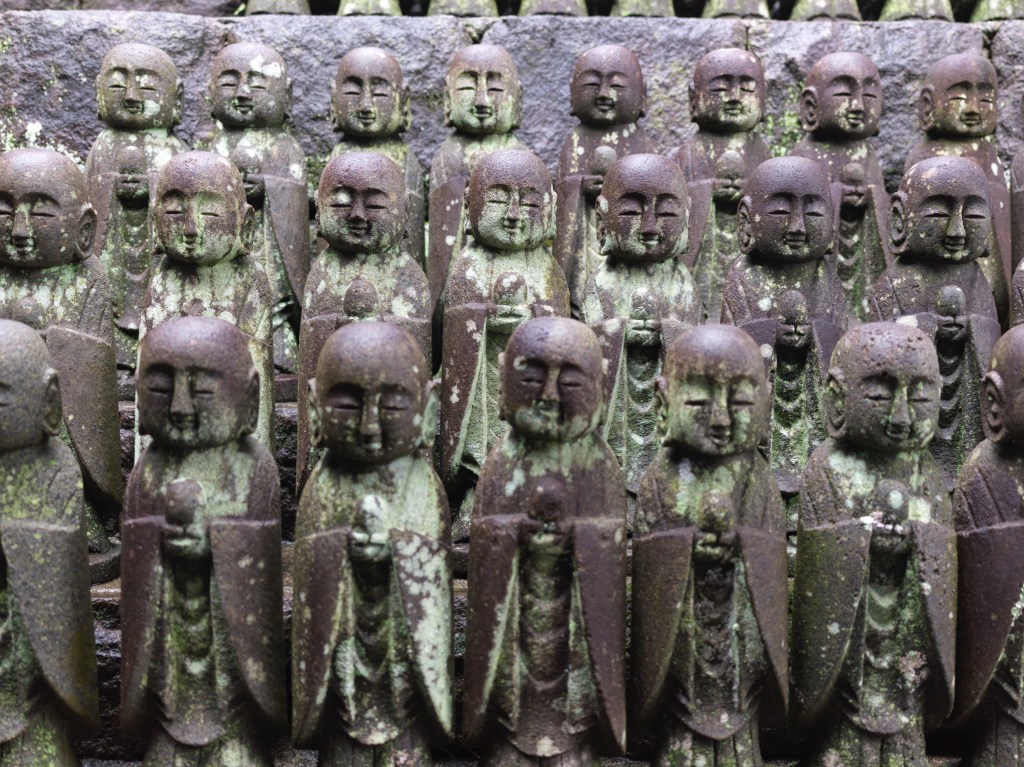
Bodhisattvas leading children after death.
Verdant green of the gardens at Hasedera.
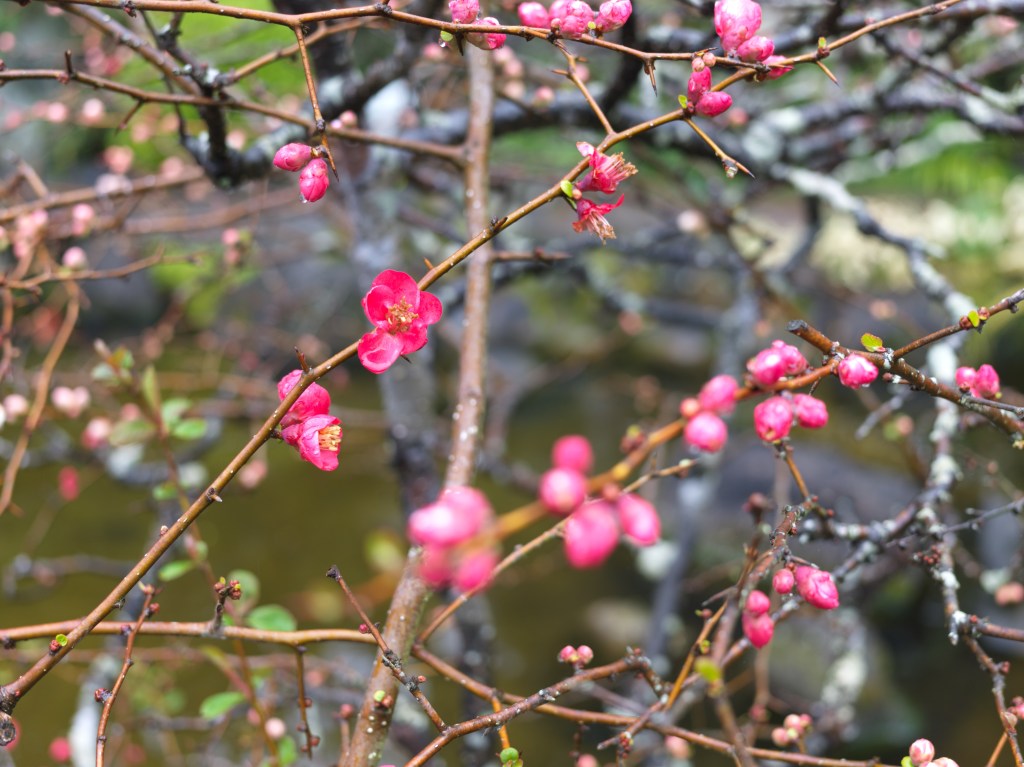
Blooms just beginning…
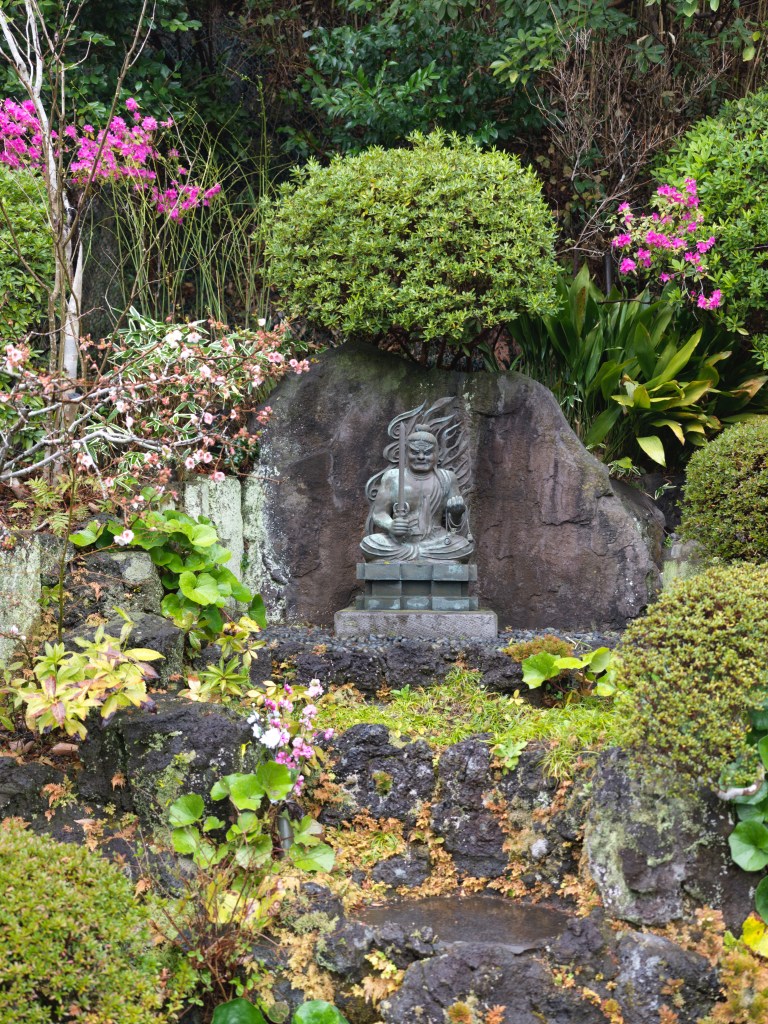
Wrathful Deities protecting the entrance to the caves.
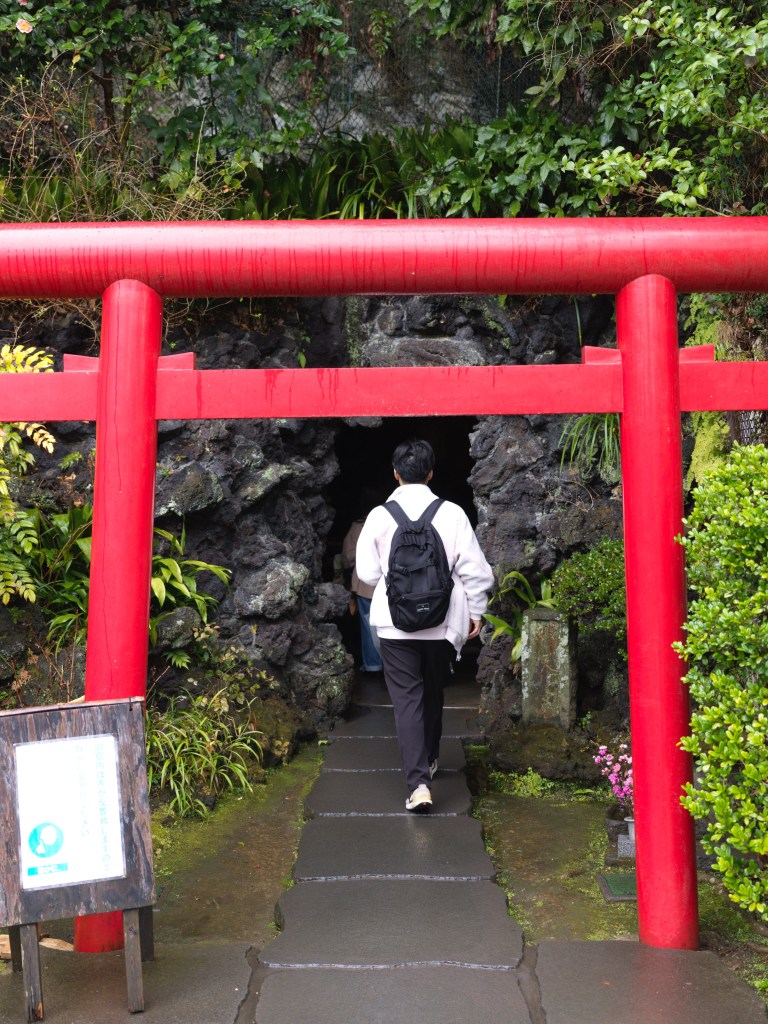
Entering the caves at Hasedera (wish I had a wider angle lens!)
In temples all over Japan are ritual purification practices put into place as a means of ritual cleansing. Passing through this tori gate into the cave is representative of the idea that we can purify ourselves of negative thoughts and emotions (as also represented by the wrathful deities at the entrance). When I first traveled to Japan in 2008, I was surprised to find so many of these ritual practices in visits to all of the shrines and temples. It makes sense, doesn’t it? The practice of clearing one’s mind before entering a sacred place is an important practice to prepare one’s mind for what’s to come. Too, it helps get your “mind right” so to speak; to be ready to receive the gift of connection to awareness.
The visit to Hasedera and the Daibatsu in Kamakura were wonderful moments. The cold rain made the day just that much more poignant.





 Reflections on the Path