Emptiness and the Mental Conundrum

If I ever form a band, I’m going to call it “Emptiness and the Mental Conundrum.”  Of course that band will have a brief career and disappear into obscurity very quickly.

In studying the nature of mind,  it’s clear that one important piece to understanding mind is to be with emptiness.  When I first heard the term, I immediately thought about nihilism; the notion that nothing really matters because everything we experience is meaningless.  The reality that we are “born to die”, in the immortal words of about 1000 poets, is one source of nihilistic thought.

The trick to understanding the Buddhist concept of emptiness for me was to understand that the idea is not, in any way, nihilistic or depressing.  The point is to recognize that all experiences, thoughts, things are inherently of “empty essence.”  It does NOT mean that things do not matter; we are affected by cold or hot weather, illness, anger, laughter, a new car, a happy baby,  all of those life events and material objects we possess do affect us.  We are not detached, zombie-like, to the world around us.  We are present in the world; we feel, we act, we express, we understand. I’ve thought that if I can really comprehend this idea, my understanding of the world might open.  Hmmm.

In a recent teaching from Sogyal Rinpoche, he mentioned this concept, the concept of emptiness, and explained that when we say “empty” we don’t mean “nothing”….the meaning, the idea is better expressed in Tibetan: tongpanyi = anything can arise in the unnamable space.  With this understanding, it’s easier to comprehend that anything can arise in our world.  A cup can be brought into existence using clay, hand work, and fire.  A cup can be destroyed by dropping it on the floor, the pieces flying in all directions.

Staying with this idea, all things come into and out of existence through “dependent arising” or “interdependence” or “cause and effect”.  Using this idea, I grasped or understood that a thing, an idea, an emotion, comes and goes…it is, in fact, essentially “empty”…only present from a very brief moment.  Once I realized that all things begin and end, rise and fall, I am no longer attached to that thought, cup, event, in the same way.

I say “in the same way” because we know the person, thing, idea is present in the moment.  Those things are not nothing and so we are not going to wander the earth destroying things, people and such.  We are ethical creatures (most of us are!) and we are not going to create chaos and destruction.

So as I weave my way through these ideas I sometimes get lost.  It’s like a forest with a path that appears clear only to slowly disappear in the distance.  I think I get it….and then…well, you get the idea.

So, I played around with the notion that a thing is empty of essence.  Here’s the thought experiment I used: I drive a car.  It’s a small Nissan that zips around town…nothing fancy or special.  I like that car.  My daughter says I “wear the car” but whatever.  I am attached to the car, driving the car, owning the car, playing music in the car, just being in the car.  Maybe that’s uniquely American to just be able to drive and drive on roads that seem to go forever.

And I know, I really know, that this car will pass.  I will no longer own this car.  In the distant future the transmission might go out, engine cease to function, or the car gets damaged and becomes unworkable.  Or I sell it and I buy another car.  Regardless  of what happens to it, it will be gone….it’s pieces broken into a myriad of smaller pieces….parts to be sold, reused, or disposed of.  At some point this car I so loved and cared for will no longer exist as a car….the metal will breakdown, crumble; the paint will fade, flake off, or wash away.  The car as I know it now will no longer exist.

Nissan Versa
The Car I Wear Each Day

So the fun question is, did it really exist?  Of course it did.  It was designed, manufactured and sold (to me).  The car came into existence through a series of events: it’s existence in my possession was dependent on a series of decisions, actions, tools, metal, glass, plastic, etc.  It exists.  At some point, however, it will not.

Staying with that theme, at some point the car will not exist. I can visualize, imagine or think about how the car did not exist at some point, did exist, and then did not exist.  Further, even as I now own this car, the plastic, the metal, the glass is comprised of molecules and atoms.  Those atoms are made up of electrons, etc.  Those protons electrons etc are further made up of quarks.  All of those pieces of the car work together to make up what I know as a car.  However, any one of those pieces alone are not a car.  The mirror is not a car.  The glass window is not a car.  Simply put, the car is an idea and a construction dependent on all of these other pieces together.

Mark Epstein, M.D. wrote a book about this idea of everything being dependent on another thing using a psychological approach: Going to Pieces Without Falling Apart.  In this book, Dr. Epstein talks about the whole idea of seeing the world as dependent on various pieces….and by extension that our minds, our thoughts are also made up of these pieces….we don’t like something or someone because of some incident or thought about that thing or person.  Letting go of these attachments to ideas we think can help free us from our own mind!

As I sit here today, I wonder at the my own thoughts and what those thoughts say about me (to me).  If I am a collection of thoughts and those thoughts fly away from my mind each second then who am I? Fun stuff.
 

Buddhanature: It’s Not About Mindfulness

As a practitioner of meditation and Vajrayana, I am constantly dealing with some aspect of mind.  As I mentioned before, I did not start my journey in Buddhist practice specifically, I started with the whole idea of mindfulness and meditation as a way to reduce stress and come to terms with the world around me.

After reading Full Catastrophe Living by John Kabat-Zinn and practicing the lessons in the associated course, I gained some insight into mindfulness and the role of meditation in maintaining a healthy perspective on stress and stress reduction.  The course, and the associated readings, taught me a lot about how to look at my mind; how to recognize thoughts and feelings as they rose and to avoid grasping those thoughts and emotions to be aware of my experience in the moment.  Specifically, to understand that thoughts and emotions are fleeting mental experiences.

As I look back on the course and my work in Vajrayana and Ngondro, I realize that mindfulness and the whole concept of mindfulness is its own distraction.  Since about 1979, mindfulness has become an industry filled with books on meditation and stress reduction, ways to deal with pain, anxiety, emotional issues, and all of those thoughts and feelings that rise and fall in our minds each and every second of the day. (For more information, check out this article on mindfulness.)

LNNRefuge
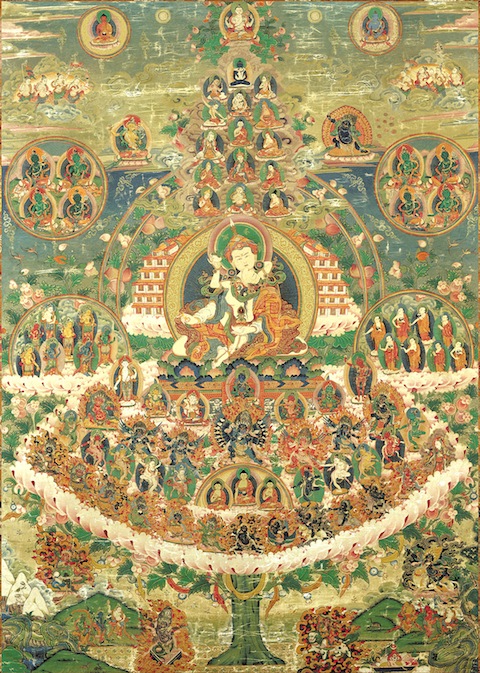
The Field of Merit

Mindfulness, however, only gets you to the place of observation and basic awareness.  The practice as taught does not “cut to the root of mind” as so many scholars and practitioners have stated.  Mindfulness meditation does help with stress reduction and pain management, certainly, and by definition keeps us in that state of being in which we have a dualistic mind; object and observer.  Specifically, the object is always thought and emotion.  Always.  The observer, our rational, conceptual mind, can be tuned to reveal concepts as they arise and can observe their passing.  At the same time, as long as thoughts and emotions are at the center of experience then our minds are full of those same thoughts and emotions.  We can be mindful while still bound by the thoughts and feelings we have.

Meditation, then, becomes a practice to simply manage those concepts rather than getting to their source. The challenge for mindfulness practice is to transition away from a dualistic mind.  As far as I know, the answers for practitioners are in the faith traditions of Hinduism, Buddhism, Taoism, and other approaches to mind training.  Without a focus on enlightenment (or unification between atman and brahman or unifying mind with path), mindfulness meditation remains in stasis.  Of course, there is nothing wrong with meditation as a practice, and meditation is not an end in itself. As I understand it, to achieve a state of being that is beyond dualism requires the dissolution of the observer or the end of dualism.

That end to dualism, for me, was revealed as I studied Ngondro and awakened to the whole idea that removing self-cherishing, in fact not focusing on self at all, was the way to understand our true nature.   As Dzongar Jamyang Khentsye has said, seeking for our true nature reveals that there is no there, there.  Unlike Hinduism or Christianity, we cannot search for an atman or soul.  Such a thing does not exist.  For many, that thought might be unsettling.  It certainly was for me when I first understood it.  I always believed that there was a soul or some core self buried in the depths of my mind; something that was eternal, permanent.  The Hindu idea of unity with Brahman or unity with god was compelling.  That some piece of you is a part of god.  Fascinating.

What I found in Vajrayana thought, however, was something quite different: that there was no me, I, or other.  Our true nature is expansive, all encompassing and clear like the sky.

Years of study and practice brought me to this understanding and this moment right now.  Through the guidance of Sogyal Rinpoche, the writings of Dzongar Jamyang Khentsye and Dilgo Khentsye Rinpoche, I came to the realization of the non-dualistic nature of mind.

For some insight into the nature of mind, check out this video:

Buddha Nature: Uttaratantra Shastra

In the Summer 2017 issue of Buddhadharma: The Practioner’s Quarterly, I found an article that really helped focus my study and brought me back to that moment of awareness, brief as it was, in 2002.

The article was on emptiness and the particular author was Dzongar Jamyang Khentsye. The essay, “The Clarity Aspect”, was a response to the idea of emptiness in Buddhist thought.  Dzongar’s approach to the subject was incredibly focused and offered an insight into the whole idea of emptiness that I had, up to this point, never really heard.

Briefly, my understanding of emptiness comes from my Ngondro practice through the Rigpa Organization led by Sogyal Rinpoche.  I see Rinpoche as my teacher.  I am committed to the path that the organization has placed before me and I am thankful have been given the opportunity to study with other Rigpa students.

The emptiness, as presented by Rigpa and as written about in the Heart Sutra always eluded me.  More than anything else, I think that my understanding, or misunderstanding of emptiness, comes from my own deluded and confused mind.  Have you ever had one of those ideas that just never made sense regardless of how hard you tried to understand it?  I have found that confusion more than a few times in my life (like when I was reading Gayatri Chakravorty Spivak ), and in the case of emptiness I kept missing the boat.

Check out this passage from the Heart Sutra:

Shariputra,
form does not differ from emptiness,
emptiness does not differ from form.
That which is form is emptiness,
that which is emptiness form.
The same is true of feelings,
perceptions, impulses, consciousness.

Do you GET it? It’s confusing even though the language is pretty straightforward.  What does “form” mean? We can understand the individual words but the meaning can still elude us (or, at least, me).

Anyway, so I didn’t quite grasp emptiness….I had a good idea about what it was and I reckoned that I’d know it when I saw it.  I always referred back to that mental impression from the guided meditation and reasoned that is what emptiness, at least in part, was.

Then in stepped Dzongar Jamyang Khyentse with his insights on emptiness and his specific suggestion that anyone really interested in this idea and the whole notion of Buddhanature itself read Maitreya’s Mahayana Uttaratantra Shastra sutra.  Khentsye made this statement, “Everything that we think exists, or does not exist, or both or neither – all these things are fabrications of our mind.” BOOM.

Sure I have heard this idea before, yes it has been communicated, but this essay revealed it to me.

I grabbed a copy of the Uttaratantra Shastra and cracked open the pages preparing to be confused, muddled, or lost in the text.  Instead, I was reading and understanding a text for the first time (please note, I am not an expert and do not claim to be; my insights are clearly insights from a deluded mind…got it? Good.)

maitreya
Arya Maitreya

The text explained emptiness and mind in such a direct way: the nature of mind is spaciousness, pure, clear.  Thoughts, emotions all rise and fall but the spaciousness remains, unstained or unobstructed by those thoughts and emotions.

So, emptiness (probably NOT the best word for me) is just the notion that these various thoughts and emotions are fleeting, passing moments and that mind, our true nature, is not affected, shaped or altered by those thoughts….thus we are all spacious.  Back in 1998, listening to the cassette tape by Sogyal Rinpoche came back to me and I could hear, in my head, his voice and his words: spaciousness, spaciousness, mind is spacious.  That talk was introducing me to the nature of mind, to buddhanature, to clarity and I didn’t get it!  What a revelation.

The Nature of Mind

Looking back on my Vajrayana experience and study, I can see the steps it took to reach this place.  In 1998 the purchase of a cassette recording of a talk given by Sogyal Rinpoche started me on the path.  The tape, Bringing the Mind Home, was transformative.  Rinpoche talked about spaciousness….spaciousness.  At the time I felt like I understood the idea.  I was deep in the midst of what one might call “New Age” philosophy.  Reading astrology, meeting with an herbalist, having my chi evaluated, considering a career in acupuncture, all of it was new and fascinating to me.


art_vajst1_frnt
Vajrasattva

Living in New Mexico, a more than casual glance at the culture and people here will reveal the strong influence of more esoteric and unusual perspectives.  From miraculous dirt in Chimayo to ghosts wandering the arroyos and acequias to crystal shops and crystal healing New Mexico has a plethora of alternative perspectives on how to live your life.

In that environment I gravitated to Vajrayana Buddhism.  Long before I really knew what Vajrayana was, I visited the KSK Stupa in Santa Fe.  Back in the late nineties, the temple had a bookstore on site and I often wandered into the space to check out the selections and pursue the books.  None of the titles or ideas were familiar to me in anyway.  I found one book that grabbed my attention, The Tibetan Book of Living and Dying by Sogyal Rinpoche.  The cassette I purchased and the book went together, and I started reading and listening.

I’d like to say that from that point on my path was set and I gradually acquired the understanding to reach the point I am at today.  None of that could be further from the truth.  I listened to the tape and enjoyed the talks, but I just didn’t get the concept of spaciousness.  Spaciousness in mind, spaciousness of perspective.  The concept was so unusual and sounded good but, really, made no sense to me.

Similarly, when I opened The Tibetan Book of Living and Dying I could not make heads or tales of it.  While I understood the text and of course read the information, the meaning eluded me.  I tried over and over to grasp the point, bringing the mind home, but that idea just didn’t make any sense!  My mind was home!

I quickly moved on to another approach, a course called Full Catastrophe Living by Jon Cabot-Zinn.  The course, taught in the Fall 2002 by Daniel Bruce, was an experience in mindfulness.  The eight-week session started slowly with readings from the book and practical applications of mindfulness.  We meditated for 15, 30, 45, 60 minutes at a time gradually building our resilience.

Jon Cabot-Zinn developed this course, originally, to help folks cope with stress.  He found that mindfulness training and meditation had an effect on helping people find calm.  The course, as taught by Dr. Bruce, Daniel, was more aligned with eastern philosophy.  We did Tai Chi, yoga, and meditation on cushions or in chairs.  Our group was made up of a wide variety of people from Santa Fe.  At the time, I was clearly among the youngest in the group in my 30s.  I asked lots of questions and wondered aloud at the source of the practice.  Daniel was patient.  He talked about the origins of many of these practices and had the authority of someone who studied in China, traveled extensively in Asia, learned yoga and Tai Chi from trained practioners.  Overall Daniel really brought a clear understanding of the material to the course.

The moment of truth came with the last class meeting of the course just before an all-day retreat.  Daniel led us on a guided meditation using the metaphor of clouds and sky.  The session was a 45 minute one and Daniel read the meditation and we sat.  Very quickly I dropped into a deep meditative state.  My breathing changed, my awareness altered.

As he guided us, my thoughts settled.  My mind rested in a state I came to understand was “calm abiding”.  I sat with no expectation of past or future.  I was in the moment.

Have you had one of those experiences in which you are just there, present, no thought? It hasn’t happened often for me but in this moment it did.  Boom.

My mind emptied entirely; spaciousness.  Complete spaciousness.  In that moment I started laughing; a sense of joy swept through me.  In the silence of the meditation room, I laughed out loud.  Imagine the looks I received!  I remember that moment like it is right now.


Walking and Building a Path

I think the word “path” has taken on a new meaning in the last 50 years or so as Taoist and Buddhist thought has spread across the West.  Path has become a kind of meme that defines a certain purpose for sense of focus for individuals seeking something other than what they were raised on or know.  In fact, I think one could accurately state that “path” is about moving in a direction away from what we are or were, as the case may be.

In my case, the word and idea “path” came to mean a focused direction away from what I understood was my life.  At the same time, as I concentrated and focused on the “path”, I soon realized that the “path” was something I had chosen long before I even knew such a thing existed.  Putting it another way, the path that I thought I chose, chose me.

This blog is a collection of ideas that come from my work building and maintaining the path. (Have I said “path” enough?)

R1-00602-0011
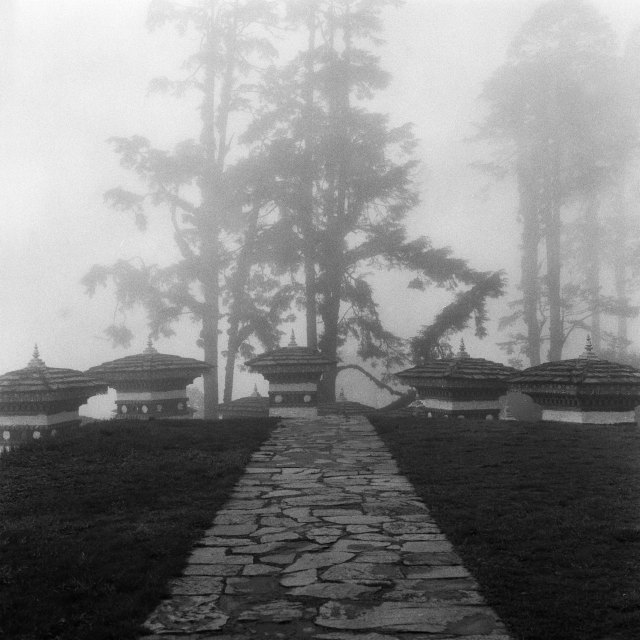
Dochula Pass, Bhutan

This blog, then, will, be a record of my adventures in building a defined roadway for my study, practice, and determination.  I will tell a tale about subjects as diverse as philosophy, photography, cultural studies, travel, family, and Vajrayana Buddhist practice.  Each of these pieces of this complex puzzle, like the flagstone that makes up the paved trail above, will reveal something about what I did, am doing, and where I am going.  If you are reading this blog, wonderful.  It doesn’t really matter if it’s read or not.  What I putting down here online is a testimony, a statement that does not need to be shared.

And yet, you might ask, why am I writing such a document online in the first place? Why not pound away on my computer and keep it private?  Good point.  I’m thinking that I can maintain access to this online presence and leave a record of being here.  In some ways it is about leaving a mark….it doesn’t matter if anyone ever reads it….it’s just a mark.